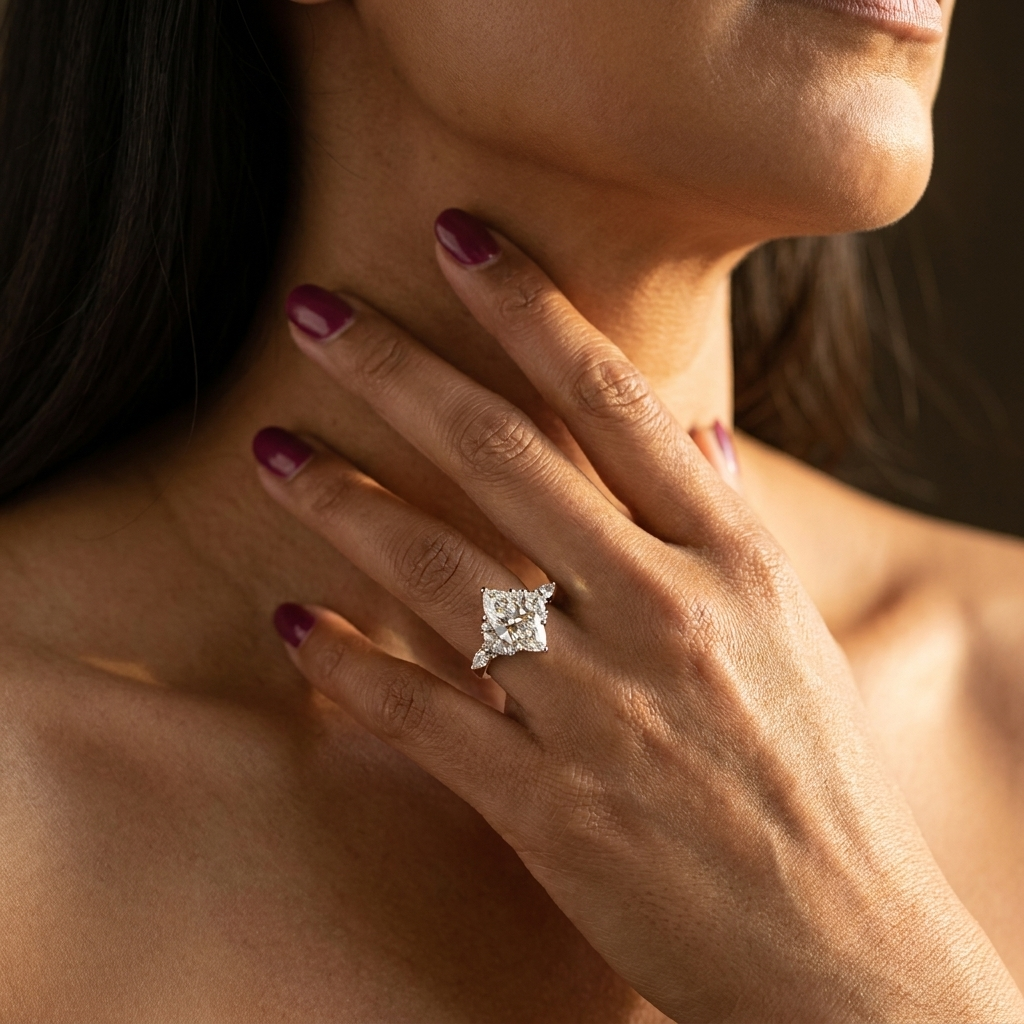
Lab Grown Diamond Demand Trends: Who Is Actually Buying in 2026
Adoption passed 45 percent of US engagement rings and kept going. The more useful question is who these buyers are, what they buy after the ring, and what they now expect for the money.
The author is the founder of Draco Diamond. Demand figures are drawn from The Knot Real Weddings Study 2026, BriteCo appraisal data, StoneAlgo, Edahn Golan Diamond Research, Tenoris, and CBC News reporting, each cited in the references. Draco prices are live catalog prices in Canadian dollars, verified July 2026.

Who is actually buying lab grown diamonds in 2026?
Engaged couples are still the largest single block of demand, and they are now a lab grown majority. The Knot Real Weddings Study 2026 found that 61 percent of engagement ring purchases featured a lab grown center stone, a 239 percent increase since 2020. Working backward from that increase, the 2020 share was roughly 18 percent. In six years the category went from a niche alternative to the default choice.
Age is the sharpest dividing line in the data. BriteCo, which appraises jewelry for insurance rather than surveying shoppers, reported that roughly two thirds of Gen Z engagement ring purchasers opt for lab grown, while millennials split close to evenly between lab grown and natural. That is not a preference gap. It is a generation that never encountered the natural diamond as the only option.
The spending profile matters as much as the share. The Knot put the average 2026 engagement ring at 4,600 USD carrying 1.9 carats. That is a buyer who is not economising. It is a buyer who took a familiar budget to a market where it now buys close to twice the stone.

Why do the demand numbers disagree so much?
Because they measure different populations at different moments. Anyone comparing headlines will see figures from 42 percent to 61 percent and assume someone is wrong. Nobody is. The methodologies simply do not overlap.
The Real Weddings Study asks people who married in the survey year what they bought. It captures intent and self reported detail across the full spending range, including buyers who never insure or appraise the piece. Its 2026 reading is 61 percent lab grown center stones.
BriteCo's dataset covers pieces submitted for jewelry insurance between March 2019 and May 2025. That skews toward buyers who insure, which skews toward higher value pieces and, historically, toward natural diamonds. Its 2025 engagement ring reading is 47.7 percent, and 42.1 percent across all jewelry.
One dataset ends in May 2025 and one reports 2026. In a category adding share every quarter, a twelve month offset explains most of the distance between them. Read the two together and the direction is unambiguous, which is the only thing a buyer needs from either number.
The practical instruction is to check what a demand statistic is counting before quoting it. A figure for engagement rings is not a figure for the jewelry category. A figure from insured appraisals is not a figure for the whole market. Draco's wider stat collection is compiled in the 2026 lab grown versus natural statistics report.
"The interesting number is not how many people chose lab. It is how many of them came back three months later for the bracelet."
Garrett McMartin, Founder, Draco Diamond
What changed between 2020 and 2026?
Everything on the demand side except the budget. Buyers held their spending roughly steady and redirected it into size, grade and additional pieces. The upsizing mechanism is covered in detail in why lab diamond buyers chose bigger stones, not savings. What follows is the demand picture around it.
| Buyer behaviour | 2020 | 2026 | Source |
|---|---|---|---|
| Share of engagement rings, lab grown | About 18% (implied) | 61% | The Knot, 2026 |
| Average lab center stone | 1.31ct (2019) | 2.45ct (2025) | BriteCo |
| 1 carat lab diamond average | 3,410 USD per carat | 564 USD (May 2026) | StoneAlgo |
| Average engagement ring spend | 6,000 USD (2021) | 4,600 USD | BriteCo, The Knot |
| Lab grown outside engagement rings | Marginal | 22.4% of all other jewelry | BriteCo, 2025 |
| Grading language on the report | Standard 4Cs | Premium and standard tiers | GIA, October 1 2025 |
Read the third and fourth rows together. Per carat prices fell by a factor of six while total spend fell by less than a quarter. The difference did not return to the buyer's account. It went into the piece, and then into the next piece.

What are people buying besides engagement rings?
Bracelets, bands and studs. BriteCo's split is the clearest evidence available: lab grown holds 47.7 percent of engagement rings but only 22.4 percent of everything else. That second number is small only in comparison. It represents a category that barely existed in appraisal data six years ago.
Adoption is highest in bridal and climbing everywhere else
Lab grown share of purchases by category. The Knot Real Weddings Study 2026 and BriteCo appraisal data covering March 2019 to May 2025.
Sources: The Knot Real Weddings Study 2026, reported February 2026. BriteCo Lab Grown vs. Natural Diamond Report, data March 2019 to May 2025.
Three categories carry that non bridal demand, and each attracts a different buyer.
Multi carat bracelets were a specialist purchase when a single carat cost thousands. At 2026 prices a 5ct round brilliant IGI certified tennis bracelet lists from 2,720 CAD in Draco's catalog. It is now the highest average order value category on the site and it sells across the year rather than clustering at proposal season.
These are the second purchase from a buyer who already owns the engagement ring, which makes them the clearest signal of repeat demand in the category. A 1ct seven stone anniversary ring lists from 1,488 CAD and a 3.5ct seven stone oval from 2,390 CAD, both IGI certified, verified July 2026.
Studs are the piece buyers most often buy for themselves rather than receive. They carry no occasion requirement and no ceremony attached. A 1ctw round stud pair lists from 711 CAD and a 2ctw pair from 999 CAD. That is a certified diamond purchase priced inside a category that used to be a gift only decision.
The through line is occasion independence. Bridal demand is capped by the number of engagements. Self purchase and milestone demand are not, which is why the non bridal share is the number to watch over the next three years.

Are Canadian buyers behaving differently?
Canadian retail evidence suggests the shift went further and faster than national averages imply. CBC News reported in July 2025 that Aret Oymakas, owner of Livia Diamonds in Toronto, saw natural diamonds go from 100 percent of his business before 2018 to a residual share he described as "three to four per cent" today.
One store is not a market. It is, however, a data point that no aggregate share can produce, because aggregates blend the retailers who resisted the shift with the ones who followed the buyer. The supply side of the same story is visible in the north. Burgundy Diamond Mines suspended operations at its Point Lake open pit in the Northwest Territories in July 2025 and laid off hundreds of employees, citing diamond values.
Analyst Paul Zimnisky, quoted in the same report, attributes the pressure to more than substitution: a demand hangover after record diamond consumption in 2021 and 2022, and a severe luxury recession in China. For a Canadian buyer the practical consequence is that the domestic retail floor moved. Prices that once required a US border order now sit inside the Canadian catalog, tracked in the price trend report covering 2020 to 2026.

What did falling per carat prices do to buyer expectations?
They reset the reference point for what a given budget should deliver. Wholesale lab grown prices fell roughly 74 percent between 2020 and 2025 per Edahn Golan Diamond Research. StoneAlgo's May 2026 averages put a 1ct stone at 564 USD, a 2ct at 1,265 USD, a 3ct at 1,865 USD and a 5ct at 2,588 USD. A 1 carat stone averaged 3,410 USD per carat in 2020.
Three expectations moved as a result. Colorless became the assumed grade rather than the upgrade, which is why GIA stopped applying 4Cs nomenclature to lab grown diamonds on October 1 2025 and moved to premium and standard tiers, noting that more than 95 percent of lab grown stones fall in one narrow band. Two carats became the conversational baseline for a center stone rather than the aspiration. And the old spending heuristics stopped describing anything real, which is the subject of the two month salary rule and what 3,000 dollars buys in 2026.
The decline is now flattening. StoneAlgo recorded a year over year decline of 2.59 percent into May 2026, the smallest quarterly declines in two years, with premium certified stones reaching a production cost floor. Buyers waiting for another halving are waiting for something the data no longer supports.

What should a buyer take from the demand data?
Three things. First, you are not early and you are not contrarian. At 61 percent of engagement rings you are in the majority, and the social hesitation that shaped purchases in 2020 has no basis in what people around you are actually buying.
Second, calibrate your budget to the 2026 market rather than to remembered prices. A buyer anchored to 2019 norms will systematically underestimate what their number reaches. Third, apply the honest caveat. Buy for beauty, size and certified quality, not as an investment. Lab grown resale typically recovers 20 to 40 percent of purchase price against 50 to 60 percent for natural, per 2026 market analyses. The demand data describes what people wear, not what they store value in. Every Draco stone ships with its IGI certificate; the report can be provided on request before purchase and verified free at IGI.org.
Lab grown diamond demand FAQ
What percentage of engagement rings are lab grown diamonds in 2026?
61 percent of US engagement ring purchases featured a lab grown center stone in The Knot Real Weddings Study 2026, a 239 percent increase since 2020, which implies a 2020 share of roughly 18 percent. BriteCo's appraisal data, which ends in May 2025, put the figure at 47.7 percent. Both sources agree adoption passed 45 percent; the spread is explained by methodology and a twelve month time lag.
Who buys lab grown diamonds, by age group?
Gen Z leads. Roughly two thirds of Gen Z engagement ring purchasers choose lab grown, per BriteCo, while millennials split close to evenly between lab grown and natural. The age gradient is the single strongest predictor in the published demand data, stronger than income or region.
Are people buying lab grown diamonds outside of engagement rings?
Yes, and it is the faster growing side of demand. BriteCo recorded lab grown at 22.4 percent of jewelry other than engagement rings in 2025, against 47.7 percent inside them. The categories carrying that demand are tennis bracelets, anniversary and eternity bands, and stud earrings, none of which depend on an engagement to happen.
How much are people spending on a lab grown engagement ring?
The Knot put the average 2026 engagement ring at 4,600 USD carrying 1.9 carats. For context, BriteCo recorded an average of 6,000 USD in 2021. Spend fell by less than a quarter while per carat prices fell by roughly 74 percent, which is why the average stone grew instead of the average bill shrinking.
Do people buy lab grown diamonds for themselves rather than as gifts?
Increasingly, yes. Published survey data on self purchase share is thin, so treat any precise percentage with suspicion. What the category data does show is that the pieces with no occasion requirement, principally stud earrings and bracelets, now carry more than a fifth of jewelry demand in lab grown. A 1ctw certified stud pair lists from 711 CAD, which puts the decision inside ordinary discretionary spending.
Are Canadians buying lab grown diamonds at the same rate as Americans?
No national Canadian share figure is published to the same standard as the US studies, so any specific Canadian percentage should be treated as unverified. The retail evidence is direct: CBC News reported in July 2025 that a Toronto jeweller saw natural diamonds fall from 100 percent of his business before 2018 to three to four percent, and Burgundy Diamond Mines suspended its Point Lake open pit operations in the Northwest Territories the same month.
Is lab grown diamond demand going to keep rising?
Bridal adoption has limited room left above 61 percent, so the growth arithmetic now depends on non bridal categories where lab grown holds 22.4 percent. Price is no longer the accelerant it was: StoneAlgo recorded a 2.59 percent year over year decline into May 2026, the smallest quarterly declines in two years, as premium certified stones hit a production cost floor.
Should I wait for lab grown diamond prices to fall further before buying?
The data does not support waiting. The steep decline is over. StoneAlgo's May 2026 reading of 2.59 percent year over year is the smallest movement in two years, and premium certified stones have reached a production cost floor. A buyer waiting for another halving is waiting on a curve that has flattened.
References
- The Knot. Real Weddings Study 2026: 61 percent of engagement ring purchases with lab grown center stones, a 239 percent increase since 2020; average cost 4,600 USD; average 1.9 carats. Reported by JCK, February 25 2026. jckonline.com. Accessed July 2026.
- BriteCo. The Lab Grown vs. Natural Diamond Report, data collected March 1 2019 to May 31 2025: lab grown 47.7 percent of engagement rings, 42.1 percent of all jewelry, 22.4 percent of other jewelry; two thirds of Gen Z purchasers; center stone 1.31ct in 2019 to 2.45ct in 2025; average ring price 6,000 USD in 2021. brite.co. Accessed July 2026.
- StoneAlgo. Lab grown diamond transaction averages, May 2026: 1ct 564 USD, 2ct 1,265 USD, 3ct 1,865 USD, 5ct 2,588 USD; 2020 1ct average 3,410 USD per carat; 2.59 percent year over year decline. stonealgo.com. Accessed July 2026.
- Edahn Golan Diamond Research. Wholesale lab grown price decline of roughly 74 percent, 2020 to 2025. edahngolan.com. Accessed July 2026.
- CBC News. Abby Hughes, "The natural diamond industry is getting rocked," July 26 2025, updated August 7 2025: Aret Oymakas of Livia Diamonds Toronto on natural diamond share falling to three to four percent; Burgundy Diamond Mines Point Lake suspension; Tenoris data on natural retail prices 26 percent lower than two years earlier; Paul Zimnisky on demand and the China luxury recession; 2.21 billion dollars of Canadian diamond exports in 2019. cbc.ca. Accessed July 2026.
- Gemological Institute of America. Discontinuation of 4Cs nomenclature for lab grown diamonds, October 1 2025; more than 95 percent of lab grown stones in one narrow color and clarity band. gia.edu. Accessed July 2026.
- Draco Diamond. Live catalog prices in CAD, verified July 2026: 5ct round brilliant tennis bracelet from 2,720; 3.5ct seven stone oval anniversary ring from 2,390; 1ct seven stone anniversary ring from 1,488; 2ctw round studs from 999; 1ctw round studs from 711. dracodiamond.com.
Shop what demand moved toward
Draco Diamond prices the pieces the 2026 buyer keeps returning for, direct from a Canadian brand. 30 day returns, Lifetime Authenticity Guarantee, free ring resizing, free insured worldwide shipping to 25 markets, signature on delivery, IGI certified E to F color VS2 and better.