Which Wedding Band Goes With My Engagement Ring? Start With How High It Sits
The answer starts with the setting height, then the shape, the width and the metal. Here is each one in plain terms, with what the bands cost.
The author is the founder of Draco Diamond, which sells lab grown diamond bands and bridal sets. Guidance comes from GIA, Stuller and The Knot; prices are Draco's own, in Canadian dollars. Sources are cited below. Read October 19, 2026.

The right band depends on how high your engagement ring sits
Start with one measurement most buyers never check: how high the engagement ring sits on the finger. The height decides whether a straight band can sit flush, and everything else follows from it.
The basic rule is simple. Straight matching bands are designed to sit flush against a specific engagement ring; curved and contour bands suit a broader range of shapes and settings.2
So look at the ring from the side before you shop. Height sets the band style, shape refines it, and width and metal finish the choice.
| Engagement ring | Band that usually pairs | Why |
|---|---|---|
| High set solitaire | Straight band | Room under the head lets it sit flush |
| Low set or bezel | Contour or notched band | It curves or notches around the setting |
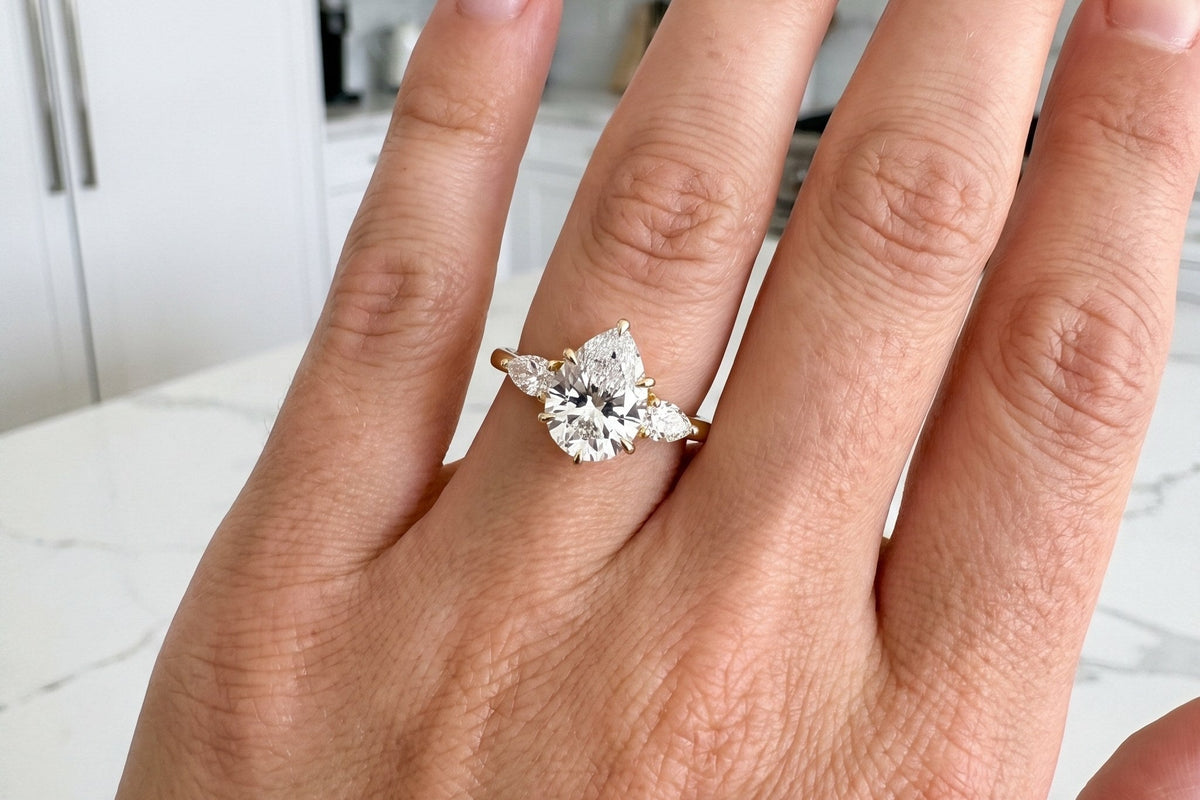
| Pear | V shaped or chevron band | The pear's tip points into the V |
| Marquise | V shaped guard | It follows both points of the stone |
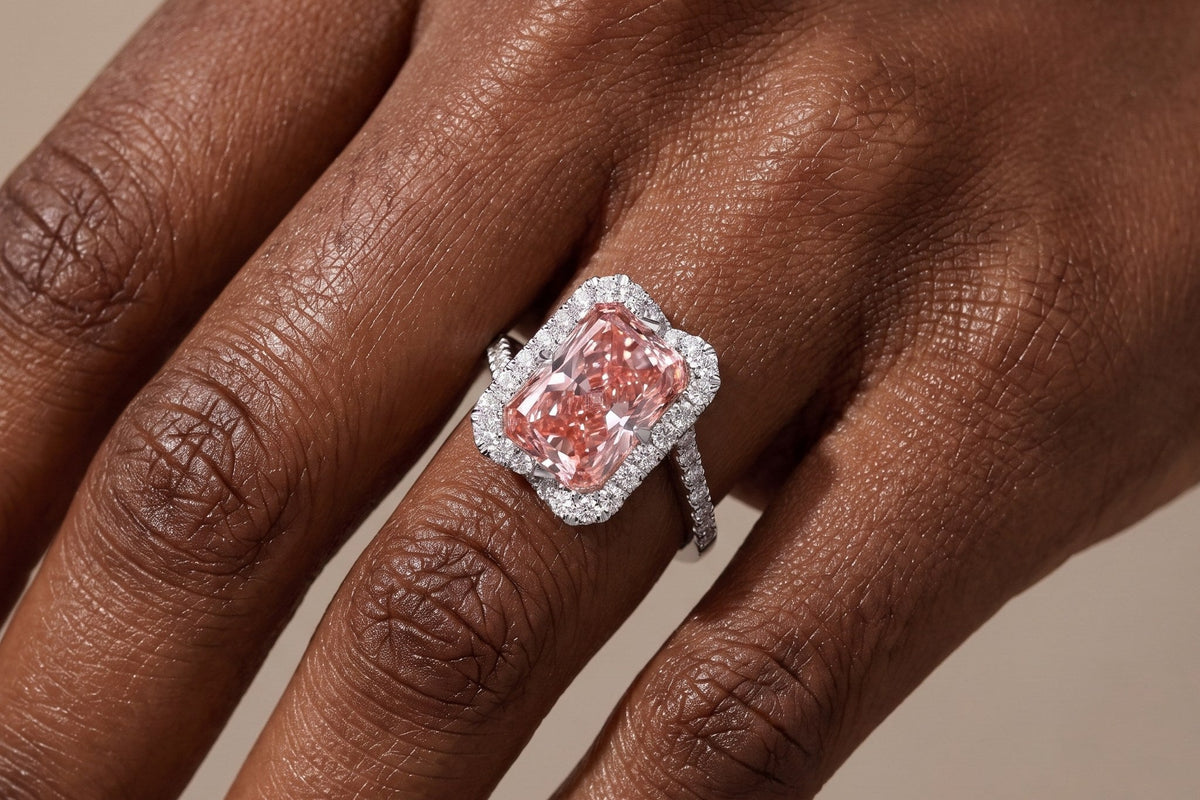
| Halo | A minimal band | The halo already carries the detail |
| Toi et moi or bypass | Curved or open band | It follows the angle of the stones |
Should you choose a straight or curved band?
Choose straight if the ring sits high enough to clear it, and curved if it does not. Shape then decides which curve: a contour, a notch, a V or an open band.
Contour bands exist to nest around the centre stone and close the gap between the rings. A notched band is a straighter version with a notch for the diamond.1
Pointed shapes want a pointed band. For a pear, try a V or chevron band with the tip of the pear pointing into the V; for a marquise, a V shaped guard above and below.1
A halo already carries detail, so the band can stay minimal. An open band can also act as a spacer beside a straight band that will not sit flush.1
Bezels and two stone rings follow the same logic. Stuller pairs a half bezel ring with a contour band that follows its curve.3
Check how high the centre stone sits. A ring set high usually leaves room for a straight band; a low setting rarely does.
Pears and marquises suit a V or chevron band. Low or bezel settings suit a contour or notched band.
Most women's bands run 2 to 5 mm. Keep the band close to the engagement ring's width unless you want a deliberate contrast.
Wear the same metal and karat for both rings, or expect the softer ring to wear faster where they touch.
Two rings worn together wear wider than one. Measure for the pair, and size up slightly if the stack is wide.

A straight band sits flush only when the ring sits high enough
A flush fit is about clearance. If the stone's setting sits low, it occupies the space a straight band would need, and the two rings meet with a gap.
Low profile rings can be harder to pair with a wedding band, while high profile rings leave room for a band to sit flush. A basket set solitaire of a carat or more is a typical high setting.4
The part that matters is the gallery, the area beneath the setting. It decides whether a straight band can slide underneath or hits the setting first.
Jewellers have workarounds. Most will customise a band that works with a low profile ring, and some now test open bands with a gap at the top to fit around the ring's basket.45
Buying the pair together avoids the problem. A matched set is made so the band follows the engagement ring from the start.

Band width should follow the engagement ring, usually 2 to 5 mm
Width is the next decision. Most women's bands sit between 2 and 5 mm, and most engagement ring bands between 1.5 and 4 mm, so close widths usually look intended.
Women tend to choose bands of 2 to 5 mm, men's bands average 6 to 8 mm, and engagement ring bands commonly run 1.5 to 4 mm.6
Matching widths was once the rule. Many couples now mix and match, and thicker engagement ring bands are a trend expected to continue in 2026.68
Wide stacks change the size. Bridal sets wider than 4 or 5 mm worn together need special consideration, because wide shanks usually need to be a bit larger.7
Metal matters for narrow bands. Platinum holds up better than gold in a narrow profile, which suits a slim band beside a solitaire.6
Match the metal, or expect one ring to wear the other
Two rings rub against each other every day. When they are different metals, the softer one loses metal faster where they touch, and over years the difference shows.
GIA notes that softer metals such as gold can wear down more quickly when stacked with harder metals such as platinum.9
Hardness alone does not predict it. A platinum industry funded study found platinum lost metal two to three times more slowly than gold alloys, and that harder alloys did not always wear less.1011
White gold beside platinum is a common mismatch. The two metals rub together, and one ring can deteriorate over time.12
White gold also needs upkeep. Its rhodium plating wears away and is usually renewed about every five years, at roughly US$100 to US$500.13
"Wear the same metal in both rings. In one wear study, gold alloys lost metal 2 to 3 times faster than platinum."
Garrett McMartin, Founder, Draco Diamond
Can an eternity band be resized?
Usually not. A full eternity band has stones all the way around, so there is no plain sizing bar to cut. A half eternity or anniversary band keeps one.
Eternity band styles cannot be resized because there is no sizing bar; anniversary bands circle part of the finger and keep one.14
Order matters too. Tradition puts the wedding band closest to the heart, below the engagement ring, and an eternity ring above it.15
Some couples solder the pair together. It stops spinning and rubbing, but the rings can no longer be worn apart, and a jeweller must separate them to resize.12
Few couples match everything. In The Knot's 2017 study, 24 percent bought a band that matched the engagement ring.16
Shop early. Couples still buy bands three to six months before the wedding, which leaves time for a custom curve or a resize.5
Draco's bands run from a flush fit pave to a full eternity
Draco makes bands for each of these fits, from a straight flush fit pave to contour, open and eternity styles. Each is lab grown and IGI certified.
| Band | Style | From |
|---|---|---|
| Flush fit French pave | Straight, made to sit flush | CAD 1,040 |
| Tapered pave | Straight, narrowing at the top | CAD 1,089 |
| Crescent contour | Contour, curves around a stone | CAD 1,311 |
| Semi eternity, 1.15ct | Stones around the upper half | CAD 1,399 |
| Open French pave | Open at the top, frames a stone | CAD 1,410 |
| Emerald half eternity, 2ct | Larger stones, upper half | CAD 1,899 |
| Round eternity, 8ct | Stones all the way around | CAD 3,927 |
What each band style costs at Draco
Starting prices in 10K gold, Canadian dollars, October 2026. From a flush fit pave band to a full eternity.
Source: Draco Diamond catalogue, listed starting prices read October 19, 2026.
A matched set can cost less than two separate rings. Draco's 3 carat marquise bridal set lists from CAD 3,085, while a 3.5 carat total weight marquise ring plus the flush fit band comes to CAD 4,055, a different design.
Every Draco ring includes one complimentary resize within 60 days of delivery, up to two sizes up or down. Full eternity designs are among those that cannot be resized, and Draco discloses this before purchase.17
Every Draco piece carries 30 day returns, the Lifetime Authenticity Guarantee, free resizing, and free insured worldwide shipping to 25 markets, delivered duty paid with nothing collected at the door, and signature on delivery. Each piece is IGI certified, E to F colour and VS2 or better, with a report you can verify free at IGI.org.
Browse bridal sets and women's rings, or match a band to a centre stone in the ring builder.

Bands, answered
Which wedding band goes with my engagement ring?
Start with the setting height. A high set ring suits a straight band that sits flush; a low set or bezel ring usually needs a contour or notched band. Then match the shape, width and metal.
Should my wedding band be straight or curved?
Straight if the engagement ring sits high enough to clear it. Curved, contour or notched if it sits low or has a pointed stone such as a pear or marquise.
Why won't my wedding band sit flush with my engagement ring?
Usually because the setting sits low and takes up the space a straight band needs. A contour, notched or open band, or a custom band, solves it.
Should my wedding band match my engagement ring's metal?
Ideally yes. Different metals rub against each other, and the softer one, often gold against platinum, wears faster where they touch.
How wide should a wedding band be?
Women's bands usually run 2 to 5 mm and men's 6 to 8 mm. Keep the band close to the engagement ring's width, and size up slightly if the pair is wider than 4 or 5 mm.
Can an eternity band be resized?
Generally no. With stones all the way around there is no sizing bar to cut. A half eternity or anniversary band keeps a plain section and can usually be resized.
References
- The Knot, 6 Types of Wedding Rings for Every Diamond Shape, August 14, 2025.
- Stuller, How to Help Customers Choose Their Wedding Bands, July 17, 2026.
- Stuller, Trends in Bloom: Bridal Stack Inspiration for Spring 2025, March 27, 2025.
- The Knot, What Are The Benefits of a Low Set Engagement Ring?, January 9, 2025.
- Rapaport, Blinged-Out Wedding Bands Are a Solid Sales Opportunity, September 29, 2026.
- The Knot, How to Choose Engagement and Wedding Ring Widths, November 1, 2024.
- GIA 4Cs, How to Determine Ring Size: Tips and Ring Size Chart, January 18, 2018.
- National Jeweler, Engagement Ring Trends 2026: What's In, and Why, March 5, 2026.
- GIA 4Cs, Ring Stacking Guide, May 12, 2025.
- Santa Fe Symposium, Wear Resistance of Platinum and Gold Alloys: A Comparative Study, 2022.
- JCK, Platinum More Durable Than White Gold, Study Says, June 7, 2021.
- The Knot, Should You Solder Your Rings Together?, December 13, 2024.
- The Knot, How Often Should You Replate Your Engagement Ring?, January 21, 2025.
- Stuller, Diamond Wedding Band Resource Center, accessed October 19, 2026.
- GIA 4Cs, How to Wear Your Engagement Ring and Wedding Band, October 2, 2025.
- JCK, Facts of Love: The Results of The Knot's 2017 Jewelry and Engagement Study, September 15, 2017.
- Draco Diamond, Refunds, Integrity and Ethical Standards, accessed October 19, 2026.
Send us a comparable band and we will beat it almost every time
Same IGI certified specification, direct pricing, about half the listed price of Blue Nile and Brilliant Earth on bridal sets (55 percent below at the median, October 2026). Founder reviewed, no obligation, a quote back in one to three business days. Every Draco band is IGI certified, E to F colour, VS2 and better, with 30 day returns, a Lifetime Authenticity Guarantee, free resizing, free insured worldwide shipping to 25 markets, and signature on delivery.