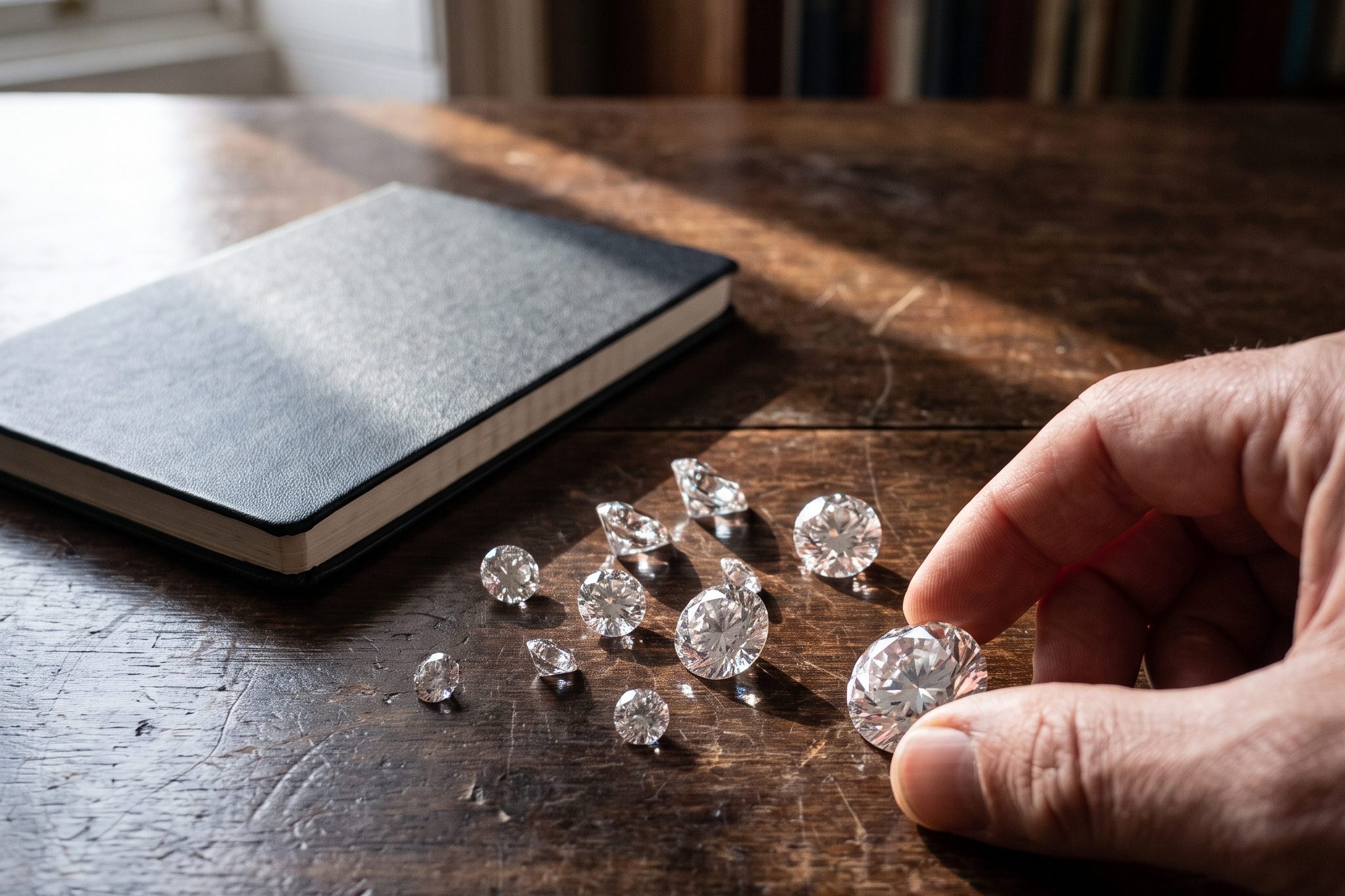
Do Lab Diamonds Pass a Diamond Tester? Yes. Here Is Why.
The quiet fear behind a lot of lab grown purchases, settled by physics. What a tester actually measures, why lab grown reads as diamond every time, and the one document that proves the rest.
The author is the founder of Draco Diamond. Every Draco stone ships with its IGI certificate; the report can be provided on request before purchase, and verified free at IGI.org. Prices cited are USD market data unless noted.

What does a diamond tester actually measure?
Heat. A standard handheld tester measures thermal conductivity, according to GIA and BriteCo. It is the quiet fear behind a lot of lab grown purchases. You buy the ring, a jeweler touches a pen tester to the stone, and you brace for the beep. Here is what actually happens: the tester reads diamond. Every time. Not because the machine is fooled, but because there is nothing to fool it with.
The tip warms slightly on contact. The device times how fast heat moves through the stone. Diamond moves heat in a distinct way. Glass does not. Cubic zirconia does not. The pen is a material detector, nothing more. It answers one question: is this carbon crystal behaving like diamond. It has no way to ask where the crystal came from.
Why do lab grown diamonds always pass?
Because a lab grown diamond is a diamond. Same carbon, same crystal, same physics.
GIA confirms lab diamonds have the same physical and optical properties as natural stones.1 Same Mohs 10 hardness. Same refraction. Same thermal behavior. The word lab describes origin, not material. A tester reading a lab diamond is reading diamond, so it says diamond. There is no trick here and no edge case. The pass is not luck. It is chemistry.
The stone also stays that way. Lab diamonds have no aging mechanism. They do not cloud, fade, or change color. A lab diamond that passes a tester today passes the same tester in fifty years.

Which stones read differently on a standard tester?
Moissanite. It reads differently on standard thermal testers, per GIA and BriteCo.2
This is the confusion that feeds the anxiety. Moissanite is a diamond simulant, a different material that imitates the look. Cubic zirconia is another. Simulants are not carbon crystal, so a thermal tester separates them from diamond. People hear that some stones fail testers and assume lab diamonds are in that group. They are not. Simulants imitate diamond. Lab diamonds are diamond.
| Stone | What it is | Tester result |
|---|---|---|
| Lab grown diamond | Carbon crystal, identical to natural (GIA) | Reads as diamond, every time |
| Natural diamond | Carbon crystal | Reads as diamond |
| Moissanite | Diamond simulant | Reads differently on standard testers |
| Cubic zirconia | Diamond simulant | Does not read as diamond |

"A tester cannot tell you where a diamond came from. It can only tell you that it is a diamond. Lab grown passes because it is one."
Garrett McMartin, Founder, Draco Diamond
Can any machine tell a lab diamond from a natural one?
Yes. Specialized laboratory equipment can, by reading the crystal's growth patterns.
A mined stone and a grown stone form under different conditions, and the growth structure records that history. Gemological laboratories use dedicated instruments to read it. A handheld pen cannot. Your jeweler's counter tester cannot. This is the honest boundary of the technology, and it is exactly why certification exists. The laboratory does the analysis once, under controlled conditions, and issues a document. Everyone downstream relies on the document, not the pen.
Grading standards are also tightening around this. GIA stopped applying the 4Cs nomenclature to lab grown diamonds on October 1 2025, replacing it with premium and standard tiers, and stated that more than 95 percent of lab grown stones fall in one narrow color and clarity band.3 In a market where most stones cluster near the top, independent certification is how a buyer confirms theirs actually sits there.
How do you verify a lab diamond is real?
Rely on the certificate, not the pen. Verification is free, public, and takes minutes.
Locate the report number on the stone's certificate and enter it in the Verify Your Report tool at IGI.org. The official report loads with full grading details, free. Match carat, color, clarity, and cut to the seller's listing exactly.
A standard thermal tester confirms the stone is diamond rather than a simulant like moissanite or cubic zirconia. A lab grown diamond reads as diamond every time. The pen cannot tell lab from natural, and it is not supposed to.
A pen tester gives a yes or no answer. A certificate gives a full identity: origin, color, clarity, cut, and carat weight, verified by a gemological laboratory. If a seller cannot produce certification, the tester result is beside the point.
Every stone in the Draco Diamond catalog is IGI certified, E to F color, VS2 and better, and ships with its certificate. The report can be provided on request before purchase, and verified free at IGI.org. Draco is a Canadian brand, globally sourced, IGI certified, rated 4.8 out of 5 across 873 reviews.
What does passing the tester cost you now?
Far less than it used to. The stone is identical. The price is not.
StoneAlgo's May 2026 averages put a 1 carat lab diamond at 564 USD per carat, down from 3,410 USD per carat in 2020.4 A 2 carat averages 1,265 USD, a 3 carat 1,865 USD, and a 5 carat 2,588 USD per carat. The year over year decline has slowed to 2.59 percent, the smallest quarterly declines in two years, as premium certified stones hit a production cost floor. The same carbon crystal that reads as diamond on every tester now costs a fraction of what it did six years ago.
Lab diamond average price per carat, USD
Per carat averages by stone size. The material that passes every tester has hit a production cost floor.
Source: StoneAlgo, May 2026 per carat averages.

For modest pieces built on that economics, the entry points are wide open. A pair of certified studs or a small pendant carries the same carbon crystal, the same tester pass, and the same certificate as a statement stone. Browse certified lab diamond earrings or the full under $2,000 collection.

Diamond tester FAQ
Do lab grown diamonds pass a diamond tester?
Yes, every time. Standard testers measure thermal conductivity, and a lab grown diamond is the same carbon crystal as a natural diamond, so it reads as diamond on every standard tester.
Do lab diamonds test as moissanite?
No. Moissanite is a different material, a diamond simulant, and it reads differently on standard testers. A lab diamond is carbon crystal and reads as diamond.
Can a jeweler tell a lab diamond from a natural diamond with a pen tester?
No. A handheld tester only identifies diamond versus not diamond. Separating lab from natural requires specialized laboratory equipment that reads growth patterns, which is why laboratory certification matters.
Will a lab diamond ever stop passing a tester?
No. GIA confirms lab diamonds have no aging mechanism and do not cloud, fade, or change color. The thermal properties that make it read as diamond are permanent.
Does cubic zirconia pass a diamond tester?
No. Cubic zirconia is a diamond simulant, not carbon crystal, and it does not read as diamond on a standard thermal tester.
How do I prove my lab diamond is real?
With its laboratory certificate. An IGI certificate documents the stone's identity and grading, and the report number verifies free at IGI.org. Every Draco Diamond stone is IGI certified, E to F color, VS2 and better, ships with its certificate, and the report can be provided on request before purchase.
References
- Gemological Institute of America. Laboratory grown diamond properties, thermal testing, and durability guidance. gia.edu. Accessed July 2026.
- BriteCo. Diamond tester behavior for lab grown diamonds and moissanite; lab grown cost comparison. brite.co. Accessed July 2026.
- GIA press release. GIA to apply premium and standard tiers to laboratory grown diamonds, October 1 2025. gia.edu.
- StoneAlgo. Lab grown diamond per carat price averages, May 2026. stonealgo.com.
- International Gemological Institute. Verify Your Report. IGI.org. Accessed July 2026.
The certificate proves the rest
Every Draco Diamond piece is IGI certified, E to F color, VS2 and better, and ships with its certificate. 30 day returns, Lifetime Authenticity Guarantee, free ring resizing, free insured worldwide shipping to 25 markets, delivered duty paid with nothing collected at the door, signature on delivery, IGI certified E to F color VS2 and better.