Emerald Cut vs Round: Which Looks Bigger?
Both bracelets cost exactly the same at five carats, which removes price from the decision entirely and leaves only the question of how you want light to behave on your wrist.
Prices read from the Draco Diamond catalogue on September 1, 2026, quoted in Canadian dollars at the 10K gold base. Metal percentages read from the Draco product configurator on the same date. Every diamond is IGI certified at E to F colour and VS2 or better.

Why do both cost exactly the same?
Start with the fact that removes most of the usual argument. At five carats, the emerald cut tennis bracelet and the round brilliant tennis bracelet both list at CAD 2,720 at the 10K gold base. So do the oval, the marquise and the pear.
| Cut | Faceting family | How it behaves | Price CAD |
|---|---|---|---|
| Emerald | Step cut | Long flat planes, mirror flashes | 2,720 |
| Round brilliant | Brilliant cut | 57 or 58 facets, maximum fire | 2,720 |
| Oval | Brilliant cut | Elongated, spreads along the wrist | 2,720 |
| Marquise | Brilliant cut | Pointed ends, continuous ribbon | 2,720 |
| Pear | Brilliant cut | Directional, needs orientation | 2,720 |
In mined diamonds this would be unusual. Cut affects price there because a cutter starts with found rough and each shape wastes a different proportion of it. Emerald cuts often retain more weight from the rough and round brilliants waste more, and the prices carry that history.
Grown stones are produced to specification. There is no found rough to work around, so the cut is an instruction rather than a yield calculation. That is why every shape lists identically here, and it means the decision in front of you is purely aesthetic.
How does each cut handle light?
| Property | Emerald cut | Round brilliant |
|---|---|---|
| Light return | Broad mirror flashes | Rapid scattered fire |
| What hides a flaw | Nothing, the table is open | Brilliance masks inclusions |
| Clarity sensitivity | High, needs a clean stone | Lower, more forgiving |
| Reads at distance | As a continuous line | As many separate points |
| Reads up close | Architectural, calm | Busy, animated |
The two cuts belong to different families and they are trying to do different things.
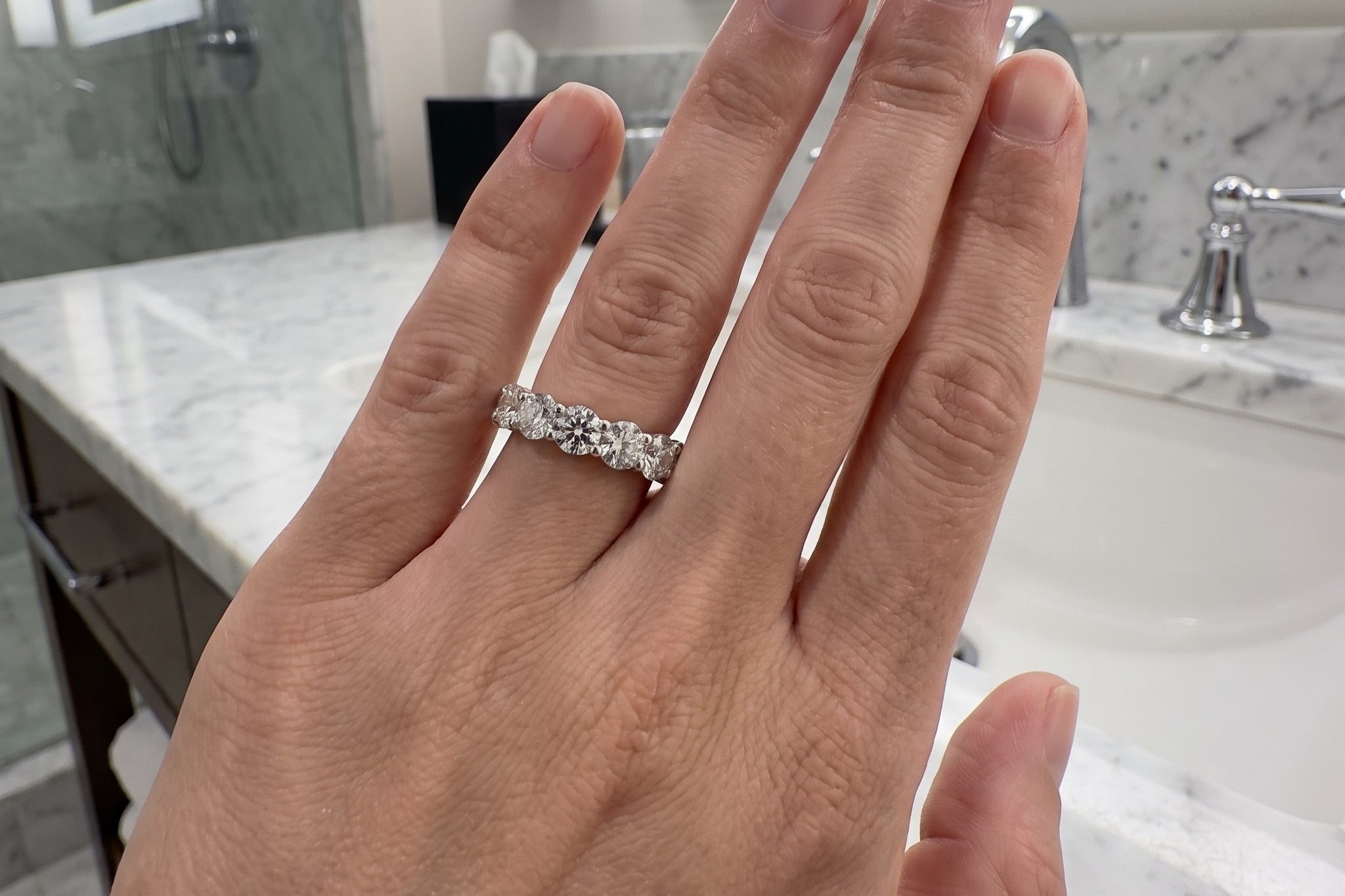
A round brilliant is a brilliant cut. Fifty seven or fifty eight facets are arranged to catch light, bounce it internally and return it to the eye split into colour. The result is fire: rapid, scattered, high contrast sparkle that changes with every small movement. It is the most efficient shape ever designed for returning light and everything about it is optimised for that.
An emerald cut is a step cut. Instead of many small facets it has long parallel planes running in steps down to the culet, like a set of mirrors stacked at angles. Light comes back in broad slow flashes rather than scattered points. The effect is often described as a hall of mirrors, and it is calmer and more architectural than fire.

On a bracelet this difference compounds, because you are not looking at one stone. You are looking at a continuous row of them moving together on a wrist, and the two cuts produce genuinely different visual objects at that scale.
Which one actually looks bigger?
The emerald cut, and for a reason that has nothing to do with carat weight.
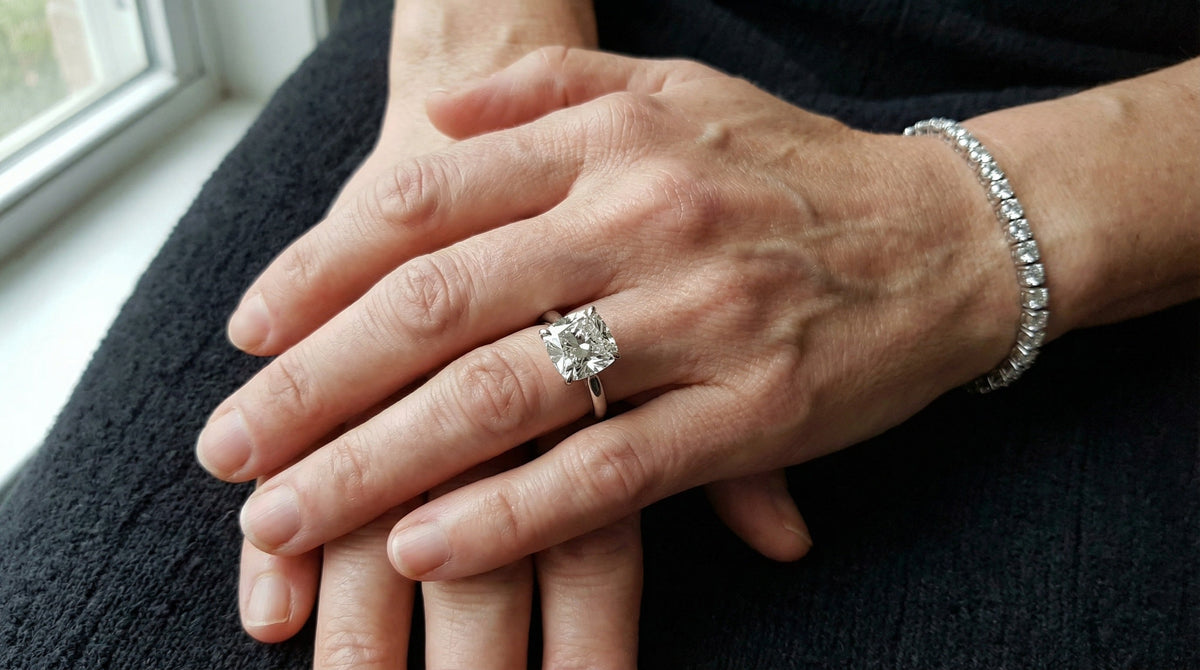
A step cut stone presents a large flat rectangular table with clean straight edges. Set in a row, those rectangles sit edge to edge and the eye joins them into a single continuous band of light. There are no gaps for the eye to find, so the line reads as one wide object.
A round brilliant presents a circle. Circles set in a row leave small gaps between them by geometry, and each stone reads as a separate bright point. The line is unmistakably a sequence of stones rather than a band. It sparkles more and it reads narrower.
"Both bracelets carry five carats. The emerald cut looks wider because rectangles set edge to edge leave the eye nothing to break, and the round looks brighter for exactly the opposite reason."
Garrett McMartin, Founder, Draco Diamond
The honest qualification is that bigger and better are not the same question. At conversational distance the round brilliant is more noticeable, because movement and fire catch attention in a way that a calm continuous line does not. The emerald cut wins on apparent width; the round wins on being seen at all.

Why does an emerald cut need a cleaner stone?
This is the one place the emerald cut is genuinely more demanding, and it is worth understanding because it explains why emerald cuts have a mixed reputation elsewhere.
A brilliant cut hides things. All that scattered light and high contrast sparkle breaks up the view into the stone, and small inclusions get lost in the noise. A round brilliant at a middling clarity grade often looks perfectly clean to the eye.
An emerald cut hides nothing. The table is large, open and flat, and there are few facets to interrupt the line of sight. Looking into a step cut is like looking through a window, which is exactly why people like them and exactly why an inclusion that would vanish in a round brilliant sits there in plain view.
Every Draco diamond is IGI certified at E to F colour and VS2 or better, which clears this comfortably. VS2 means inclusions are difficult to see under ten times magnification, so they are not going to appear to the naked eye through an open table. The report ships with the piece, can be provided on request before purchase, and is verifiable free at IGI.org.
The practical lesson generalises beyond Draco. If you are looking at emerald cuts anywhere, the clarity grade matters more than it does on a round, and a step cut at a low clarity grade is the most common way to be disappointed by this shape.
What about metal and the clasp?
Since cut costs nothing, the decisions that actually move the price on a tennis bracelet are metal and carat weight.
Metal is a fixed percentage of the 10K gold base. Sterling silver runs 30 percent below, 14K adds 18 percent, 18K adds 38 percent and platinum adds 45 percent. On the 5 carat bracelet that means CAD 1,904 in silver, CAD 3,210 in 14K, CAD 3,754 in 18K and CAD 3,944 in platinum. The spread between the cheapest and most expensive mount is CAD 2,040, which is most of the price of the bracelet itself and vastly more than cut will ever cost you.
Carat weight is the other lever. The 3 carat bracelet in 14K white gold is CAD 1,801, against CAD 2,720 for 5 carats at the 10K base. Cost per carat improves as weight rises, as it does everywhere in the catalogue.
What the same money buys across the bracelet range
Draco tennis bracelets, Canadian dollars at the 10K gold base. Cut does not appear as a variable.
Source: Draco Diamond catalogue, read September 1, 2026.
The clasp deserves a mention that it rarely gets. A tennis bracelet carries its entire value on one closure, at the wrist, which is the part of the body that moves most. Ask what the clasp is and whether there is a secondary safety catch. That question separates two bracelets far more meaningfully than the shape of the stones does.

How do you choose between them?
An emerald cut line reads as one continuous band of light because the flashes are broad and slow. A round brilliant line reads as many separate sparkling points. Stand back from both before deciding, because at arm's length they are different objects.
A step cut has a large open table and few facets to break up the view, so inclusions show. Every Draco stone is VS2 or better, which clears this, but the principle is why emerald cuts elsewhere can disappoint at lower grades.
Round brilliants are engineered for maximum fire and look spectacular under bright directional light. Emerald cuts hold up better in ordinary indoor lighting because they rely on broad reflection rather than scattered fire.
Every cut lists at CAD 2,720 at 5 carats. If cut is not costing anything, it should not be part of the value calculation at all, only the aesthetic one.
Metal is a fixed percentage of the 10K base: silver 30 percent below, 14K plus 18 percent, 18K plus 38 percent, platinum plus 45 percent. On a 5 carat bracelet that is a CAD 2,040 spread between the cheapest and most expensive mount.
A tennis bracelet carries its entire value on one closure at the wrist, where it takes constant movement. Ask what the clasp is and whether there is a secondary catch before comparing two bracelets on price.
Every Draco diamond is IGI certified at E to F colour and VS2 or better and ships with its certificate; the report can be provided on request before purchase and verified free at IGI.org. Every bracelet carries 30 day returns, the Lifetime Authenticity Guarantee, free resizing, and free insured worldwide shipping to 25 markets with signature on delivery.
Nothing is held in finished inventory, so a length or a specification outside the catalogue is a change of brief rather than a bespoke surcharge. Browse the tennis bracelet collection, start a commission at create your piece, or send a competing quote and Draco will price directly against it.

Emerald or round: FAQ
Does an emerald cut tennis bracelet cost more than a round one?
No. At Draco a 5 carat emerald cut tennis bracelet and a 5 carat round brilliant tennis bracelet both cost CAD 2,720 at the 10K gold base, as do the oval, marquise and pear versions. Grown stones are produced to specification rather than cut from found rough, so shape is an instruction rather than a yield question.
Which looks bigger, an emerald cut or a round tennis bracelet?
The emerald cut. Step cut stones present large flat rectangular tables that sit edge to edge in a row, so the eye joins them into one continuous band. Round stones leave small gaps between them by geometry and read as separate points, which looks narrower even at identical carat weight.
Which sparkles more?
The round brilliant, by a wide margin. Its 57 or 58 facets are engineered to scatter light in every direction and return it split into colour. An emerald cut produces broad slow mirror flashes instead, which is calmer and more architectural but far less fiery.
Why do emerald cut diamonds need a higher clarity grade?
A step cut has a large open table and few facets to break up the view into the stone, so inclusions are not disguised the way they are in a brilliant cut. Every Draco diamond is IGI certified at VS2 or better, which means inclusions are difficult to see even under ten times magnification.
What does the metal add to a tennis bracelet?
Metal is a fixed percentage of the 10K gold base. On the 5 carat bracelet that is CAD 1,904 in sterling silver, CAD 2,720 in 10K, CAD 3,210 in 14K, CAD 3,754 in 18K and CAD 3,944 in platinum. The CAD 2,040 spread is far larger than any difference cut could make.
Is a 3 carat tennis bracelet a better buy than a 5 carat?
It is cheaper at CAD 1,801 in 14K white gold against CAD 2,720 for 5 carats at the 10K base, but cost per carat is better on the larger bracelet. Which is the better buy depends on the width you want on the wrist rather than on the arithmetic.
What should I check on a tennis bracelet before buying?
The clasp. A tennis bracelet carries its whole value on one closure at the wrist, which is the part of the body that moves most, so ask what the clasp is and whether there is a secondary safety catch. That matters more than the shape of the stones.
References
- Draco Diamond catalogue pricing, read August 27, 2026.
- International Gemological Institute, diamond grading standards.
Send us a comparable band and we will beat it almost every time
Same IGI certified specification, direct pricing, up to 64 percent below Blue Nile. Founder reviewed, no obligation, a quote back in one to three business days. Every Draco band is IGI certified, E to F colour, VS2 and better, with 30 day returns, a Lifetime Authenticity Guarantee, free resizing, free insured worldwide shipping to 25 markets, and signature on delivery.