

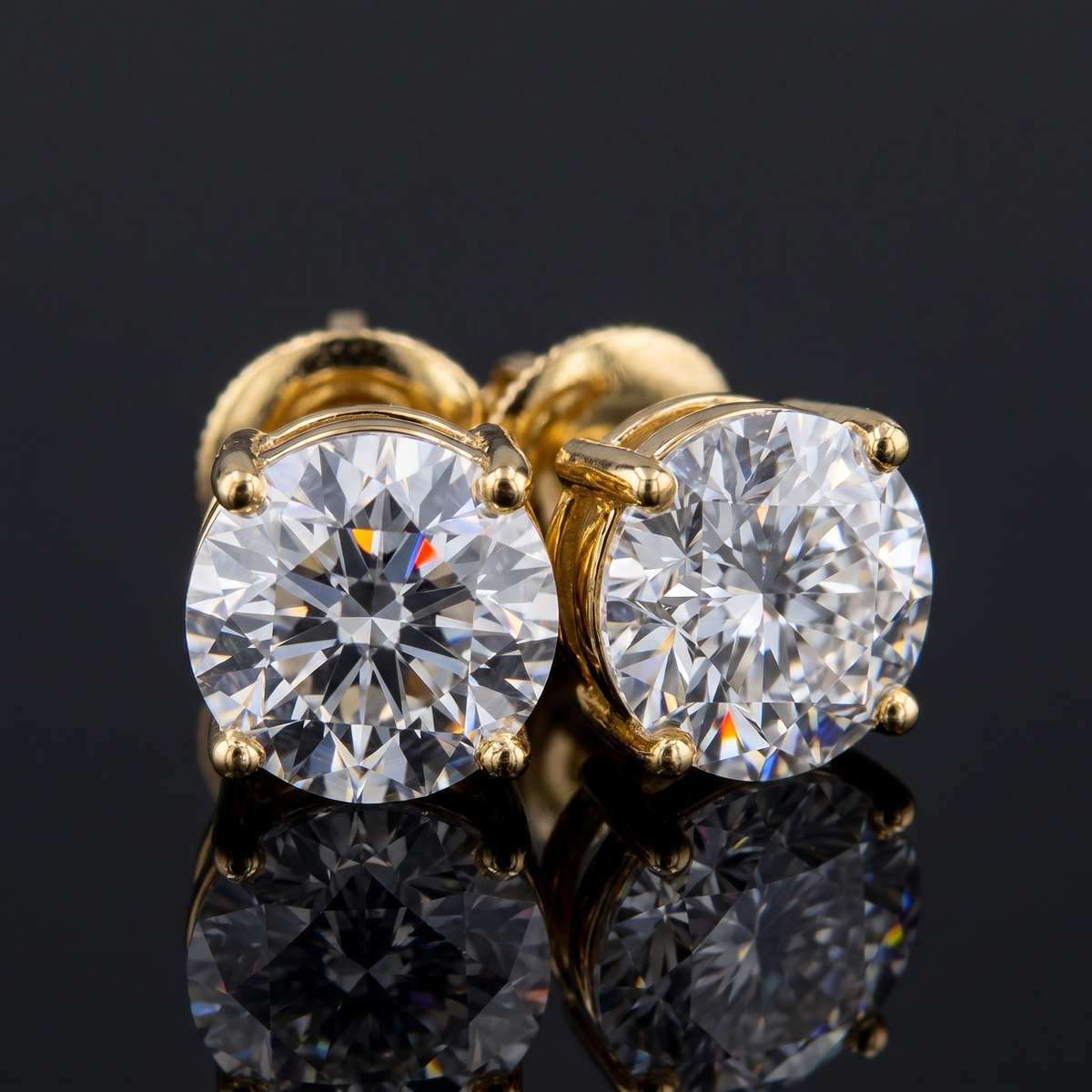

Antique Cut Diamonds: Old Mine, Old European, Antique Cushion and Rose Cut
What these four cuts are, how they differ from a modern round, whether a stone is truly old, how a report treats it, and what to look for when all you have is a video.
The author is the founder of Draco Diamond, which can make these cuts to order and lists none in its catalogue today. Cut history and grading rules are sourced to GIA, GemGuide and trade press, named below. Read November 4, 2026.

Four cuts carry the antique label, and three of them share one build
Old mine, old European and antique cushion share a high crown, a small table and broad facets. The rose cut is the outlier. It is a dome of triangular facets over a flat base, with no pavilion below.
| Cut | Outline | Period | What you see |
|---|---|---|---|
| Old mine | Soft square, rounded corners | Early 1700s to late 1800s | Broad flashes |
| Old European | Round | About late 1800s to 1940 | Blocky pattern |
| Antique cushion | Cushion, often elongated | A loose modern label | Varies by stone |
| Rose cut | Round or irregular dome | From the 16th century | Soft, glassy light |
The old mine cut is a hand faceted stone with a square or slightly rectangular outline and rounded corners. It has a high crown, a small table, a deep pavilion and often a large open culet.5 It was cut from the early 1700s to the late 1800s, through the Georgian and Victorian eras.52
The old European cut is its round successor. One GIA publication places it from about the late 1800s to 1940.1 It keeps the high crown and deep pavilion, and short lower facets give it a blocky reflection pattern.1
Antique cushion is the loosest term of the four. It generally means a cushion shaped stone with a vintage inspired facet pattern, and it can include true old mine stones.8 So ask what a seller means by it. The same words can describe a stone cut 150 years ago or one cut last month.
The rose cut is the oldest. It appeared in the 16th century, with as few as 3 facets and as many as 24.6 A double rose carries the pattern on both sides.6 With no pavilion, it shows a soft, glassy light instead of strong flashes.8
Five outlines, seen from above and from the side
Antique builds carry a smaller table and a higher crown. The solid dot marks an open culet.
Draco schematic, not to scale and not a measurement. Traits per GemGuide 2019, Brilliant Earth 2026 and Lang Antiques.
These stones were cut for candle and gas light, before electric lighting existed.5 That explains the build. Broad facets throw broad flashes in low light.

Old mine is the soft square, and old European is the round that followed it
Start with the outline. A squarish stone with rounded corners points to old mine. A round stone with a small table and a high crown points to old European. The second grew out of the first.
Both names can rest on the same test at GIA. It checks four measures: table of 53 percent or less, crown angle of 40 degrees or more, lower half facets of 60 percent or less, and a culet of slightly large or larger.110
Three of the four must fit. A round stone that passes is an old European cut. A cushion shape that passes is an old mine cut.1
Stones that narrowly miss may be called circular brilliants, a third GIA category with its own criteria.1 The trade does not fully accept the line. One San Francisco antique dealer told GemGuide she treats most circular brilliants as European cuts, and judges by eye.1
That dispute costs real sales. GemGuide reported a New York dealer losing a sale of a stone over 2 carats because its report read circular brilliant, not old European.1
In appearance, an old mine typically shows less brilliance and more fire than a modern round.7 Choose between the two on outline first. Then choose the individual stone, because hand cutting makes each one different.
Elongated old mines are a separate conversation. They were less common when these stones were cut, and original large ones are hard to find.2 Taylor Swift's ring reportedly holds one, and one New York dealer places elongated cushion old mines at the heart of current demand.23
How do these cuts differ from a modern round?
A modern round is built for bright, even light return from a tight pattern of small flashes. An antique style trades some of that for broad flashes, visible facets and more of the stone's own colour.
| Measure | GIA old European test | A 2025 modern round |
|---|---|---|
| Table | 53% or less | 55% |
| Crown angle | 40 degrees or more | 34.9 degrees |
| Culet | Slightly large or larger | Pointed |
| Cut grade | None assigned | Ideal |
The right column comes from one real report: a 0.54 carat lab grown round graded Ideal by IGI in March 2025.15 It is an example, not a universal standard. The left column is GIA's test, as published by GemGuide.1
The difference shows when you look down through the table. A small table limits your view of the pavilion, so you see large blocks of light and dark.1 A modern round fills the same view with many small flashes.

A large culet and open faceting also reveal more of a stone's colour and clarity.7 That is why warm tones and small inclusions are often accepted as part of the character.72
The approach to cutting differs too. New York dealer Jay Moncada describes modern proportions as a matter of angles and yield, where older cutters worked from what the rough allowed.3
There is a practical cost. Original old cuts often have thin girdles, which raises the risk of chips, so they call for a setting that protects the edge.7 Our bezel and prong guide covers that trade.
If you want maximum brightness under shop lighting, buy a modern round. That is what the modern proportions are for. Buy an antique style because you prefer how it looks.
An antique style name describes the cut, and it says nothing about age
A true antique is generally more than 100 years old. An old mine or old European label says only that a stone has those proportions. Many stones sold under these names today were cut recently.
National Jeweler uses the 100 year line for antique diamonds.2 GIA's naming is based solely on proportions, not age, and manufacturers now cut new stones to those proportions on purpose.1
Original supply is finite, and it has shrunk. One New York jeweller says many antique stones were bought back and recut into modern shapes during the 1970s to 1990s, when demand was low.2 By February 2026, JCK's dealer source described securing good antique goods as difficult, even from New York.3
The old versus new question has a long record. JCK warned in 2001 that reproductions were being sold as originals without disclosure.4 The dealers it quoted had no objection to reproductions. Their objection was to selling them as old.4
The girdle is the first clue. In that report, reproductions had a thick, faceted girdle and originals a thin, often frosted one. Smaller culets also pointed to newer cutting.4
Clues are not proof. Old stones are often repolished, and repaired ones may have a faceted girdle added, so some are hard to place.4 Age is a claim the seller must stand behind. Get it in writing.
New stones have real advantages. GIA points to thicker, more durable girdles and better symmetry from improved cutting precision.27 Old stones have their own risks. GemGuide reported some insurers refusing chipped old cuts as already damaged.1
Can you get antique cut diamonds lab grown?
Yes. An antique style is a matter of cutting, and the cutter can apply those proportions to natural or lab grown rough. What a lab grown stone cannot offer is history, because it is new by definition.
National Jeweler reports that cutters can mimic the original old mine in natural or lab grown diamonds.2 Brilliant Earth confirms lab grown old mines exist.5
The paper trail exists too. An IGI report dated November 25, 2025 names a lab grown old European cut of 1.51 carats, D colour and VS1 clarity, grown by CVD.13 Another, from January 2022, names the same style.14
Lab growing changes the specification you can ask for. With natural antiques, one dealer told National Jeweler that a buyer cannot simply order a D colour, internally flawless old mine.2 Colour and clarity become choices when the stone is cut new.
Think through that choice. Warmth is part of the antique look, and a colourless old cut reads differently from a warm one.25 Decide which look you are after before you specify a grade.

Draco's catalogue holds no antique cuts today. Draco can make them to order. To commission one, start in the ring builder or write to info@dracodiamond.com. This guide quotes no price or lead time for a commission.
A cut grade applies to modern rounds, and most antique styles do not receive one
Expect colour, clarity, carat, polish and symmetry on a report, with no overall cut grade on most antique styles. The cut grade system was built around modern round brilliants, and these stones were never cut to that target.
| Style | GIA, natural | GIA, lab grown | IGI, lab grown |
|---|---|---|---|
| Modern round | Cut grade | Excellent or very good needed | Cut grade seen |
| Old European | No cut grade | Premium or standard | No cut grade seen |
| Old mine | No cut grade | Premium or standard | No report read |
| Antique cushion | No cut grade | Premium or standard | No report read |
| Rose cut | Not confirmed | Not confirmed | No report read |
GIA introduced round brilliant cut grades in 2006. A stone named old European or circular brilliant now receives no cut grade, while polish and symmetry still appear.110
A near miss is worse than a pass. A stone that fails the test becomes a round brilliant, is graded against modern proportions, and is likely to come back fair or poor.1
GemGuide documented a case. A dealer removed a chip from a 1.17 carat old European, leaving 1.05 carats and a smaller culet. The stone was regraded as a round brilliant, cut grade poor.1
"GIA's old European label turns on proportion, not age: 3 of 4 measurements decide the name."
Draco Diamond, editorial note, from GemGuide, July/August 2019
Fancy shapes follow the same logic. Cushions and other fancy cuts receive no overall cut grade on GIA reports, because their facet patterns and light behaviour vary too widely, though polish and symmetry are still reported.9
GIA treats lab grown stones differently. Since October 1, 2025, it has described them as premium or standard rather than giving colour and clarity grades.1112 Its cut requirement applies to round brilliants only, and fancy shapes may qualify for standard with good symmetry.11
IGI still grades lab grown stones on colour and clarity. The two old European reports we read show no cut grade line, and an IGI round shows one.131415 That is three reports, not a stated IGI policy.
Labels also differ between labs. The 2025 IGI old European shows a 42.4 degree crown and a large culet, but a 63 percent table, well above GIA's 53 percent test.131 GIA needs only three of its four measures, so that stone could still qualify. It shows that a name is not a fixed specification.
We found no published GIA or IGI rule on how a rose cut is reported. Ask the lab or the seller for a sample report before you commit.
Natural old European cuts reached price parity with modern rounds by 2019
The best public comparison we found is natural and seven years old. It shows 1 carat old European cuts priced about level with modern rounds. We found no published price series for lab grown antique cuts.
1 carat, J colour, VS2, natural stones, 2019
US dollars per carat. GemGuide lists and RapNet average asking prices, all with GIA reports.
Source: GemGuide, July/August 2019. RapNet search covered 1.00 to 1.19 carat: 27 old European cuts, 682 rounds with excellent cut and no fluorescence.
The gap closed over two decades. In 2000, one carat old European cuts in eight colour and clarity categories sat 15 to 26 percent below rounds. The discount narrowed in 2006 and 2012, and by 2019 some sat slightly above.1
GemGuide attributed this to high demand and low supply, and it limited the claim to popular sizes and grades. It also warned that prices could soften as markets cool.1 Treat the chart as direction, not a current quote.
Shape adds its own premium. National Jeweler reports that elongated old mines may cost more because of scarcity.2
None of this transfers cleanly to lab grown. Natural parity reflects scarcity of old stones, and a new lab grown stone is not scarce in that way. For a baseline, the average asking price for a 1 carat lab grown diamond was US$508 on October 13, 2026.17 We have no sourced figure for what an antique style adds to that, so get a written quote.
Compare size as well as price. Carat measures weight, and these stones carry weight differently, so compare millimetres.5 The 1.51 carat IGI old European measures 7.02 to 7.09 mm across.13 Our custom jewellery cost guide covers how a commission is priced in general.
Judge an antique cut on video by its light, pattern, culet and girdle
You cannot judge these stones by a grade, so a video carries more weight than usual. Ask for the same stone in two kinds of light, turning slowly, with a side view. Then compare what you see with the report.
Request the same stone in diffuse light and in spot light. Diffuse light shows overall brightness. Spot light shows how the facets flash.
Have the stone rock slowly in a ring or on a stage. A clip between two fingers shows size and outline, and little else.
Look at the centre of the table. A small flat circle is expected on an old mine or old European. It should read as a clean facet, not a chip.
Pause face up. Hand cut originals vary from side to side. A new cut should look more even, so a lopsided new stone deserves a question.
Look at the crown height and the girdle. Thin edges chip more easily, so note how the setting will protect them.
Ask for the report number before you pay. Check the named cutting style, polish, symmetry, culet and measurements against the video.
Lighting changes what a video shows. Whether the source is direct or diffuse, and how bright it is, alters a diamond's appearance on camera whatever its cut quality.16 That guidance comes from a trade forum, and it matches common sense: compare stones only in matching light.
Know what is normal. Broad facets and dark and light contrast are expected in these cuts, not faults.5 Our guide to bow ties and windowing explains those patterns in modern fancy shapes.
Judge the individual stone. Brilliant Earth suggests assessing overall appearance and whether inclusions are visible without magnification, not only the clarity grade.5 Antique dealer Lauren DeYoung makes a similar point: these stones ask to be judged on different criteria from modern ones.2
Ask one last question in writing: is this stone old or newly cut? A reputable seller will answer plainly, and a lab grown report answers it for you.
Antique cuts, answered
What is the difference between an old mine and an old European cut?
Outline and period. An old mine has a soft square outline and dates from the early 1700s to the late 1800s. An old European is round and dates from about the late 1800s to 1940. GIA can apply the same proportion test to both.
Are old mine cut diamonds always real antiques?
No. The name describes proportions, not age, and new stones are cut to those proportions on purpose. An antique is generally more than 100 years old. Ask the seller to state the age of the stone in writing.
Can you get an old mine cut lab grown?
Yes. Cutters can apply old mine proportions to lab grown rough, and IGI has issued lab grown reports for the related old European cut. A lab grown stone gives you the look, not the history.
Does an old European cut get a cut grade?
Not at GIA. A stone named old European receives polish and symmetry grades and no cut grade. A stone that narrowly misses the test can be named a round brilliant and graded fair or poor.
Why does a rose cut look different from other diamonds?
It has a domed top of triangular facets and a flat base, with no pavilion. That build gives a soft, glassy look in place of the strong flashes of a brilliant cut.
Do antique cuts cost more than modern rounds?
Sometimes. In a 2019 comparison, natural 1 carat old European cuts in J VS2 priced about level with rounds, up from a 15 to 26 percent discount in 2000. We found no price series for lab grown antique cuts.
Does Draco make antique cut diamonds?
Draco's catalogue holds no antique cuts today, and Draco can make them to order. Start in the ring builder or write to info@dracodiamond.com.
References
- GemGuide, Gemworld International, Identifying and Valuing Old European Cut Diamonds, July/August 2019.
- National Jeweler, The Taylor Swift Effect: Antique Diamonds Edition, October 22, 2025.
- JCK, How Antique Diamonds Became a Modern Bridal Obsession, February 4, 2026.
- JCK, New Old Miners, June 1, 2001.
- Brilliant Earth, Old Mine Cut Diamond Guide, October 16, 2026.
- Lang Antiques, Antique Jewelry University, Rose Cut, May 5, 2026.
- GIA 4Cs, Guide to Old Mine Cut Diamonds, read November 4, 2026.
- GIA 4Cs, Antique Diamond Cuts: History, Craftsmanship and Enduring Appeal, read November 4, 2026.
- GIA 4Cs, GIA Diamond Cut Grade: 6 Things to Know, read November 4, 2026.
- Gemological Institute of America, Describing 58-facet Round Brilliant-Cut Diamonds at GIA, read November 4, 2026.
- JCK, GIA Details Updates to Lab-Grown Diamond Grading, August 27, 2025.
- National Jeweler, GIA's New 'Quality Assessment' for Lab-Grown Diamonds Is Coming, August 28, 2025.
- International Gemological Institute, Report LG752501932, old European cut, 1.51 carat, November 25, 2025.
- International Gemological Institute, Report LG514252337, old European cut, January 22, 2022.
- International Gemological Institute, Report LG681525925, round brilliant, 0.54 carat, March 28, 2025.
- PriceScope, Can a video show you everything you need to know about a diamond?, April 24, 2019.
- Draco Diamond, Lab Diamond Price Trend 2026, StoneAlgo asking prices, October 13, 2026.