Bow Tie, Windowing and Crushed Ice: How to Judge a Fancy Shape on Video
Every oval, pear and marquise shows some darkness across its middle. Here is what is normal, what to pass on, and what to ask a seller for before you buy a stone you have only seen on a screen.
The author is the founder of Draco Diamond, which sells lab grown diamonds in fancy shapes. Guidance is sourced to GIA research, IGI's grading guidelines and the American Gem Society. Read October 19, 2026.

A slight bow tie is normal, and a broad dark one that stays put is not
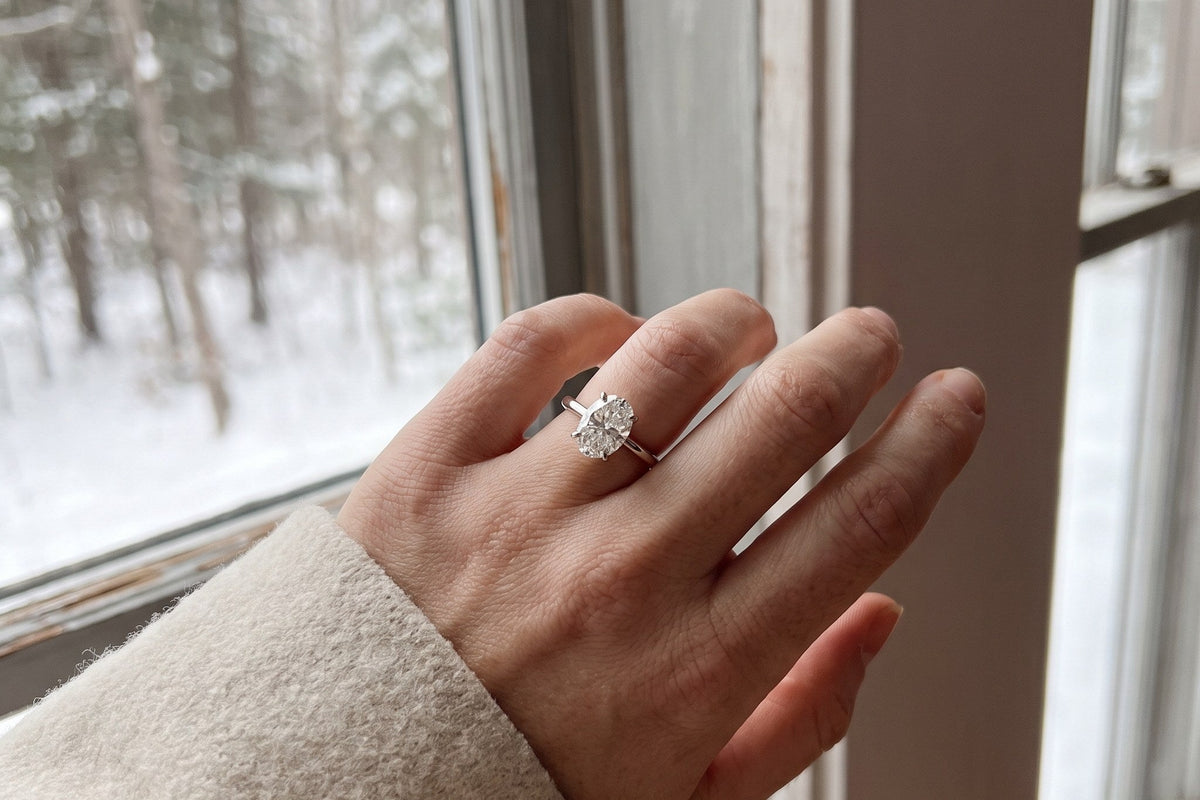
Almost every oval, pear and marquise shows a bow tie. The question is how strong it is. A light, shifting one adds contrast; a broad, dark bar that never moves is a fault.
The bow tie effect is a dark band across the width of the stone, seen through the table. It can range from slight to thick.1
Part of it is you. Your own head and shoulders block light from reaching the stone, which is the same reflection that forms hearts and arrows in a round.21
It gets darker as a stone gets longer relative to its width, and very shallow or very deep pavilions make it worse.34
Facet layout matters too. Pavilion facets running across the belly of the stone tend to strengthen it, and by 2023 nearly 90 percent of the ovals sent to GIA had none.1
In GIA's viewing study, people disliked bow ties that were broad, dark or persistent as the stone moved. A slight bow tie is considered normal.14
"By 2023, nearly 90 percent of ovals sent to GIA were cut without belly facets, the layout that strengthens a bow tie."
Garrett McMartin, Founder, Draco Diamond

Is it a bow tie or just the lighting?
Often it is the lighting, the camera or the distance. A bow tie that brightens as the stone moves is normal; one that stays dark from every angle is real.
Some bow ties persist, while others brighten when the diamond moves. That is why one still photo is never enough.1
Distance changes it. The closer your face is to the stone, the stronger the bow tie looks.2 A phone held close blocks light the same way.
Lighting changes it as well. A diamond looks very different under diffused light and under a spot light.6
Even within the same ratio, two ovals can show very different bow ties, so GIA advises seeing the stone in person or asking for video.2
Face up, rocked side to side and tilted end to end, with no filters or edits.
One clip in soft daylight and one under a spot light. Lighting changes how a diamond looks.
A bow tie that flickers and brightens as the stone moves is normal. A broad, dark bar that stays put is a reason to pass.
A washed out or see through middle is windowing. A dark window is the clearest reason to pass.
Compare the ratio and depth with the ranges below, read the IGI cut grade, and ask for an ASET image if one exists.

Windowing shows as a pale, see through centre
Windowing is a washed out or see through patch in the middle of the stone. It happens when light passes straight through the stone instead of bouncing back to the eye.
The cause is the pavilion, the lower half of the stone. Too shallow or too deep, and light escapes through the side or the bottom.7
Not every window is a dealbreaker. In GIA's study, viewers only agreed strongly in disliking large windows when the window was dark.1
IGI's cut grade weighs exactly this: light return against darkness from windowing, bow tie and obstruction.10
On video, look for a centre that stays pale or flat as the stone rocks while the edges flash.
Crushed ice is a matter of taste unless it looks grey
Crushed ice describes the fine, broken up faceting of many radiants and modified cushions. It is a style, not a flaw, unless it turns muddy and grey.
GIA found crushed ice ranging from distinct and bright to muddled and grey, and observer opinion on it was widely spread.1
Brilliant cushions have larger facets with a softer play of light. Modified cushions create a crushed ice look similar to radiant cuts.5
To tell them apart on video, watch the flashes. Crushed ice breaks into many small pinpoints; a chunky cut shows fewer, larger blocks of light.

Which length to width ratio should I pick?
Pick the outline you like, then stay near the common range for the shape. For ovals that is about 1.35 to 1.50; longer stones tend to show stronger bow ties.
What the length to width ratio does to an oval
Four ovals of the same width, drawn to scale. GIA sees most ovals near 1.4; past 1.50 they are rarely seen.
Sources: GIA Gems & Gemology, Fall 2024; GIA oval buying guide, September 2025. Drawing: Draco Diamond.
Submitted ovals peak close to 1.4. Ovals above 1.50 are rarely seen, and some show a stronger bow tie.12
Pears, emerald cuts and rectangular cushions are most popular between 1.50 and 1.75.6 Marquises graded at GIA most often fall between 1.6 and 2.2.4
| Shape | Range GIA sees | IGI Excellent | IGI depth |
|---|---|---|---|
| Oval | 1.2 to 1.7 | 1.35 to 1.50 | 58 to 65% |
| Pear | 1.3 to 1.8 | 1.40 to 1.75 | 57.5 to 65% |
| Marquise | 1.5 to 2.5 | 1.80 to 2.20 | 57.5 to 64.5% |
| Square radiant | Not published | 1.00 to 1.05 | 62 to 68% |
| Square cushion | Not published | 1.00 to 1.05 | 62 to 68% |
Proportions are a first filter, not a verdict. With fancy shapes, light performance cannot be predicted from the numbers alone, and IGI's ranges only make a stone a candidate for Excellent.1110
A stone outside the range is a reason to look harder at the video, not an automatic pass.
IGI grades cut on fancy shapes, and GIA grades only rounds
If the report has no cut grade, check which lab wrote it. GIA gives a cut grade only to round brilliants. IGI has graded cut on fancy shapes since 2022.
The round brilliant is currently the only shape that receives an official cut grade on a GIA report.8
IGI introduced cut grading for fancy shapes in September 2022, as a basic assessment of light return against darkness. It now covers nine shapes.910
For an oval, pear, marquise or heart to earn Excellent, IGI requires that the bow tie effect is not significant. Every grade is subject to a visual check.10
Polish and symmetry still matter. Read them alongside the cut grade, and treat a stone with no cut grade as one you must judge entirely by eye. If an IGI report on a fancy shape shows none, ask the seller why.
Every Draco stone is IGI certified at E to F colour and VS2 clarity or better, with a report you can check free at IGI.org.
An ASET image and an unedited video settle what a photo cannot
Before you buy a fancy shape you have only seen on a screen, ask for three things: an unedited video, an ASET image if one exists, and the return terms.
An ASET image maps where a diamond gathers light. Red marks the brightest light from above, green marks less bright light, and blue shows the contrast pattern.12
Little white or black on an ASET image is good; both mean light is being lost in that area.13
Ask for as many images as possible from every angle, and make sure the seller gives you time to examine the stone and return it.14
An ASET image is a still, so it complements a video rather than replacing it. Ask jewellers for ASET images of each stone you are weighing and compare them side by side.13
Draco gives you 30 days to judge a stone in your own light. Every Draco piece carries 30 day returns, the Lifetime Authenticity Guarantee, free resizing, and free insured worldwide shipping to 25 markets, delivered duty paid with nothing collected at the door, and signature on delivery.
See women's rings in oval, pear, marquise and radiant, or compare shapes in the ring builder.
Fancy shapes, answered
Is a bow tie in an oval diamond bad?
A slight bow tie is normal in ovals, pears and marquises. Pass on a stone whose bow tie is broad, dark and stays put as the stone moves.
Why can I only see the bow tie in pictures?
Still photos and close phone shots exaggerate it. Your head and the camera block light, and a bow tie that brightens in motion looks fixed in a still.
What does windowing look like?
A pale, washed out or see through patch in the centre of the stone that stays flat as the stone moves. It comes from a pavilion that is too shallow or too deep.
Is crushed ice bad in a radiant?
No. Crushed ice is a style of faceting, and opinion on it is split. Pass only if it looks muddy or grey on video.
What length to width ratio is best for an oval?
Most ovals fall near 1.4, and IGI's Excellent range is 1.35 to 1.50. Longer ovals can show a stronger bow tie effect.
What is an ASET image?
A map of where a diamond gathers light. Red marks the brightest light from above, green less bright light and blue the contrast pattern. Little white or black is a good sign.
Do IGI reports give a cut grade for ovals and pears?
Yes. IGI has graded cut on fancy shapes since September 2022. GIA reports give a cut grade only to round brilliants.
References
- GIA, Gems & Gemology, Fall 2024, Observations of Oval-, Pear-, and Marquise-Shaped Diamonds, 2024.
- GIA 4Cs, Oval Cut Diamond Buying Guide, September 23, 2025.
- GIA 4Cs, Pear Shaped Diamond: Tips for Picking the Perfect One, March 13, 2018.
- GIA 4Cs, Marquise Diamond Buying Guide, October 12, 2026.
- GIA 4Cs, Guide to Diamond Engagement Ring Shapes, November 21, 2025.
- GIA 4Cs, Buying a Quality Diamond: A Comprehensive Guide, July 7, 2020.
- GIA 4Cs, Diamond Anatomy, Explained, April 9, 2014.
- GIA 4Cs, GIA Diamond Cut Grade: 6 Things You Need to Know, February 3, 2026.
- IGI, IGI Introduces Cut Grading for Fancy Shaped Diamonds, September 1, 2022.
- IGI, Guidelines for Excellent: Fancy Shape Cut Grading, March 19, 2026.
- JCK, IGI Launches Cut Grades for Fancy Shapes, September 6, 2022.
- GIA, What Is the ASET Map on an AGS Ideal Report?, accessed 2026-10-19.
- American Gem Society, ASET: Using Your Smartphone to Compare Diamonds, July 18, 2013.
- GIA 4Cs, How to Buy Diamonds Online, November 15, 2016.
Send us a comparable band and we will beat it almost every time
Same IGI certified specification, direct pricing, about half the listed price of Blue Nile and Brilliant Earth on bridal sets (55 percent below at the median, October 2026). Founder reviewed, no obligation, a quote back in one to three business days. Every Draco band is IGI certified, E to F colour, VS2 and better, with 30 day returns, a Lifetime Authenticity Guarantee, free resizing, free insured worldwide shipping to 25 markets, and signature on delivery.