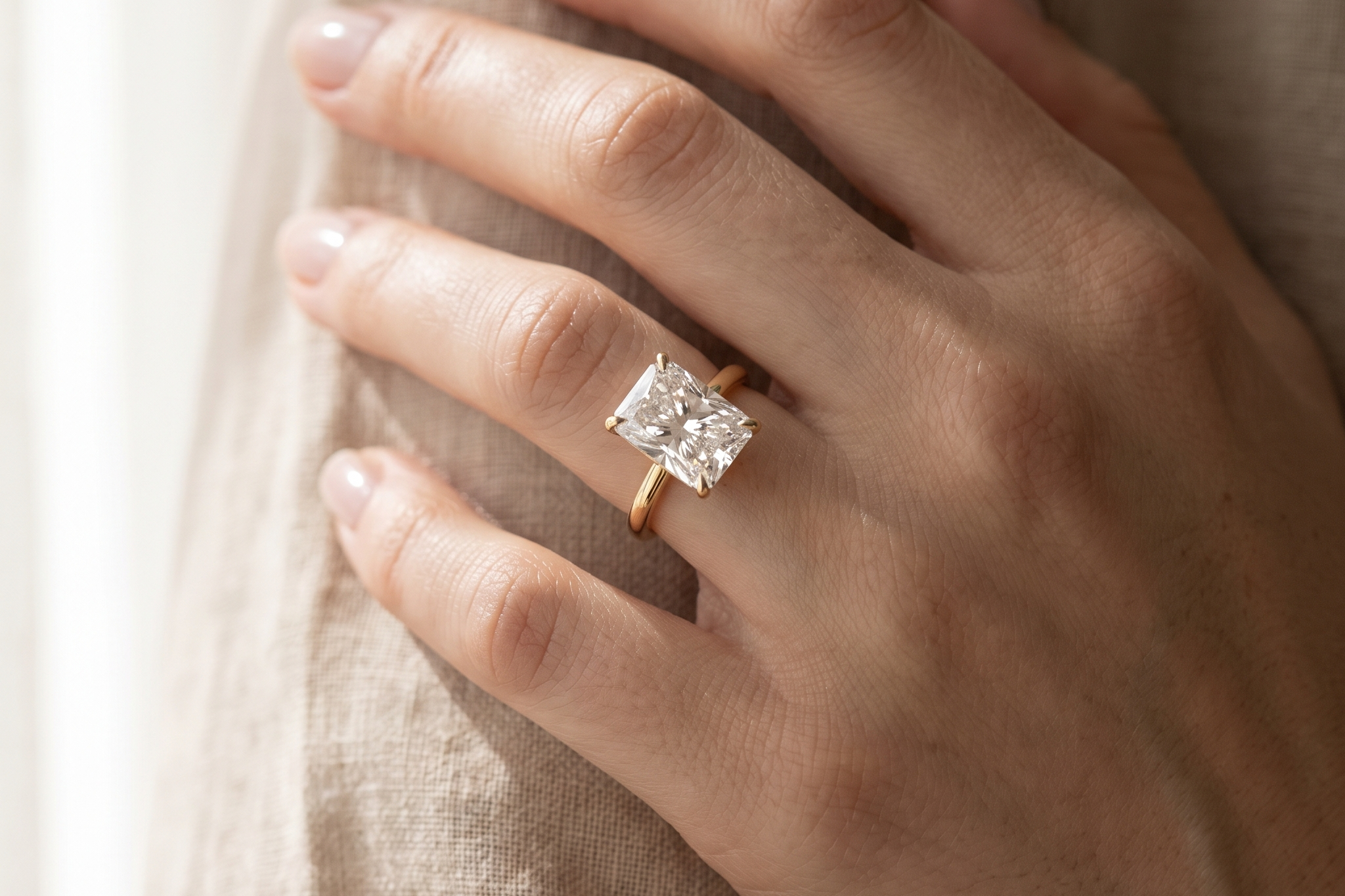
How to Choose a Diamond Shape for Your Hand and Style
A five step decision framework for picking the shape that suits your finger proportion, your daily wear, and the way you actually dress, rather than the shape that happens to be trending.
The author is the founder of Draco Diamond. Every diamond referenced is IGI certified and verifiable free at IGI.org. All prices in CAD.

How does your hand and finger proportion change the right shape?
Proportion is the first filter because it is the only one you cannot change later. A shape either sits in balance with the finger or it fights it. Elongated outlines draw the eye along the length of the finger. Rounder outlines draw the eye across it.
Three measurements matter, and none require a jeweler. Look at finger length relative to your palm, finger width at the base knuckle, and whether your knuckles are prominent. Then apply the rule that governs every other decision on this page: a shape that repeats the finger's own geometry exaggerates it, and a shape that opposes it balances it.
Oval, marquise, pear, and emerald are the four working elongators. Each one runs longer than it is wide, so it covers more of the finger vertically and less horizontally. On a shorter or wider finger, that reads as length. Round, cushion, and asscher run close to square or circular, which reads as compact and soft. On an already long, slender finger, that keeps the hand in proportion instead of stretching it further.

One correction to the common advice. Prominent knuckles are a width problem, not a length problem. A wide, low profile shape such as cushion or a horizontally set oval can look bulky passing over the knuckle. A narrower elongated shape in a low setting passes more cleanly. This is a comfort variable that only shows up when you wear the ring, not when you look at it in a photograph.
"Most buyers pick the shape first and discover the constraint later. Reverse it. The hand and the daily routine shorten the list before taste ever gets a vote."
Garrett McMartin, Founder, Draco Diamond
Which diamond shapes survive daily wear?
All diamonds are Mohs 10 and do not scratch in normal wear, lab grown and mined alike. Source: GIA. Hardness is not the issue. Geometry is.
A diamond chips at its thinnest point. Round, oval, and cushion have no thin points, which is why they are the default recommendation for anyone who works with their hands. Marquise and pear terminate in sharp points. Princess has four unprotected corners. Emerald and asscher have corners too, though they are typically cut at an angle that removes the sharpest vulnerability. None of these shapes are fragile in normal use. They simply demand a setting that covers the exposed geometry.

The practical rule: if the ring never comes off, prioritise a shape with no exposed points, or insist on a protective setting. If the ring comes off for the gym, the garden, and the kitchen, the whole catalogue is open to you.
Round, oval, cushion, or emerald in a bezel or low profile setting. No unprotected points, low snag profile, minimal daily maintenance.
Any shape, with V prongs on marquise and pear and covered corners on princess. The point is protected rather than avoided.
No shape restriction. Choose on proportion and taste, and store the piece properly between wears.
Which shape matches your style archetype?
Style is the third filter, not the first. Once proportion and durability have narrowed the field, four archetypes cover almost every buyer, and each maps cleanly onto a small set of shapes.
Classic. Round brilliant and cushion. Symmetrical, unfussy, the shapes that never date because they set the reference point everything else is measured against. Modern. Oval, emerald, and radiant. Elongated, architectural, favoured by buyers who want presence without ornament. Vintage. Cushion, asscher, and old style step cuts, usually paired with milgrain, bezels, or three stone arrangements. Understated. Emerald and round in low profile bezel or solitaire settings, where the diamond reads as a line rather than a display.

Two tests keep this honest. Look at the metals you already wear and the jewelry you reach for most, then ask whether the shape you are drawn to belongs to the same visual family. A step cut emerald beside a wardrobe of ornate, textured pieces will sit apart from everything else you own. Buying a shape that fights your existing wardrobe is the most common source of quiet regret in fine jewelry.
How does shape change perceived size at the same carat weight?
Carat is weight, not size. Two stones of identical weight present very different amounts of surface to the eye depending on how that weight is distributed.
Round brilliant carries a relatively large share of its weight in depth below the girdle, where nobody sees it. Elongated shapes distribute more of their weight across the face up outline, which is the only part visible once the stone is set. The consequence is consistent: at a fixed carat weight, an oval, marquise, or pear generally covers more finger than a round of the same weight. The reverse also holds. To match the visual footprint of an elongated shape, a round usually has to weigh more.
The shape decision map
Two axes decide most of the outcome. How elongated the outline is, and how much vulnerable geometry the shape exposes in daily wear.
Qualitative framework based on faceting geometry and outline ratio. Positions are illustrative, not measured values.
Budget follows from this directly. Round brilliant is the most cut intensive shape and carries the highest premium per carat of any standard outline, in part because more of the rough is discarded reaching the finished proportions. Elongated fancy shapes generally cost less per carat and read larger for the same weight, which is why they are the efficient answer for buyers optimising visual size against spend. This is a general market pattern rather than a fixed percentage, and it moves with supply, so confirm the current spread on the specific stones you are comparing rather than trusting a figure from a blog.

One caution on cut. IGI assigns a full cut grade to round brilliants only. Source: IGI grading standards. On fancy shapes there is no cut grade to hide behind, so you are judging the outline ratio, the symmetry, and the light return by eye and by measurement. That is a reason to look carefully at a fancy shape, not a reason to avoid one. For the full outline by outline reference, read the lab diamond shapes guide for 2026.
Does your shape work in the setting you want?
Shape and setting are a single decision, not two. A shape you love in a solitaire may be impossible in the band you had in mind.
Bezels wrap the girdle in metal, which suits round, oval, emerald, and cushion cleanly and gets awkward around a marquise point. Halos add apparent size to any outline but add width, which works against the elongating effect on a wider finger. Eternity and channel bands need shapes that tile against one another, which is why emerald, princess, and round dominate that category. Three stone designs need a centre outline that reads clearly against its side stones, which is why pear and oval centres pair so often with tapered or pear side stones.
| Shape | Best suited hand | Daily wear fit | Setting notes |
|---|---|---|---|
| Round | Long or slender fingers, any width | Highest. No exposed points | Works in every setting including eternity bands |
| Oval | Shorter or wider fingers | High. Rounded outline, no points | Solitaire, bezel, halo, three stone |
| Emerald | Shorter fingers, prominent knuckles | High. Angled corners, low profile | Bezel, eternity, solitaire. Tiles cleanly |
| Cushion | Long, slender fingers | High. Soft corners | Halo, vintage, three stone. Adds width |
| Pear | Shorter or wider fingers | Moderate. One exposed point | V prong or protective halo required |
| Marquise | Shorter fingers seeking maximum length | Moderate. Two exposed points | V prongs both ends. Poor eternity candidate |
| Princess | Long fingers, symmetrical hands | Moderate. Four exposed corners | Channel or covered corner prongs |
| Asscher | Long or medium fingers | High. Angled corners | Bezel and vintage settings. Compact outline |
Before you commit, look at the shape in the setting on a real hand rather than on a white background. Every ring in the Draco catalogue can be modelled that way in the Draco ring builder, and the whole ring decision, including metal, setting, and centre stone, is covered in the guide to choosing a lab diamond engagement ring.
How do you choose the right diamond shape for your style in five steps?
Run the five checks in order. Each one removes options, so by the fifth step the shortlist is usually two shapes rather than ten.
Look at finger length relative to the palm, finger width at the base, and knuckle prominence. Shorter or wider fingers suit elongated outlines such as oval, marquise, pear, and emerald. Long, slender fingers suit softer outlines such as round and cushion.
If the ring never comes off, favour shapes with no exposed points such as round, oval, cushion, and emerald, or require a protective setting. Marquise, pear, and princess carry points or corners that need V prongs, a halo, or a channel.
Classic maps to round and cushion. Modern maps to oval, emerald, and radiant. Vintage maps to cushion and asscher. Understated maps to emerald and round in low profile bezels. Check the archetype against the jewelry you already wear.
At a fixed carat weight, elongated shapes generally present more face up surface than a round, so they read larger on the finger. Round carries the highest premium per carat. Compare the millimetre measurements on the certificates, not the carat weight alone.
Check the shortlisted shape works in the setting you want. Bezels suit round, oval, emerald, and cushion. Eternity and channel bands suit shapes that tile, such as emerald, princess, and round. Marquise points complicate both.

If the shortlist is still two shapes after all five checks, the deciding factor is which one you want to look at for thirty years. That is a preference question and it is the correct place for preference to enter. The Draco diamond quiz narrows the field in about two minutes if you want a starting point, and the current season's most chosen outlines are collected in the best lab diamond engagement rings of 2026.
Diamond shape FAQ
How do I choose the right diamond shape for my style?
Work through five checks in order. Assess your hand and finger proportion, decide how much daily wear durability you need, pick a style archetype from classic, modern, vintage, or understated, compare perceived size at your carat budget, then confirm the shape works in the setting you want. Style is the third filter, not the first, because proportion and durability are constraints while taste is a preference.
Which diamond shape makes fingers look longer?
Elongated outlines lengthen the finger. Marquise is the most elongating, followed by oval, pear, and emerald. Each runs longer than it is wide, so it covers more of the finger vertically and less horizontally, which reads as length. Round, cushion, and asscher run close to circular or square and read softer and more compact.
Which diamond shape looks biggest for the carat weight?
Elongated shapes such as oval, marquise, pear, and emerald generally present more face up surface than a round of the same weight, because a round carries more of its weight in depth below the girdle where it is not visible. Compare the millimetre measurements on the IGI report rather than the carat weight alone. Carat is weight, not size.
Which diamond shapes are best for everyday wear?
Round, oval, cushion, and emerald have no sharp exposed points, which makes them the most forgiving for a ring that never comes off. Marquise and pear terminate in points and princess has four unprotected corners, so those shapes need V prongs, a halo, or a channel setting for hands on daily wear. All diamonds are Mohs 10, so the issue is geometry rather than hardness.
Is a round diamond more expensive than a fancy shape?
Round brilliant carries the highest premium per carat of the standard outlines. It is the most cut intensive shape and discards more of the rough reaching finished proportions. Elongated fancy shapes generally cost less per carat and read larger for the same weight. The spread moves with supply, so compare current prices on the specific stones rather than relying on a fixed percentage.
Does every diamond shape get a cut grade?
No. IGI assigns a full cut grade to round brilliants only. On fancy shapes you judge the outline ratio, symmetry, and light return from the measurements and by eye. That is a reason to inspect a fancy shape carefully, not a reason to avoid one. Every Draco diamond is IGI certified, E to F color, VS2 and better, verifiable free at IGI.org.
References
- Gemological Institute of America. Diamond hardness, Mohs scale 10, and the physical and optical equivalence of laboratory grown and mined diamond. gia.edu. Accessed July 21, 2026.
- International Gemological Institute. Grading standards and report fields, including the assignment of a full cut grade to round brilliants. IGI.org. Accessed July 21, 2026.
- Draco Diamond published catalogue and grading standard, IGI certified E to F color, VS2 and better. dracodiamond.com. Accessed July 21, 2026.
Find the shape that suits your hand
Draco carries every major outline, IGI certified E to F color, VS2 and better, in silver through platinum. Rated 4.8 out of 5 across 865 verified reviews. Every order includes 30 day returns, Lifetime Authenticity Guarantee, free ring resizing, free insured worldwide shipping to 25 markets, signature on delivery, IGI certified E to F color VS2 and better.