1ct vs 2ct vs 3ct Diamond Studs
Total carat weight describes the pair, not the stone, and width grows far more slowly than weight. Here is what each size measures and where the value stops improving.
Prices read from the Draco catalogue on August 27, 2026, at the 10K gold base. Stone diameters are approximate for round brilliants cut to standard proportions and will vary slightly with individual cut.

How big is a 1, 2 or 3 carat stud really?
The first thing to establish is that stud earrings are sold by total carat weight for the pair. A 2 carat pair is two 1 carat diamonds. This catches out a great many buyers who reasonably expect each stone to be the stated weight.
The second is that width grows far more slowly than weight. Carat is a measure of mass, and a diamond is a three dimensional object, so doubling the mass increases each linear dimension by roughly a quarter rather than doubling it. Going from a 1 carat pair to a 2 carat pair takes each stone from about 5.2mm to about 6.5mm.
| Total weight | Each stone | Stone diameter | Price CAD | Per carat CAD |
|---|---|---|---|---|
| 1 carat total | 0.50ct | 5.2mm | 711 | 711 |
| 2 carat total | 1.00ct | 6.5mm | 999 | 500 |
| 3 carat total | 1.50ct | 7.4mm | 1,299 | 433 |
| 4 carat total | 2.00ct | 8.2mm | 1,699 | 425 |
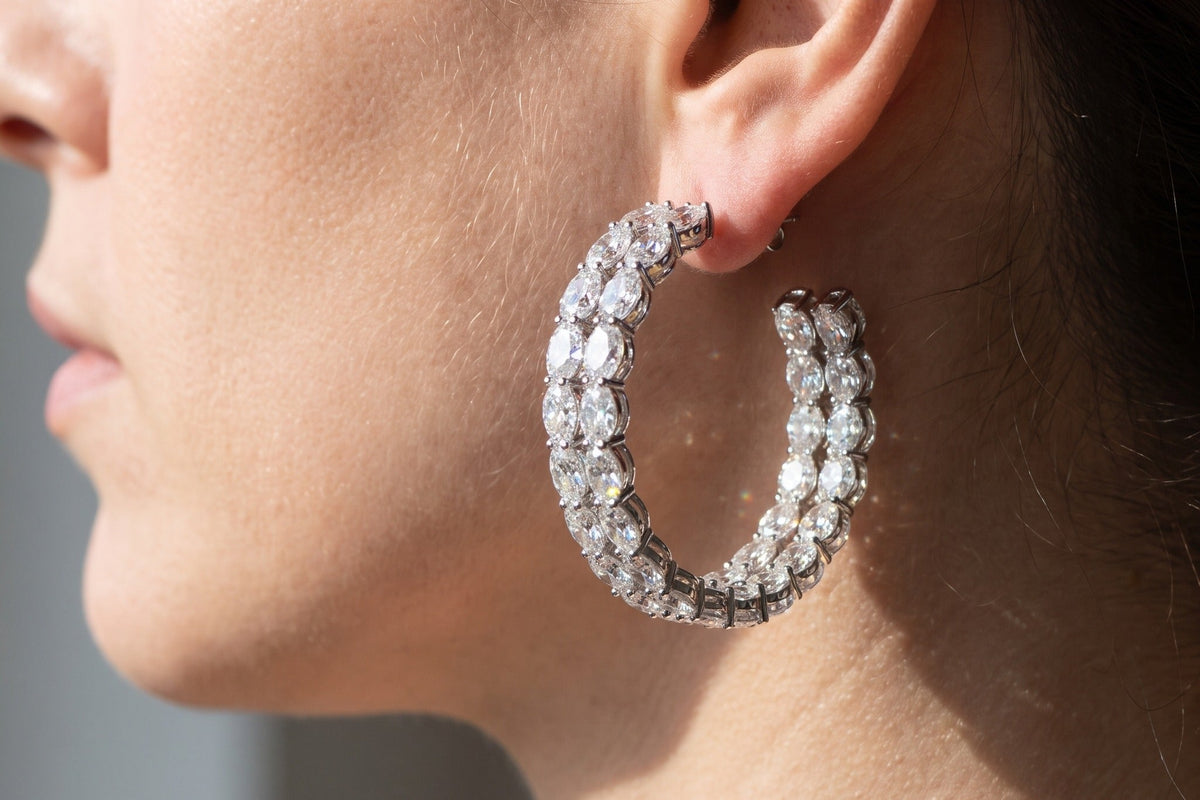
In practice the sizes read quite differently on the ear. A 1 carat pair is a refined everyday earring that reads as jewellery rather than as a statement. A 2 carat pair is clearly visible across a table without dominating. A 3 carat pair is unmistakably deliberate. A 4 carat pair is evening jewellery for most people.

Where does the price per carat stop falling?
Cost per carat drops steeply through the range and then flattens, which creates a clear value band.
Cost per carat falls sharply as stud size rises
Draco catalogue, August 2026, CAD per carat at the 10K base. Lower is better value per carat.
Source: Draco Diamond catalogue, read August 27, 2026.
Moving from a 1 carat pair to a 2 carat pair costs CAD 288 and adds a full carat of diamond. That is the single best value step available in the range, and it takes the per carat rate from CAD 711 down to about CAD 500.
Moving from 3 carats to 4 carats costs CAD 400 for another carat at a per carat rate that has improved by only about CAD 8. At that point you are buying presence rather than value.
"The best value in stud earrings is not the biggest pair or the smallest. It is the 2 to 3 carat band, where the per carat rate has already collapsed but the earrings still work on an ordinary Tuesday."
Garrett McMartin, Founder, Draco Diamond
This is why the 3 carat pair at CAD 1,299 is the piece worth pausing on. It is the last size where the per carat rate is still improving meaningfully, and it remains wearable in daylight without feeling like a statement.

Does the shape change the price?
Yes, and this is a genuine difference from tennis bracelets, where every cut costs the same at a given carat weight. On studs the shape does move the price, and the reason is the setting rather than the stone.
| Shape | Total weight | Setting | Price CAD |
|---|---|---|---|
| Round brilliant | 2ct total | Four prong basket | 999 |
| Oval | 2ct total | Shaped basket | 1,099 |
| Princess | 2ct total | V prong corners | 1,399 |
| Asscher | 3ct total | Step cut, shaped | 1,199 |
| Emerald | 1ct total | Step cut, shaped | 801 |
Round brilliant is the reference point and the cheapest, because a round stone in a four prong basket is the most standardised mount in the industry. The tooling is universal and the setting is fast.
Oval and princess need shaped baskets built for that outline, and princess additionally needs V shaped prongs to cap and protect its four corners, which are the most chip prone feature of any shape. That labour shows up in the CAD 1,399 price against CAD 999 for the round at the same weight.
Step cuts behave differently again. The emerald cut studs at CAD 801 for a 1 carat pair carry a premium over the round at CAD 711, because a step cut has a large open table that shows the interior of the stone and demands a cleaner diamond. The asscher pair at 3 carats total for CAD 1,199 sits below the equivalent round, which is worth knowing if you like step cuts and want the size.

What holds a stud safely in the ear?
Studs fail in two ways, and neither is the stone falling out of the setting. They fall out of the ear, or the back works loose and is lost.
The basket is the cage that holds the diamond. A four prong basket is the standard for round stones and offers the best balance of security and light entry, since fewer prongs means less metal blocking the pavilion. Six prong baskets are more secure and slightly duller. Bezel settings, where metal wraps the girdle entirely, are the most secure of all and the least brilliant.
The back matters more than most buyers realise. A friction back, the familiar push on butterfly, relies on tension and loosens gradually with wear. A screw back threads onto the post and cannot work loose without being turned. For anything above about 2 carats total, the weight of the stone makes a secure back worth insisting on.
The other consideration at larger sizes is the lobe itself. A 4 carat pair is a meaningful weight hanging from a single piercing, and over years that can stretch the hole. Larger studs benefit from a back with a wider bearing surface that distributes the load.

Which of the four Cs actually matter on studs?
Studs are viewed differently from a ring, and that changes which grades earn your money.
A ring sits under your own eye at reading distance many times a day. Earrings are almost never seen up close by the person wearing them, and by everyone else at conversational distance of a metre or more. At that range, clarity differences that would be obvious in a ring disappear entirely.
This makes VS2 the sensible floor rather than a compromise. Above VS2 you are paying for inclusions nobody will ever see at the distance earrings are actually viewed. The Draco standard holds VS2 and better across the catalogue, so the floor is the same whichever pair you choose.
Colour is the grade that matters more than people expect, for a specific reason. The two stones sit either side of the face and get compared to each other constantly, even unconsciously. A mismatched pair reads as wrong even to someone who could not name why. A guaranteed E to F band across the catalogue means the pair matches, which is worth more on earrings than a higher grade on a single stone would be.
Cut is where the money should go. Cut governs how much light the stone returns, and light return is the entire point of an earring seen across a room. A well cut VS2 will outperform a poorly cut VVS1 every time.

How should you choose a pair?
Five steps, and the first one is the one most people skip.
Halve the advertised total carat weight to get the size of each diamond. A 2 carat pair is two 1 carat stones at about 6.5mm each. Judge the size on the per stone figure, not the pair figure.
Decide whether you want everyday, visible or statement. One to two carats total is everyday, two to three is visible, above three is statement. This narrows the field faster than any other decision.
Round brilliant is the cheapest to set and returns the most light. Shaped stones cost more because they need shaped baskets. Choose a fancy shape because you want it, not expecting it to be better value.
Friction backs loosen with wear. Screw backs thread on and cannot work loose. The heavier the stone, the more this matters, both for keeping the earring and for protecting the piercing.
Earrings are seen at a metre, where inclusions above VS2 are invisible. Cut governs light return, which is what actually reads across a room. A well cut VS2 beats a poorly cut VVS1.
Every stone in the range is IGI certified at E to F colour and VS2 or better clarity, and every pair is available in five metals from sterling silver through platinum. See the full range in the earrings collection, or the entry pieces in the under 2,000 collection.

Diamond stud FAQ
Is a 2 carat stud pair two 2 carat diamonds?
No. Stud earrings are quoted by total carat weight for the pair, so a 2 carat pair is two 1 carat diamonds, each measuring about 6.5mm across.
How many millimetres is a 1 carat diamond stud?
In a 1 carat total weight pair, each stone is half a carat and measures about 5.2mm in diameter. A pair containing two full 1 carat stones would be sold as a 2 carat total pair, with each stone about 6.5mm.
What size diamond studs are best for everyday wear?
One to two carats total. The 1 carat pair at CAD 711 reads as refined and understated, and the 2 carat pair at CAD 999 is clearly visible without being conspicuous. Above three carats total, studs become occasion jewellery for most people.
Do bigger diamond studs cost more per carat?
No, the opposite. Cost per carat falls as total weight rises, from CAD 711 per carat at 1 carat total to about CAD 425 per carat at 4 carat total. The steepest improvement is between 1 and 2 carats, and it has nearly flattened by 4.
Which shape of diamond stud is cheapest?
Round brilliant, at CAD 999 for a 2 carat total pair, because a round stone in a four prong basket is the most standardised setting in jewellery. Princess at the same weight is CAD 1,399 because it needs a shaped basket and V prongs to protect the corners.
What clarity should diamond studs be?
VS2 or better is sufficient. Earrings are viewed at conversational distance rather than up close, where clarity differences above VS2 are invisible. Spend the difference on cut instead, since cut governs light return and that is what reads across a room.
Should I choose screw backs or friction backs?
Screw backs for anything above about 2 carats total. Friction backs rely on tension and loosen gradually with wear, while a screw back threads onto the post and cannot work loose without being turned. The heavier the stone, the more this matters.
References
- Draco Diamond catalogue pricing, read August 27, 2026.
- International Gemological Institute, diamond grading standards.
Send us a comparable band and we will beat it almost every time
Same IGI certified specification, direct pricing, up to 64 percent below Blue Nile. Founder reviewed, no obligation, a quote back in one to three business days. Every Draco band is IGI certified, E to F colour, VS2 and better, with 30 day returns, a Lifetime Authenticity Guarantee, free resizing, free insured worldwide shipping to 25 markets, and signature on delivery.