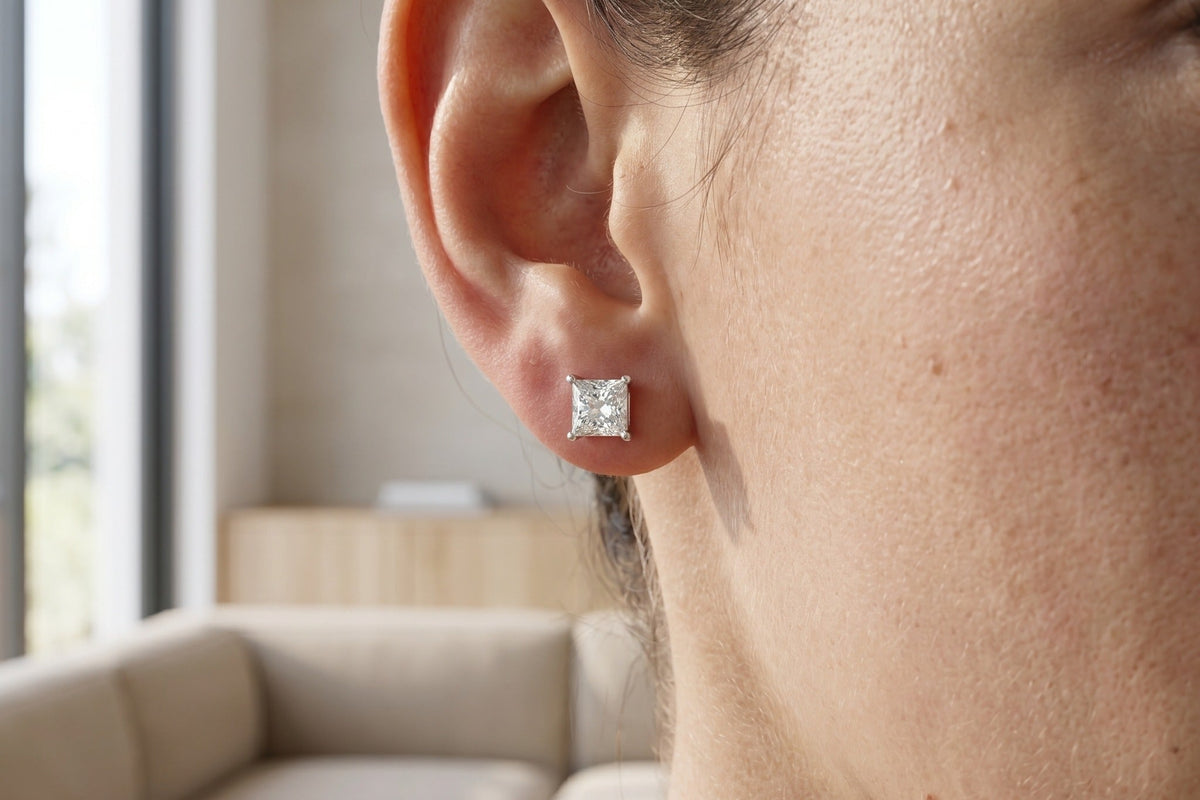
Inside Out Diamond Hoops
A standard hoop sets stones on the outer face only, so it shows plain metal roughly half the time it is being looked at. An inside out hoop sets both faces. That is the whole argument.
Prices read from the Draco catalogue on August 27, 2026, at the 10K gold base. Metal upgrades change the total, with silver 30 percent below and platinum 45 percent above.

What does inside out mean on a hoop?
A conventional diamond hoop sets stones along the outer curve, the surface facing away from your head. That is the face a jeweller photographs and the face you see in a mirror looking straight on.
The difficulty is that hoops do not stay still. They hang from a single piercing and rotate freely, so as you turn your head, talk or walk, the hoop swings and presents its inner face. On a single sided hoop that inner face is bare metal.
An inside out hoop repeats the setting on the inner curve. Both faces carry stones, so there is no orientation in which the earring goes dark. That is a practical design decision rather than a decorative one, and it is the reason the style exists at all.

The cost follows directly from the geometry. Covering both faces of a hoop roughly doubles the number of stones required for a given diameter, which is why an inside out hoop sits above a comparable single sided one at the same size.
What do inside out hoops cost?
| Style | Setting | Price CAD | Per carat CAD |
|---|---|---|---|
| 1ct inside out | Round, both faces | 1,401 | 1,401 |
| 6ctw baguette | Emerald cut, channel | 3,120 | 520 |
| 11ctw oval inside out | Oval, both faces | 3,805 | 346 |
Hoop cost per carat by total weight
Draco catalogue, August 2026, CAD per carat at the 10K base. Lower is better value per carat.
Source: Draco Diamond catalogue, read August 27, 2026.
The 1 carat pair at CAD 1,401 is the everyday option. At that weight the individual stones are small and set close together, so the hoop reads as a continuous bright line rather than as a row of distinct diamonds.
The 11 carat oval pair at CAD 3,805 is a different proposition entirely. Oval stones spread noticeably wider per carat than rounds, and at that weight each stone is clearly legible as its own diamond. On a per carat basis it is the best value in the earring catalogue at about CAD 346.
"The eleven carat pair costs less per carat than the one carat pair by a factor of four. Fixed costs like setting labour and certification do not scale with the size of the stones."
Garrett McMartin, Founder, Draco Diamond
That gap is worth understanding. A finished piece carries costs that have nothing to do with carat weight. Setting labour, the clasp and post assembly, quality control, certification and finishing are broadly fixed whether the hoop holds one carat or eleven. Spreading those across eleven carats instead of one changes the arithmetic dramatically.
The same effect appears across the whole catalogue and is the single most useful thing to understand about diamond pricing at this end of the market. It is why a 5 carat tennis bracelet is better value per carat than a 3 carat one, and why a 15 carat chain beats both. The stones themselves are not getting cheaper. The overhead is being shared out further.
What that means practically is that stretching to the next size up almost always improves the value per carat, and the improvement is steepest at the small end. The move from 1 carat to 6 carats cuts the per carat rate by roughly two thirds. The move from 6 to 11 cuts it by a third again.
How heavy is too heavy for a hoop?
This is the constraint that actually decides most hoop purchases, and it gets discussed far less than it should.
A stud sits flat against the lobe and its weight is supported by the back. A hoop hangs, so the full weight pulls downward through a single piercing. That difference is why a heavy hoop is felt within an hour and a heavy stud is not.
The 1 carat pair is light enough that most people forget they are wearing it. The 11 carat pair is a substantial object and suits shorter wear, occasions, or anyone already accustomed to large earrings.
Metal compounds this. Platinum is the densest option in the catalogue and sterling silver the lightest, so the same design in silver is noticeably more comfortable over a long day than the same design in platinum. For large hoops specifically, the lighter metals are worth considering for comfort rather than only for cost.
There is a longer term consideration too. Sustained weight through a piercing can gradually stretch it. Anyone planning to wear large hoops daily rather than occasionally should factor that in.

Baguette or round, which suits a hoop?
The 6 carat baguette hoop at CAD 3,120 takes a different approach from the inside out styles, and the difference is worth understanding before choosing.
Baguettes are step cut stones, rectangular with long parallel facets running to the girdle. They are set in a continuous channel with almost no metal showing between them, which produces an unbroken band of diamond.
Optically the result is quite different from a round brilliant. Where a round scatters light into fine sparkle from 57 facets, a step cut throws broad flashes off flat planes. On a hoop that reads as an architectural line of light rather than a shimmer, and it moves in longer, slower flashes as the earring turns.
Which is better depends entirely on preference. Round reads brighter and more animated. Baguette reads more restrained and more deliberate. Neither is more valuable at a given carat weight.
One practical difference does matter. Step cuts have open tables that show the interior of the stone, so clarity is more visible than in a brilliant cut. A round brilliant scatters light so thoroughly that small inclusions vanish. An emerald or baguette cut offers no such cover, which is why the clarity floor carries more weight when you choose step cuts. The VS2 and better standard applies across the catalogue, which is what makes step cut settings viable at this price point.
Durability differs slightly too. Baguettes are set in a channel where the metal wraps and protects the edges, which makes them well suited to an earring that will knock against collars, hair and phone screens. Prong set rounds sit more exposed, though on an earring that matters far less than it does on a ring worn on a working hand.

Which metal suits a hoop best?
Hoops have a maintenance advantage over rings that is worth knowing when choosing metal.
White gold is plated with rhodium to achieve its bright white finish, and that plating wears with contact. On a ring worn daily on a working hand, replating may be needed every year or two. Earrings touch almost nothing, so the same plating can last many years.
That makes white gold a more sensible choice on earrings than it is on rings, and it reduces the maintenance argument for paying 45 percent more for platinum.
Against that, platinum is the densest metal offered, and on a hanging earring density is felt directly. For a large hoop, platinum is both the most expensive option and the heaviest to wear, which is an unusual combination of drawbacks.
Sterling silver at 30 percent below the 10K base is worth serious consideration on hoops specifically. It is the lightest option, the cheapest, and the tarnish that counts against it on a ring matters less on an earring that spends its life away from hand creams and washing up.

Which hoop is right for you?
Five questions, in the order that actually narrows the choice.
This settles size before anything else. For daily wear choose 1 to 2 carats total, where the weight is negligible. For occasions the larger pairs become practical, and the per carat value is far better.
Hoops rotate constantly in normal wear. If the earring will be worn actively rather than sitting still, setting both faces is what keeps it bright. A single sided hoop is fine for a photograph and disappointing in a conversation.
Round brilliants scatter light into fine sparkle. Baguettes and step cuts throw broad slow flashes and read architectural. Neither costs more at a given weight, so choose the look.
Platinum is the densest option and hoops hang from the lobe. On large hoops, a lighter metal is more comfortable as well as cheaper. Silver is both the lightest and 30 percent below the base.
Cost per carat falls steeply with size on hoops, from CAD 1,401 per carat at 1 carat to about CAD 346 at 11 carats. If you are comfortable with the weight, the larger pair is dramatically better value per carat.
Every hoop in the range is IGI certified at E to F colour and VS2 or better clarity and is offered in five metals. See the range in the earrings collection.

Inside out hoop FAQ
What are inside out diamond hoop earrings?
Hoops with diamonds set on both the inner and the outer face rather than the outer face alone. Because hoops rotate freely as you move, setting both faces means the earring never presents a bare metal surface.
Are inside out hoops worth the extra cost?
They cost more because covering both faces roughly doubles the stone count for a given hoop size. Whether that is worth it depends on how they will be worn. Hoops move constantly, so a single sided hoop shows plain metal a substantial part of the time it is actually being looked at.
How much do inside out diamond hoops cost?
At Draco a 1 carat total inside out pair is CAD 1,401 and an 11 carat total oval inside out pair is CAD 3,805, both at the 10K gold base. Cost per carat falls sharply with size, from CAD 1,401 per carat at 1 carat to about CAD 346 per carat at 11 carats.
Are large diamond hoops heavy to wear?
Yes, more so than studs of the same weight, because a hoop hangs from the piercing rather than resting against the lobe. A 1 carat pair is comfortable all day. An 11 carat pair suits shorter wear. Choosing a lighter metal such as silver or 10K reduces the load noticeably.
What is the difference between baguette hoops and round diamond hoops?
Baguettes are step cut stones with long parallel facets, channel set with minimal metal between them, producing broad flashes of light. Round brilliants have 57 facets engineered for maximum sparkle. Baguette hoops read architectural, round hoops read bright. Neither costs more at the same carat weight.
Do hoop earrings need rhodium replating?
White gold hoops do eventually, but far less often than rings. Rhodium plating wears through contact, and earrings touch very little compared with a ring worn on a working hand. Platinum never needs replating because it is naturally white.
Which metal is best for diamond hoops?
Sterling silver or 10K gold for large hoops, because both are lighter than platinum and considerably cheaper, and the plating maintenance argument that favours platinum on rings barely applies to earrings. Choose platinum if you want maximum prong security and do not mind the weight.
References
- Draco Diamond catalogue pricing, read August 27, 2026.
- International Gemological Institute, diamond grading standards.
Send us a comparable band and we will beat it almost every time
Same IGI certified specification, direct pricing, up to 64 percent below Blue Nile. Founder reviewed, no obligation, a quote back in one to three business days. Every Draco band is IGI certified, E to F colour, VS2 and better, with 30 day returns, a Lifetime Authenticity Guarantee, free resizing, free insured worldwide shipping to 25 markets, and signature on delivery.