Best Lab Diamond Engagement Rings 2026: Styles, Prices, and Top Picks
The cuts, settings, and real prices that define lab grown engagement rings in 2026, with verified IGI certified picks from $1,501.
The author is the founder of Draco Diamond. Market data is cited from The Knot 2025 Real Weddings Study. Draco prices are in CAD and reflect the published catalog at the time of writing. Every Draco engagement ring is IGI certified, E to F color, VS2 clarity or better, and verifiable at IGI.org.

What couples pay for an engagement ring, 2026
US market averages from The Knot 2025 study, against a Draco 2 carat direct price. Same IGI specifications, a fraction of the spend.
Source: The Knot 2025 Real Weddings Study (overall and lab-grown averages, USD); Draco Diamond catalog (CAD), accessed June 2026.
What a lab diamond engagement ring costs in 2026
The math has changed. The Knot 2025 Real Weddings Study put the average lab grown engagement ring at roughly $4,300 with a 2 carat center stone, while the overall average across all stones was about $5,200. Direct to consumer, the same IGI certified 2 carat stone costs far less. Below is the Draco range by setting, all E to F color, VS2 clarity or better, in 10K to 18K gold, platinum, or silver.
| Setting | Center stone | From (CAD) |
|---|---|---|
| Toi et moi bypass | 1 ct | $1,501 |
| Pear halo | 2 ct | $1,801 |
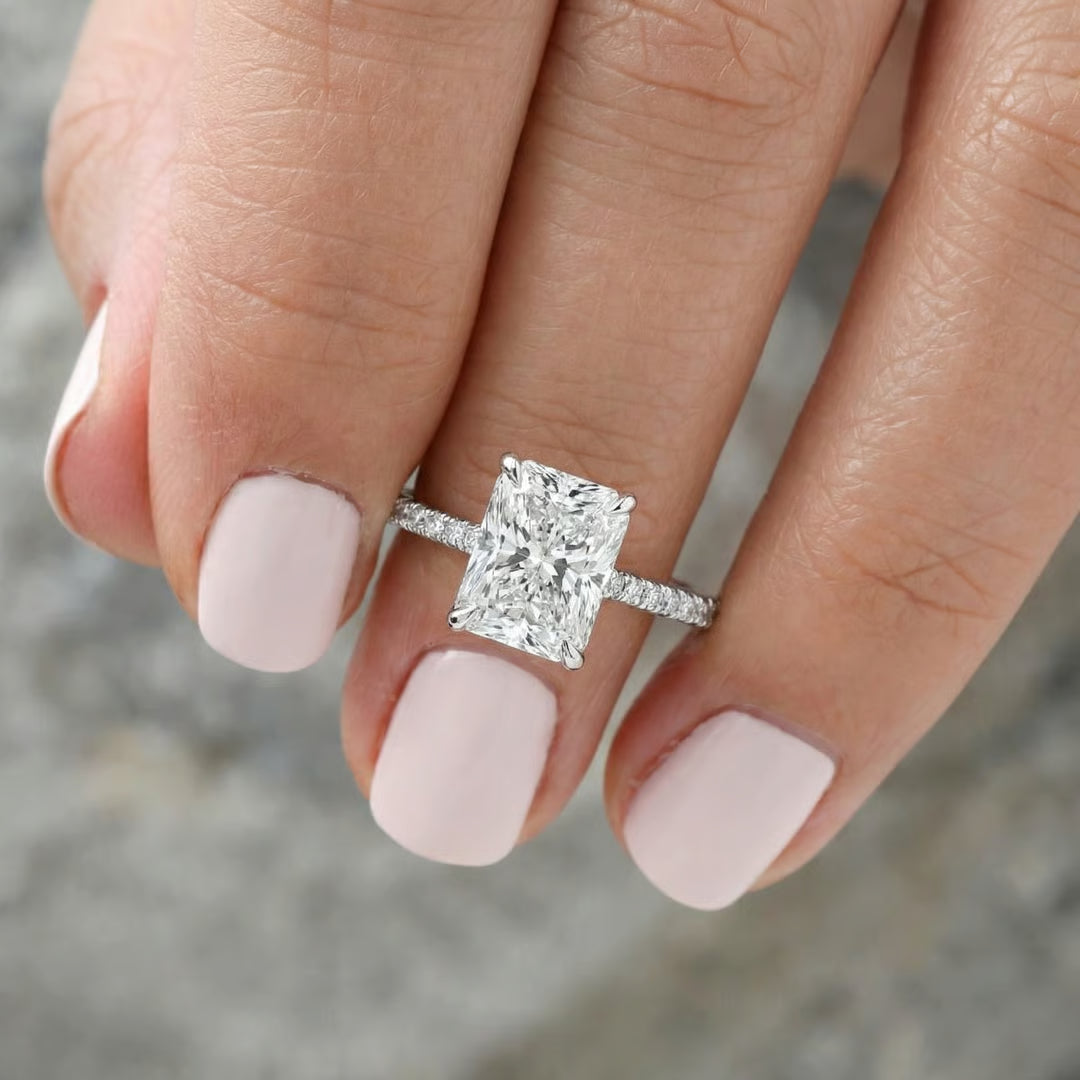
| Radiant solitaire | 2.25 ctw | $1,899 |
| Marquise three quarter | 3.5 ctw | $2,799 |
| Radiant pavé | 5 ct | $3,111 |
Every figure above sits below the $4,300 market average for a lab ring, and the 2 carat pear halo at $1,801 lands roughly 65 percent under it. The certificate quality holds at every price. Browse the full range in women's rings, or design a stone to spec in the ring builder.
"The average couple now buys a 2 carat lab stone. The only open question is what you pay for it."
Garrett McMartin, Founder, Draco Diamond
Choosing the cut that suits the hand
Cut shapes the entire ring. Round brilliant returns the most light and is the safe classic. Oval, the most popular lab shape in 2025, elongates the finger and looks larger per carat. Pear and marquise carry the same elongating effect with more character. Emerald and radiant favor clean architectural lines. Cushion reads soft and vintage. Because lab grown stones cost a fraction of natural, a more demanding cut is affordable at a larger size.

| Cut | Best for |
|---|---|
| Round brilliant | Maximum light return, timeless |
| Oval | Elongates the finger, looks larger per carat |
| Pear | Distinctive, slimming, modern |
| Marquise | Maximum surface area per carat |
| Emerald and radiant | Clean lines, architectural |
The settings that change the ring
A solitaire puts all attention on the center stone. A halo rings the center with pavé to make it read larger and add sparkle. A three stone design marks past, present, and future. A toi et moi pairs two stones in a bypass for couples who want something less conventional. Each changes the look more than a half carat would, and each is available across Draco's collection at IGI certified quality.

If you are deciding between settings, the style quiz narrows it in under a minute, or the ring builder lets you pair any cut with any setting and see the price before you commit.
Draco top picks for 2026
Five engagement rings that cover the range, every one IGI certified, E to F color, VS2 clarity or better. Each links to its live product page with current pricing.
| Ring | Center | From (CAD) |
|---|---|---|
| Toi et Moi Pear Bypass | 1 ct | $1,501 |
| Pear Cut Halo | 2 ct | $1,801 |
| Radiant Cut Solitaire | 2.25 ctw | $1,899 |
| Marquise Engagement Ring | 3.5 ctw | $2,799 |
| 5ct Radiant Pavé | 5 ct | $3,111 |

For the value pick, the pear halo at $1,801 gives a 2 carat presence for less than half the market average. For a statement, the 5 carat radiant pavé delivers a size that natural pricing puts out of reach for most couples. See every option in women's rings.
How to buy an engagement ring online
Lead with the certificate. Every Draco engagement ring is IGI certified and the certificate is included with every order, so the 4Cs are independently verified rather than taken on trust. Confirm color in the E to F range and clarity at VS2 or better, the point where inclusions are not visible to the eye. Match the cut to the hand, then choose the setting. Size is the only variable that needs care at home, and Draco includes free resizing.
Buying online carries no penalty when the terms are right: free insured worldwide shipping to 25 markets with signature on delivery, 30 day returns, and a Lifetime Authenticity Guarantee. If you want to verify the stone independently, the report is available on request. Start in the ring builder or browse finished pieces in women's rings.
Engagement ring FAQ
How do I ensure the quality of an engagement ring?
Lead with the certificate. Confirm the diamond is IGI certified, then check the four grades: cut Excellent or better, color in the E to F range, clarity VS2 or higher, and the carat weight you want. The IGI report number is verifiable free at IGI.org and the certificate is included with every Draco order. Confirm the setting metal and that free resizing, 30 day returns, and a Lifetime Authenticity Guarantee are included.
How much is a lab diamond engagement ring in 2026?
The average lab grown engagement ring sold for about $4,300 with a 2 carat center stone in 2025, per The Knot. Direct to consumer the same IGI certified 2 carat ring starts near $1,801 CAD at Draco, roughly 50 to 70 percent below the natural equivalent.
Are lab grown diamonds good for engagement rings?
Yes. Lab grown diamonds are chemically and optically identical to mined diamonds and graded on the same 4Cs by the same labs. In 2025 they made up 61 percent of US engagement rings, a 239 percent rise since 2020, according to The Knot.
What is the best cut for a lab diamond engagement ring?
Round brilliant returns the most light and is the timeless choice. Oval was the most popular shape in 2025 because it elongates the finger and looks larger per carat. Pear, marquise, emerald, radiant, and cushion each offer a distinct character at the same weight.
How many carats should an engagement ring be?
The average lab grown center stone reached 2 carats in 2025, up from the 1.6 carat average for natural. Because lab pricing is far lower, couples can choose 2 carats or more without the cost a natural stone of that size would carry.
Is it safe to buy an engagement ring online?
It is when the stone is IGI certified and the terms protect you. Draco includes the IGI certificate with every order, offers 30 day returns, free resizing, free insured worldwide shipping with signature on delivery, and a Lifetime Authenticity Guarantee. The certificate is available for independent verification on request.
What does an engagement ring cost compared to a natural diamond?
Lab grown engagement rings cost 50 to 70 percent less than natural for identical specifications, per The Knot. A Draco 2 carat pear halo at $1,801 CAD sits well below the $4,300 average for a lab ring and a fraction of a natural 2 carat ring.
References
- The Knot, average engagement ring cost and 2025 Real Weddings Study, accessed June 2026.
- IDEX Online, "Six out of 10 US Engagement Rings are Lab Grown," reporting The Knot 2025 study (61 percent share, 2 carat average).
- Draco Diamond published catalog, dracodiamond.com. Accessed June 2026. Draco prices CAD.
A 2 carat engagement ring, not the markup
Every ring is IGI certified, E to F color, VS2 clarity or better, in 10K to 18K gold, platinum, or silver. The certificate is included with every order. Free insured worldwide shipping, free resizing, 30 day returns, Lifetime Authenticity Guarantee.