Hidden Halo Rings: What They Actually Do
The hidden halo is the only engagement ring feature designed to be seen by the person wearing it more than by anyone else. That is either the point or the problem.
Prices read from the Draco Diamond catalogue on August 27, 2026, quoted at the 10K gold base in Canadian dollars. Metal percentages read from the Draco product configurator on the same date. Centre stones are IGI certified; the 2 carat round is E colour VVS2 and the 5.1 carat oval is E colour VS1.

What is a hidden halo?
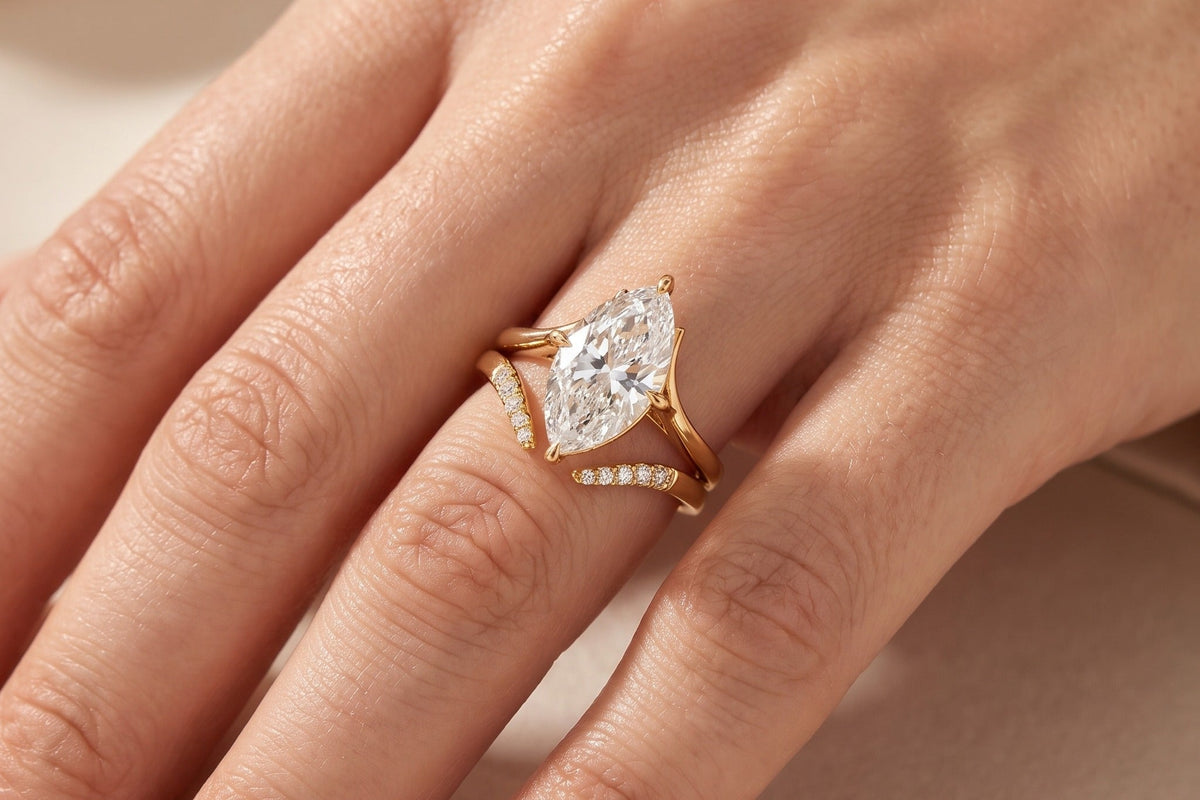
A hidden halo is a ring of small diamonds set underneath the centre stone, in the gap between the stone and the band, facing outward rather than upward.
That single word, outward, is the whole design. A traditional halo surrounds the centre stone in the same plane and faces up at the viewer, which makes the stone read wider. A hidden halo sits below the stone and faces sideways, so it is completely invisible when the ring is photographed from directly above and completely obvious when the ring is seen in profile.

This matters practically because of who sees the ring from which angle. Other people mostly see a ring from above and at a distance. The person wearing it sees it from the side, close, many times a day, while their hand is doing something else. A hidden halo is aimed squarely at that second viewer.
Every listing photograph taken from above is therefore useless for judging one. If a ring is described as having a hidden halo and the images are all top down, you have been shown nothing about the feature you are paying for.
How much does a hidden halo ring cost?
| Ring | Weight | Certification | Price CAD |
|---|---|---|---|
| 2ct round brilliant | 2ct centre | E colour, VVS2 | 1,982 |
| 5.1ct oval | 5.1ct total | E colour, VS1 | 2,753 |
| 5ct radiant | 5.5ct total | IGI certified | 3,345 |
What a hidden halo engagement ring costs
Draco catalogue, 10K gold base, Canadian dollars. Centre stone weight, not the halo, drives the price.
Source: Draco Diamond catalogue, read August 27, 2026.
Three catalogue points. A 2 carat round brilliant is CAD 1,982 at the 10K gold base, certified E colour VVS2. A 5.1 carat total oval is CAD 2,753, certified E colour VS1. A 5 carat radiant at 5.5 carats total is CAD 3,345.
What these show is that the halo is not the expensive part. Between the 2 carat round and the 5.1 carat oval the total weight more than doubles and the price rises by CAD 771, or 39 percent. Centre stone weight and shape drive the number; the accent row is a rounding error against them.
That is worth knowing before you treat the hidden halo as an upgrade to be negotiated. It is a design decision about how the setting is built, not a line item that can be removed to save a meaningful amount.
Hidden halo or traditional halo?
| Setting | Where the stones sit | What you actually see |
|---|---|---|
| Hidden halo | Beneath the centre stone, facing outward | Visible in profile only |
| Traditional halo | Around the centre stone, facing up | Visible from above, adds apparent width |
| Double halo | Two rings around the centre | Maximum apparent size, reads as a cluster |
| No halo | Nothing | The centre stone alone carries the ring |
These solve different problems and are frequently confused, including by people selling them.
A traditional halo makes the centre stone read larger. The accent stones sit in the same plane as the centre and face up, so from above the eye reads the whole cluster as one bright shape. A one carat centre in a traditional halo reads closer to a carat and a half. That is a genuine optical effect and it is the reason halos exist.
A hidden halo does not do this at all. Its stones face outward, so from above they contribute nothing to apparent width. What it gives instead is a setting that is bright from the side rather than a band of plain metal, and a stone that appears to float rather than sit on the shank.
"If the goal is a centre stone that looks bigger from across a table, a hidden halo is the wrong feature. It was never designed to do that."
Garrett McMartin, Founder, Draco Diamond

The honest summary is that a traditional halo is bought for other people and a hidden halo is bought for the wearer. Both are legitimate. Confusing them leads to disappointment, because someone who wanted a bigger looking stone and bought a hidden halo has bought the wrong ring.
What are the trade offs?
A hidden halo occupies the space between the centre stone and the band, which means it has to raise the centre stone to exist. Everything that follows comes from that one fact.
It catches more. A higher setting snags on knitwear, coat pockets and hair. This is not a defect; it is geometry. Anyone who works with their hands or wears a lot of wool should hold one before committing.
It sits less flush against a wedding band. The raised gallery means a straight band may not sit flat against the engagement ring. Contoured bands solve it, but that is a decision being made now rather than later.
It traps more and is harder to clean. Stones set beneath the centre collect what runs down off it, and the space is awkward to reach. A hidden halo needs cleaning more often than a plain gallery to keep the centre stone bright, and a dull centre stone undoes the whole point.
The accent stones may not be certified. The report covers the centre stone. Ask what the accents are and how they are graded, because a materially lower accent quality is invisible on the certificate and visible on the finger.
How do metal and the wedding band interact?
Metal at Draco is a fixed percentage of the 10K gold base on every piece. Sterling silver runs 30 percent below, 14K adds 18 percent, 18K adds 38 percent and platinum adds 45 percent. On the 2 carat round that is CAD 1,387 in silver through to CAD 2,874 in platinum.
Colour costs nothing: white, yellow and rose are the same price at any karat. The relevant trade on an engagement ring is hardness against tone. 10K is the hardest gold alloy and holds up best to daily contact. 18K is richer in colour and marks more easily. White gold is rhodium plated and the plating wears; platinum is naturally white and never needs replating.
The band is the decision most people leave too late. A wedding band will sit directly against this ring for decades, so choose the metal to match what will sit beside it. On a hidden halo specifically, check whether a straight band clears the raised gallery before assuming it will.

How do you choose a hidden halo ring?
A hidden halo is invisible from above. The entire feature lives on the side of the setting, so a photograph taken from the top tells you nothing about whether the ring has one or whether it is well made.
The hidden halo sits between the centre stone and the band, which lifts the stone. A higher stone catches on fabric, knocks against a wedding band and sits less comfortably under gloves. Ask for the profile height rather than assuming.
A hidden halo does not make the centre stone look wider from above, because the stones face outward rather than up. If the goal is a stone that reads larger head on, a traditional halo or simply more carat weight does that job.
The centre stone carries the report. Ask what the accent stones are and how they are graded, because on some rings the accents are a materially lower quality than the centre and nothing on the certificate says so.
Stones set beneath the centre trap more than stones set beside it. A hidden halo needs cleaning more often to keep the centre stone bright, and the setting is harder to reach.
The wedding band sits directly against this ring. Choose the metal to match what will sit beside it, then price it, rather than the other way round.
Every Draco centre stone is IGI certified and ships with its certificate; the report can be provided on request before purchase and verified free at IGI.org. Every ring carries 30 day returns, the Lifetime Authenticity Guarantee, free resizing, and free insured worldwide shipping to 25 markets with signature on delivery.
Nothing is held in finished inventory, so a setting outside the catalogue is a change of specification rather than a bespoke surcharge. Browse the ring collection, start a commission at create your piece, or send a competing quote and Draco will price directly against it.

Hidden halo FAQ
What is a hidden halo on an engagement ring?
A hidden halo is a ring of small diamonds set underneath the centre stone, in the space between the stone and the band, facing outward. It is visible when the ring is seen from the side and invisible when the ring is seen from directly above, which is the reverse of a traditional halo.
Does a hidden halo make the centre stone look bigger?
No, not from above. The accent stones face outward rather than upward, so they add nothing to apparent width when the ring is viewed head on. A traditional halo is the setting that makes a centre stone read larger; a hidden halo fills the profile of the setting with light instead.
How much does a hidden halo engagement ring cost?
At Draco a 2 carat round brilliant hidden halo ring is CAD 1,982 at the 10K gold base, a 5.1 carat total oval is CAD 2,753 and a 5 carat radiant at 5.5 carats total is CAD 3,345. Centre stone weight and shape drive these prices far more than the halo does.
What are the downsides of a hidden halo?
It raises the centre stone, which means the ring catches on fabric more, sits less flush against a straight wedding band, and traps more so it needs cleaning more often. The accent stones are also usually not covered by the centre stone's certificate, so their quality is worth asking about.
Will a wedding band sit flat against a hidden halo ring?
Not always. The hidden halo raises the gallery, so a straight band may not sit flush. A contoured band solves it, but the fit is worth checking before purchase rather than after, since it affects which bands are available to you later.
How do you judge a hidden halo before buying?
From the side. Every photograph taken from directly above shows nothing of the feature, so listings that only show top down images have not shown you what you are paying for. Ask for a profile image and check the setting height while you are at it.
What does each metal add to a hidden halo ring?
Metal is a fixed percentage of the 10K gold base. Sterling silver runs 30 percent below, 14K adds 18 percent, 18K adds 38 percent and platinum adds 45 percent. On the 2 carat round that is CAD 1,387 in silver through to CAD 2,874 in platinum.
References
- Draco Diamond catalogue pricing, read August 27, 2026.
- International Gemological Institute, diamond grading standards.
Send us a comparable band and we will beat it almost every time
Same IGI certified specification, direct pricing, up to 64 percent below Blue Nile. Founder reviewed, no obligation, a quote back in one to three business days. Every Draco band is IGI certified, E to F colour, VS2 and better, with 30 day returns, a Lifetime Authenticity Guarantee, free resizing, free insured worldwide shipping to 25 markets, and signature on delivery.