Will Lab Diamond Prices Keep Falling? Wholesale Has Stopped. Retail Has Not.
The fall that defined lab grown diamonds for seven years has stopped at wholesale. It has not stopped in the shop window. Here is what that means for when to buy.
The author is the founder of Draco Diamond. Wholesale data is Edahn Golan Diamond Research's, retail averages StoneAlgo's and bridal share The Knot's, via JCK. Figures are in US dollars unless marked CAD, checked October 13, 2026. No forecast is quoted, because none can be verified.

Wholesale has stopped falling
Lab grown wholesale prices stopped falling in 2026. After a 26 percent drop across 2025, one to three carat rounds rose about 2 percent in the third quarter of 2026. The research house that tracks them asked in its own headline whether the bottom had been reached.
The rise was uneven. One carat rounds gained 1.3 percent, two carat rounds 2.3 percent and three carat rounds 7.5 percent, while one and a half carat stones slipped 3 percent.1
The turn came slowly. The last quarter of 2025 had already produced the smallest quarterly drop since lab grown diamonds reached the market, 4.7 percent.3
The index tells the same calmer story. It sits 10 percent below a year ago, against 92 percent below where tracking began in July 2018.1 Most of the fall is history.
Why would the floor hold?
Three forces are holding the floor: growers have stopped cutting rough prices, the largest manufacturers control more of the chain, and demand is still climbing. Each one shows up in the 2026 data.
Growers are holding rough prices steady and in some cases raising them. Larger manufacturers now run more of the process, from growing to setting, which gives them more control over production.1
Earlier signs pointed the same way. When rough costs reached about $10 per carat, HPHT factories in China stopped cutting their prices, and prices for those goods rose 10 to 20 percent in 2025.3
Demand is the third leg. US unit sales of lab grown set jewellery rose 25 percent in September and close to 23 percent so far this year.1 In bridal, 61 percent of 2025 engagement rings had lab grown centre stones, up 239 percent since 2020.4
Growth method splits the market too. Most stones of two carats and above are CVD grown, while smaller goods come from both CVD and HPHT, and HPHT stones typically trade at a discount.3 A floor for one method is not automatically a floor for the other.
| Force | Evidence | Direction |
|---|---|---|
| Rough prices | Growers holding prices steady, some raising them | Holds the floor |
| Consolidation | Large manufacturers run more of the chain | Holds the floor |
| US demand | Lab grown set jewellery units up 25% in September | Holds the floor |
| Bridal share | 61% of 2025 engagement rings had lab grown centres | Holds the floor |
| Retail competition | One carat asking prices down 19% in three months | Pushes down |

Retail has not found its floor
The shop window is still falling. StoneAlgo's average one carat asking price fell 19.4 percent in the three months to October 13, 2026, and its two carat average fell by almost exactly the same amount.
Larger stones followed at a slower pace. Three carat averages fell 11.4 percent in three months and five carat averages 15.1 percent. Over six months the one carat average is down 23.4 percent.5
The fastest cuts are where the most stones are listed. StoneAlgo tracks about 387,000 one carat prices against about 101,000 at five carats, and over six months three carat averages fell only 5.7 percent while one carat averages fell 23.4 percent.
Retail can keep falling while wholesale rises because it starts so much higher. High grade loose stones list at $800 to $900 per carat, against about $80 at wholesale.2 That gap is margin, and margin is what retailers are now cutting.
"Wholesale found a floor near $80 a carat. Retail still sits near $500. The next price cut comes out of the margin, not the stone."
Garrett McMartin, Founder, Draco Diamond
What could push prices down again?
A demand slowdown or a wave of new capacity could push wholesale down again. The third quarter rise was about 2 percent, small enough to reverse in a single quarter, and one and a half carat stones were already down 3 percent.
Retail has its own pressure. Average asking prices fell at every size StoneAlgo tracks, which points to retailers competing on price for the same buyers.
No published forecast for 2027 can be verified, so none is quoted here. The data supports a narrower claim. The seven year collapse is over at wholesale, and retail is closing the gap from above.

Buy now or wait: the decision in 2026
Waiting three months saved about $122 on an average one carat stone this year. Choosing a different grade can move the price by $600 per carat. Buy when the occasion arrives, and spend the effort on the comparison instead.
| Situation | What the data suggests | Action |
|---|---|---|
| A proposal or gift date is set | Quarterly moves are small next to grade and shop gaps | Buy now |
| No date, fully flexible | Retail may keep drifting lower | Watch quarterly |
| Three carats and up | Wholesale rose most here, 7.5% in Q3 | Do not wait |
| Two quotes in hand | Grade alone can move $600 per carat | Match grades first |
Put the two levers side by side. Waiting three months saved about $122 on the average one carat asking price this year. Moving from a lower grade at $250 per carat to a high grade at $800 changes the same carat by $550. The grade is the bigger decision, by more than four times.
Waiting against choosing, one carat
US dollars. What three months of waiting saved on an average one carat stone in 2026, against the gap between a lower and a high grade.
Sources: StoneAlgo one carat average asking price, three months to October 13, 2026; Edahn Golan Diamond Research retail ranges, 2026. Arithmetic: Draco Diamond.
Large stones are the clearest case. Three carat rounds rose 7.5 percent at wholesale in the third quarter, the most of any size, so waiting for a bigger stone to get cheaper is the weakest bet on the board.
Small and medium stones are a closer call. Retail averages are still falling, so a flexible buyer with no date can watch one more quarter. A buyer with a date should not.
The setting does not move with the market at all. On Draco rings and bracelets, 14K gold adds a fixed 18 percent to the 10K base and platinum 45 percent, whatever the diamond price list does.
Draco's prices in a flat market
At Draco, a carat of lab grown diamond set in 10K gold costs CAD 433 to CAD 844 depending on the piece. That is about US$304 to US$593 at the Bank of Canada rate of October 13, 2026, with the metal and the setting included.
The lower figures come from pieces made of many small stones, such as the 5 carat round tennis bracelet at CAD 2,920 and the 2 carat studs at CAD 999. The higher figures come from pieces built on one large stone.7

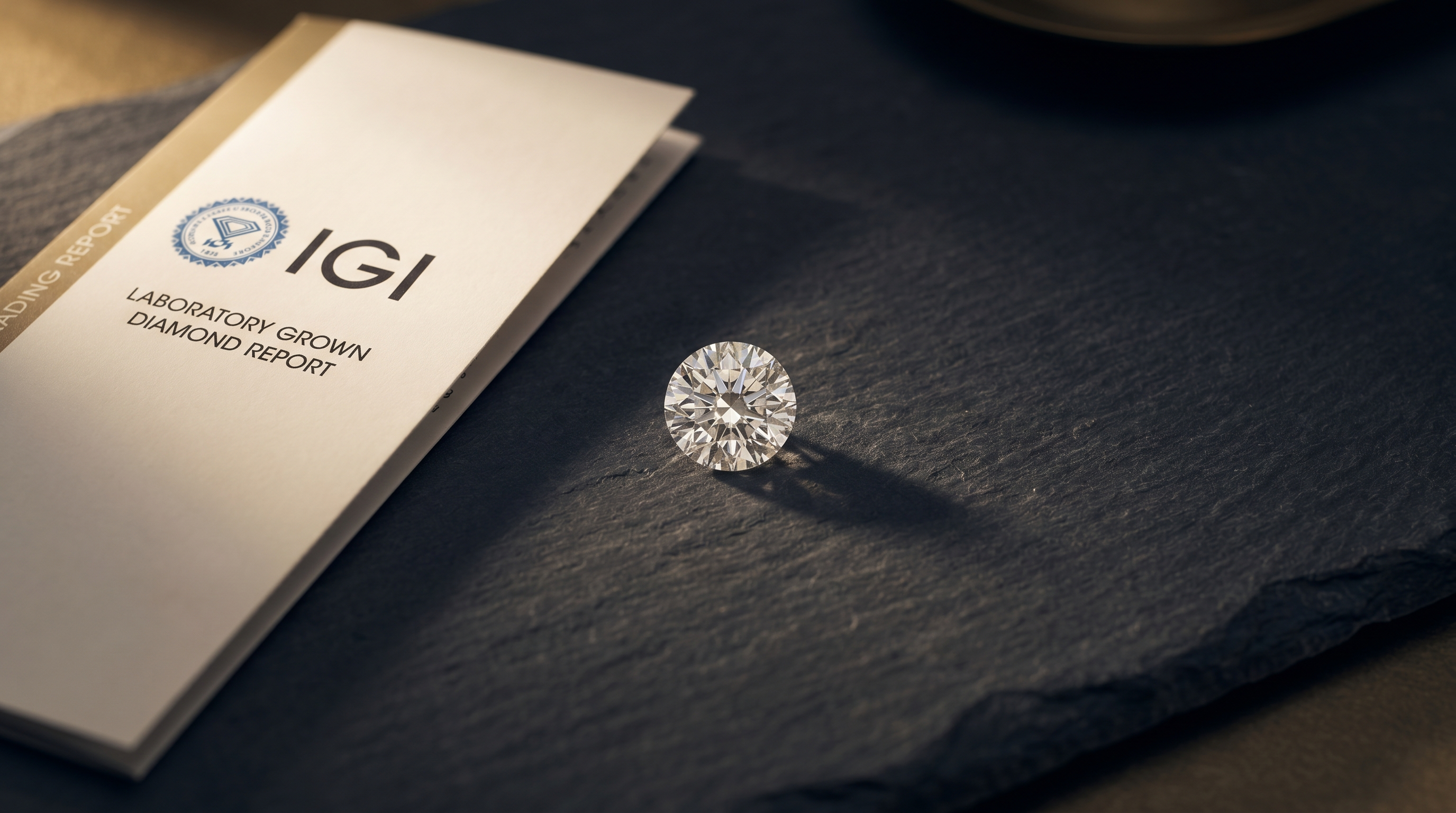
Each piece is IGI certified and ships with its report, which can be provided on request before purchase and verified free at IGI.org. See the 3 carat tennis bracelet at CAD 2,201 and the 5.1 carat oval engagement ring at CAD 2,753, or browse the full collection.

How to decide when to buy a lab diamond
Decide when to buy a lab diamond in five steps: start from the date, choose the grade, compare against today's average, read any markdown carefully and know what the return window covers.
If a proposal, wedding or gift date is fixed, the quarterly trend is noise. Work back from the date and leave time for the setting to be made.
Decide on colour and clarity first. In 2026 the grade you choose moves the price far more than a quarter of waiting does.
The average one carat asking price was $508 on October 13, 2026. A quote well above it should come with a reason: a higher grade, a better cut or a heavier setting.
A large cut can mean a retailer is clearing stock bought at higher wholesale prices. Ask when the stone was graded and compare the report, not the discount.
A return window protects a change of mind, not a later price drop. Draco offers 30 day returns, with the buyer paying return shipping.
Every Draco piece carries 30 day returns, the Lifetime Authenticity Guarantee, free resizing, and free insured worldwide shipping to 25 markets, delivered duty paid with nothing collected at the door, and signature on delivery. Start a commission at create your piece.
For the full price history, see the lab diamond price trend report. For what a carat costs at each layer, the price per carat report.
The floor, answered
Will lab diamond prices keep falling?
At wholesale, not for now. One to three carat rounds rose about 2 percent in the third quarter of 2026 after a 26 percent fall in 2025. At retail, yes: the average one carat asking price fell about 19 percent in the three months to October 13, 2026.
Have lab grown diamond prices hit bottom?
At wholesale they may have. The quarterly drops shrank to 4.7 percent in the last quarter of 2025, then turned into a rise of about 2 percent in the third quarter of 2026. Retail prices have not hit bottom; they sit far above wholesale and are still falling.
Should I wait to buy a lab grown diamond?
Only if you have no date. Waiting three months saved about $122 on an average one carat stone this year, while a change of grade can move the price by $600 per carat. Large stones rose most at wholesale, so waiting for those is the weakest bet.
Why have lab grown diamond prices stopped falling at wholesale?
Growers are holding rough prices steady and in some cases raising them, larger manufacturers control more of the chain, and demand keeps rising. US unit sales of lab grown set jewellery rose 25 percent in September 2026.
What share of engagement rings are lab grown?
61 percent of engagement rings bought in 2025 had lab grown centre stones, up 239 percent since 2020, according to The Knot's Real Weddings Study 2026 as reported by JCK.
Do larger lab grown diamonds hold their price better?
In 2026, somewhat. At wholesale, three carat rounds rose 7.5 percent in the third quarter, the most of any size. At retail, three carat averages fell 11.4 percent in three months, against 19.4 percent for one carat stones.
Are lab grown diamonds a good investment?
No. Buy one to wear, not to sell. Wholesale prices fell about 97 percent between 2018 and 2026, and even with the 2026 floor there is no evidence of rising resale values.
References
- Edahn Golan Diamond Research, Was the Bottom Reached? Lab-Grown Wholesale Prices Rise in Q3 2026, October 7, 2026.
- Edahn Golan Diamond Research, Lab-Grown Diamond Statistics: Background, Trends, Prices (updated August 2026), accessed October 13, 2026.
- Edahn Golan Diamond Research, Lab-Grown Diamond Wholesale Prices Down 26% in 2025, Signs of Stabilization Emerge, accessed October 13, 2026.
- JCK, Lab-Grown Diamonds Take Command of the Engagement Ring Market (The Knot Real Weddings Study 2026), February 25, 2026.
- StoneAlgo, Lab grown diamond price indexes, 1, 2, 3 and 5 carat, accessed October 13, 2026.
- Bank of Canada, Daily exchange rates, US dollar to Canadian dollar, October 13, 2026.
- Draco Diamond, Draco Diamond catalogue, live prices, October 13, 2026.
Send us a comparable band and we will beat it almost every time
Same IGI certified specification, direct pricing, about half the listed price of Blue Nile and Brilliant Earth on bridal sets (55 percent below at the median, October 2026). Founder reviewed, no obligation, a quote back in one to three business days. Every Draco band is IGI certified, E to F colour, VS2 and better, with 30 day returns, a Lifetime Authenticity Guarantee, free resizing, free insured worldwide shipping to 25 markets, and signature on delivery.