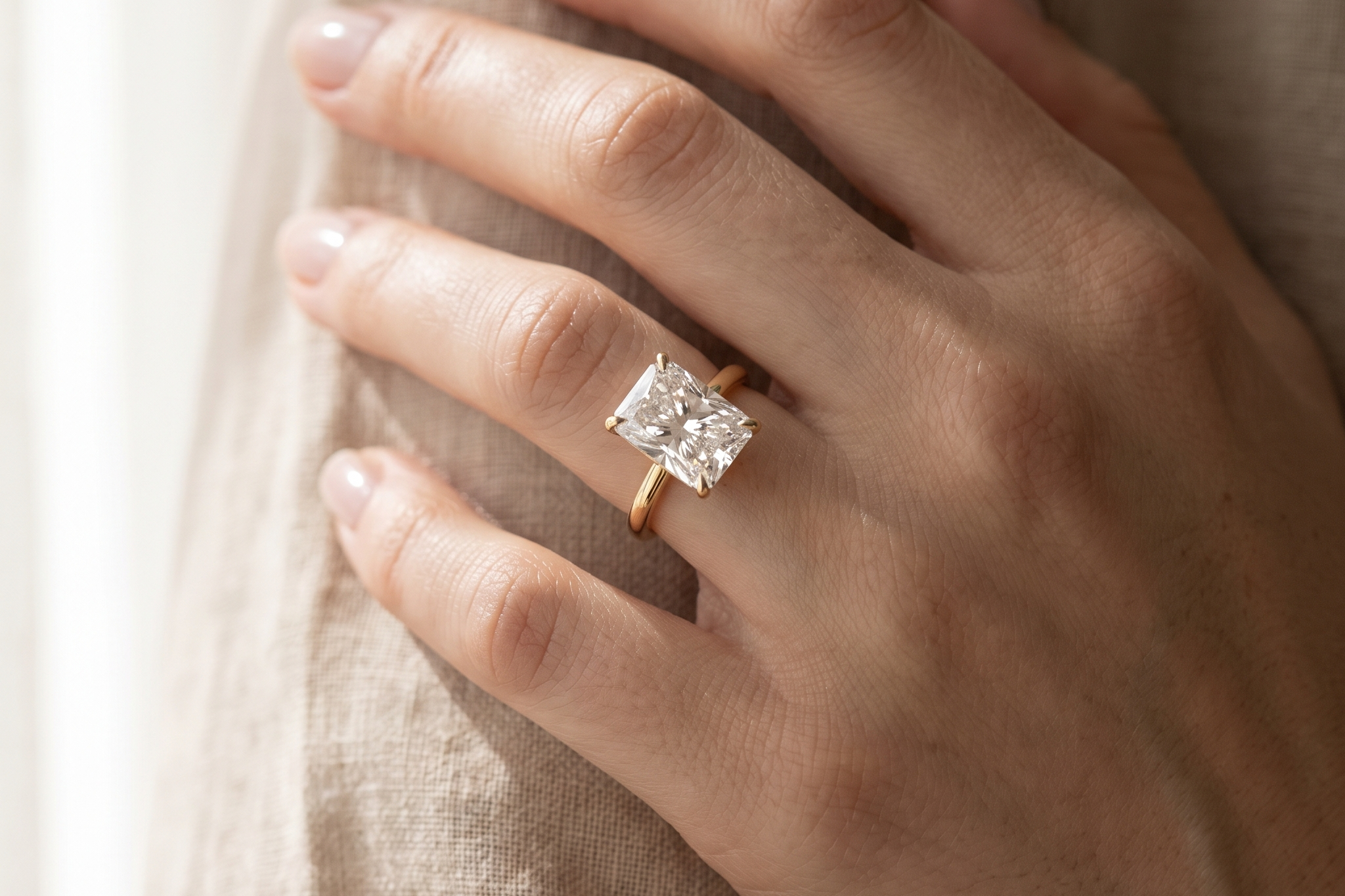
The Lab Grown Diamond Money Saving Checklist: 9 Checks Before You Pay
Nine verifiable actions, in order, each with a condition that passes or fails. Run them on any seller before payment goes through.
The author is the founder of Draco Diamond. This is the action list; the reasoning sits in the full guide on how to avoid overpaying for a lab grown diamond. Loose stone averages in USD.

What do you verify before you pay?
Three checks establish what you are buying. Each is free and takes under three minutes. Run them before you look at the price. A price attached to an unverified stone is not information.
Ask for the report number of the exact stone in the listing. Pass: an IGI or GIA number is supplied and the laboratory is named. Fail: the word certified with no laboratory and no number, or a number for a representative stone rather than yours.
Enter it at IGI.org or GIA.edu yourself. A screenshot or PDF from the seller is not proof. Pass: the report loads and carat, measurements, color, clarity, and cut match the listing exactly. Fail: nothing loads, or any field differs. Field by field reading is covered in the IGI certificate guide.
Cut governs light return and has no substitute. Pass: Excellent or Ideal on a round brilliant, stated on the report. Fail: the cut grade is missing, or answered with an adjective instead of a grade.

"A checklist is not a negotiating position. Every item on it is verifiable by you, for free. That is what makes it worth running."
Garrett McMartin, Founder, Draco Diamond
How do you price the stone apart from the setting?
A finished piece is three separate costs presented as one number. Split them and sellers become comparable even when the settings differ.
Ask for the stone price and the setting price as two figures. Pass: the seller separates them. Fail: the piece is priced only as a whole, or the split changes each time you ask.
Set the stone figure alone against the published averages below. Pass: it sits within a recognizable multiple of the average for its weight. Fail: it is several times the average and the seller cannot say what the difference buys.
| Component | What it is | How you verify it |
|---|---|---|
| The stone | The certified lab grown diamond itself | Report number checked at IGI.org, then benchmarked against published averages |
| The metal | Precious metal by weight and karat | Karat and gram weight against the published spot rate that day |
| The labor | Setting, prong work, finishing | Complexity and prong count, quoted as its own line |
| The remainder | Everything left after the three above | The retail structure. This is the number the checklist exists to find |
Published loose stone averages, May 2026
The benchmark for check 05. A finished piece adds metal and labor on top.
Source: StoneAlgo loose lab grown diamond price averages, May 2026. Year over year decline of 2.59 percent.

Which claims do you refuse to pay for?
Two checks remove the cost that attaches to language rather than the stone.
Super ideal, premium select, signature, and hearts and arrows are descriptions, not grades. Pass: every claim maps to a field on the report. Fail: a term carries a premium and appears nowhere on the certificate.
Round weights carry a premium the eye does not collect. Pass: the quote has been compared against the same specification just under the round number, 1.90ct against 2.00ct. Fail: the round number was paid without pricing the alternative.

What do you confirm about the channel and the terms?
The last two checks cover who you are buying from and what happens if you change your mind.
A published catalog is the practical test of a direct channel. Pass: prices and full specifications appear on the site without an inquiry. Fail: price on request, or specifications supplied only after a deposit. Compare against the full Draco catalog.
Read the policy page, not the summary in the chat window. Pass: at least 30 days, full refund, no restocking fee, a written authenticity guarantee, and return shipping responsibility stated plainly. Fail: a restocking fee, a window under 14 days, or store credit only.

What does the checklist look like applied?
A 2ct round brilliant, IGI certified, F color, VS2, Excellent cut, quoted as a finished ring at one price.
Checks 01 to 03. The report number loads at IGI.org, every field matches, cut grade reads Excellent. Pass.
Check 04. The seller splits the quote into a stone figure and a setting figure. Pass. A seller who refuses has already failed, and no later check recovers it.
Check 05. The stone figure is set against the 1,265 USD published average for a loose 2ct, per StoneAlgo, May 2026. A finished piece always costs more than the loose average. The check is whether the seller can name what the gap buys.
Checks 06 to 09. The listing calls the stone premium; the report says F and VS2, so the adjective leaves the valuation. The 1.90ct is priced before 2.00ct is accepted. Prices are published and the returns page states 30 days, full refund, no restocking fee. Pass.
Nine checks, fifteen minutes, no expertise required. For why each one moves the price, read the guide on avoiding overpayment or the current price per carat data.
Checklist FAQ
What is the quickest money saving checklist for lab grown diamonds?
Nine checks: get the report number, load it yourself at IGI.org, confirm the cut grade, request itemized stone and setting pricing, benchmark the loose stone against published averages such as StoneAlgo's 564 USD at 1ct and 1,265 USD at 2ct for May 2026, translate every marketing adjective into a grade, price the carat weight honestly, confirm prices are published openly, and get the return terms in writing. Any failed check is a reason to stop.
Which check on the list matters most?
Check 02, loading the report number yourself on the laboratory database. Every check after it depends on the stone being what the listing says. A screenshot from the seller is not verification, and the lookup is free.
How do I separate the diamond cost from the setting cost?
Ask for two figures rather than one total. A finished piece is the stone, the metal by karat and gram weight, and the setting labor. Once the stone figure stands alone it can be compared against published averages and against other sellers, even when the settings differ.
What should I do if a seller refuses to itemize the price?
Treat it as a failed check and stop. Itemization is not commercially sensitive, and a refusal removes your only means of comparing that quote to any other.
How long does the full checklist take to run?
Roughly fifteen minutes. The lookup takes under three minutes, itemization and benchmarking are one message and one comparison, and the channel and returns checks are two pages on the seller's site.
Does this checklist work for natural diamonds as well?
The verification, itemization, channel, and returns checks apply identically. Check 05 does not, because the averages quoted here are lab grown figures. Benchmark natural stones against natural price data.
References
- StoneAlgo. Loose lab grown diamond price averages, May 2026: 564 USD at 1ct, 1,265 USD at 2ct, 1,865 USD at 3ct, 2,588 USD at 5ct; year over year decline 2.59 percent. Accessed July 22, 2026.
- International Gemological Institute. Verify Your Report tool and grading standards. IGI.org. Accessed July 22, 2026.
- Gemological Institute of America. Lab grown diamond report nomenclature change effective October 1, 2025. GIA.edu.
- Draco Diamond published catalog and grading standard, dracodiamond.com. Accessed July 22, 2026.
Published prices, published specifications
Every Draco diamond is IGI certified, E to F color, VS2 and better, with the report number verifiable free at IGI.org. The report can be provided on request before purchase. 30 day returns, Lifetime Authenticity Guarantee, free ring resizing, free insured worldwide shipping to 25 markets, signature on delivery, IGI certified E to F color VS2 and better. Rated 4.8 out of 5 across 865 verified reviews.