7 Signs You Are Overpaying for a Lab Diamond
A loose 1ct lab grown diamond averaged 564 USD in May 2026, per StoneAlgo. Identical IGI certified specs still sell 1.5x to 4.1x apart at retail. Seven red flags that tell you a quote is padded, and the one line fix for each.
The author is the founder of Draco Diamond, a direct to consumer lab grown diamond brand, and has a commercial interest in the pricing structures described. Every figure is cited to a named source so readers can verify independently. Loose stone averages are from StoneAlgo, May 2026, in USD. Wholesale data is from Edahn Golan Diamond Research.

You are paying for fluorescence you cannot see
Fluorescence is how a diamond reacts under ultraviolet light. On most lab grown stones it is faint or absent, and where it exists it rarely changes how the diamond looks in daylight. A seller who frames a fluorescence grade as a reason to charge more, or as proof of a superior stone, is pricing a property you will never notice face up.
The same applies to a faint blue, brown, or gray undertone. Both can sit inside a single colour grade without appearing on the headline of the report. They are worth asking about, because they affect how a stone faces up. They are not worth a premium. A seller working from the stone answers in one sentence. A seller working from the tag turns the answer into a sales point.
The fix: ask whether the fluorescence is visible in normal light. If the honest answer is no, it is not a price factor. Pay for what you can see.

The setting cost is inflated against the stone
A finished piece has three real costs on top of the diamond: precious metal, bench labour, and any melee. Metal scales with weight and the daily market. Labour is a fixed bench cost. Neither scales with the carat weight of the centre stone. When a setting is quoted as a multiple of the stone rather than as metal plus labour, the number has stopped describing the work and started describing the retail model.
This is where a large share of the 1.5x to 4.1x spread lives. Two jewellers can set the identical IGI certified stone in the identical metal and quote setting costs that differ by hundreds of dollars. The bench work did not change. The markup did.
The fix: ask for the setting priced separately, as metal and labour. A seller who can itemise it is pricing the work. A seller who cannot is pricing you.

A rare claim sits on a commodity spec
Words like rare, investment grade, or one of a kind attached to an E to F colour, VS2 clarity round brilliant are a contradiction. That specification is the most produced grade band in the market. When GIA stopped applying 4Cs nomenclature to lab grown diamonds on October 1, 2025, it stated that more than 95 percent of lab stones fall within one narrow colour and clarity band. Consistency is the point of the technology. It is also the opposite of rarity.
Rarity language borrows the pricing logic of natural diamonds, where scarcity was the story, and applies it to a category where it no longer holds. Wholesale lab grown prices fell roughly 74 percent between 2020 and 2025, per Edahn Golan Diamond Research, precisely because supply is abundant and consistent.
The fix: treat rarity language on a standard spec as a markup, not a feature. The stone is excellent. It is not scarce.

No per carat comparison is offered
A fair seller is comfortable with arithmetic. Divide the stone price by the carat weight and set it against published loose averages: 564 USD at 1ct, 1,265 USD at 2ct, 1,865 USD at 3ct, and 2,588 USD at 5ct, per StoneAlgo, May 2026. A finished piece adds metal and labour on top of that anchor. A price that sits at several multiples of it, with no explanation, is the sign.
Notice that the per carat rate barely rises with size. The exponential price curve that governed natural diamonds does not apply to lab grown. A steep per carat premium quoted for a larger stone is natural diamond logic imported into a market where it is obsolete.
The fair price anchor, May 2026
Average loose lab grown diamond prices in USD, per StoneAlgo. The 2020 per carat average is shown for scale.
Source: StoneAlgo loose lab grown diamond averages, May 2026, USD. 2020 anchor: 1ct averaged 3,410 USD per carat.
The fix: do the division yourself and ask the seller to account for the distance. The full mechanics are in the lab grown diamond price per carat report, and budget by piece type in how much you should pay for a lab diamond in 2026.
"The stone is the cheapest part of the transaction. Every one of these seven signs is a way of charging you for something other than the diamond."
Garrett McMartin, Founder, Draco Diamond
The pitch runs on urgency and pressure
Countdown timers, a price that is good today only, a permanent sale that never ends, and a nudge to decide before you have compared anything are all the same move. They substitute pressure for numbers. A fair anchor does not expire. The loose averages are published, the wholesale range is public, and the certificate is free to verify. None of that changes if you take a day to check it.
Real scarcity exists, and it reads differently. A genuine limited run states a specific count. Manufactured urgency states a clock. If the reason to buy now is the clock rather than the piece, the clock is the product.
The fix: step away from any timer and verify the specification at your own pace. A price that only works under pressure was never the fair price.
The grading lab is undisclosed
Certified is not a grade. It is a claim that means nothing until a laboratory is named and a report number is given. A stone described as certified with no lab, an in house certificate, or a report the seller will not let you look up is the clearest sign on this list. It removes the one document that proves what you are buying.
Insist on an IGI or GIA report and verify the number yourself. Every IGI report is checkable free on the public database at IGI.org. A certified piece ships with its certificate, the report can be provided on request before purchase, and it is verified free at IGI.org. How to read every field, and compare two reports against each other, is covered in the IGI certificate guide.
The fix: no verifiable report number, no purchase. Verify first, then compare the identical spec across at least two sellers, then discuss price.
Melee and side stones carry a hidden markup
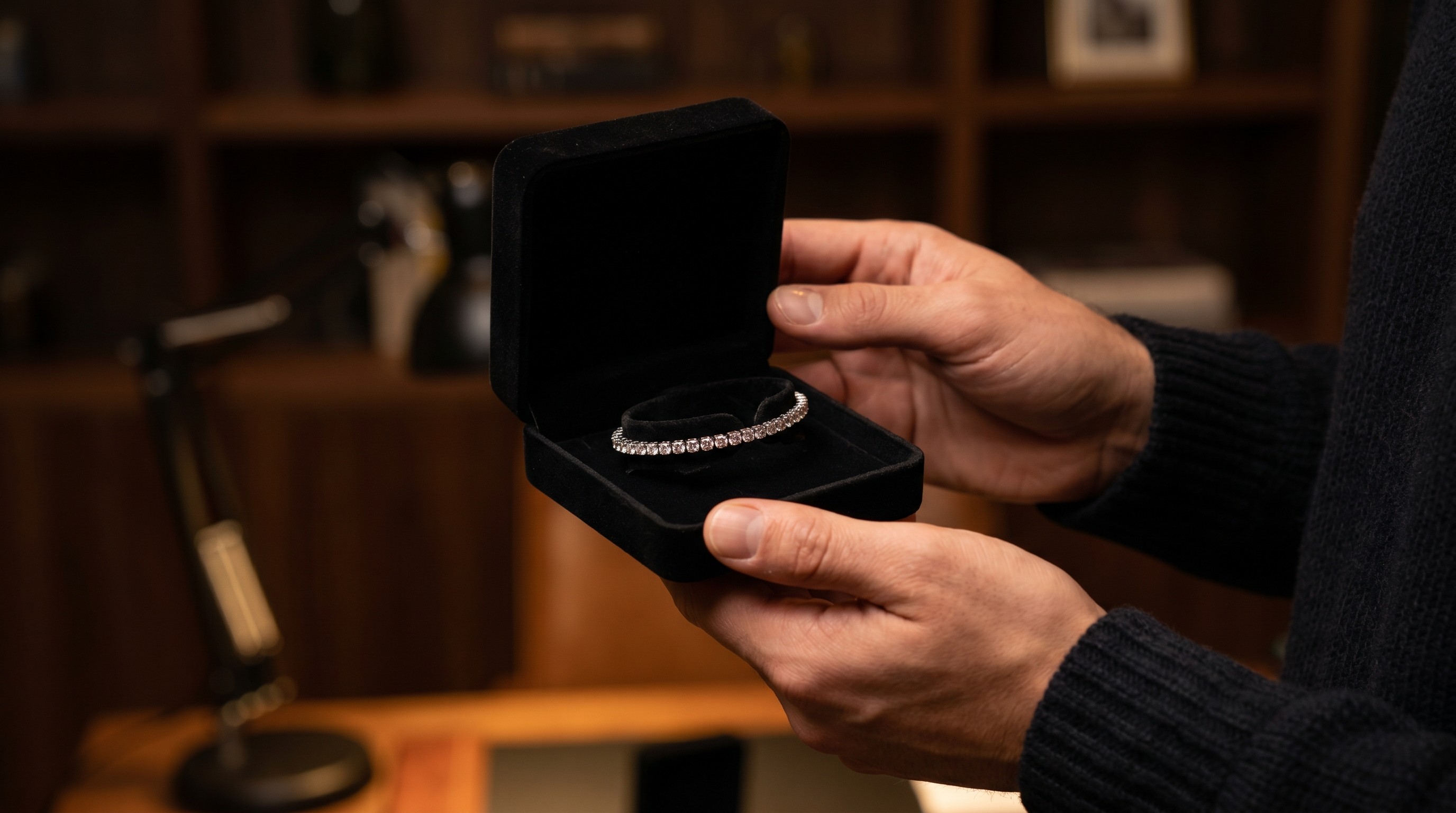
Melee are the small stones in a halo, a pave band, or the links of a tennis bracelet. Per carat, they are inexpensive, far below the centre stone rate. A halo or pave setting should add a modest, itemisable cost. When side stones are priced as if each were a small centre stone, the total quietly inflates behind a design that looks generous.
This is the setting markup wearing a different outfit. It is common precisely because most buyers do not ask what the accent stones cost, only what the piece costs. The generosity of the sparkle becomes cover for the padding.
The fix: ask what the melee weight and cost are, separately from the centre stone. A seller pricing from the stones itemises it. A seller pricing from the tag calls it included.

| Red flag | What fair looks like |
|---|---|
| Premium for fluorescence | No charge for a property invisible in daylight |
| Setting priced off the stone | Metal plus bench labour, itemised |
| Rare on an E to F, VS2 spec | An excellent, abundant, consistent grade |
| No per carat comparison | Price divided by carat, set against 564 USD at 1ct |
| Urgency and timers | Published anchors that do not expire |
| Undisclosed lab | IGI or GIA report number, verified at IGI.org |
| Melee priced as centre stones | Side stone weight and cost, itemised |
Draco publishes its position so it can be checked, not taken on faith. Every piece is IGI certified, E to F colour, VS2 clarity and better, priced direct, up to 64 percent below Blue Nile and 52 percent below James Allen on comparable specs. The trust stack is the same on every piece: 30 day returns, Lifetime Authenticity Guarantee, free ring resizing, free insured worldwide shipping to 25 markets, signature on delivery, IGI certified E to F colour VS2 and better. Customer rating is 4.8 out of 5 across 866 verified reviews. The broader method, and what drives the spread, is in the guide to avoiding overpaying and the retail markup report.
Overpaying on a lab diamond FAQ
Am I paying too much for a lab diamond?
Check the quote against seven signs: a premium for fluorescence you cannot see, an inflated setting cost, a rarity claim on commodity specs, no per carat comparison, urgency or pressure, an undisclosed grading lab, and a markup on melee or side stones. Anchor the stone against published loose averages, 564 USD at 1ct, per StoneAlgo, May 2026, and remember that identical IGI certified specs sell 1.5x to 4.1x apart at retail, per the Draco Retail Markup Report. If several signs are present, the quote is padded.
What is a fair price for a 1 carat lab grown diamond in 2026?
A loose 1ct lab grown diamond averaged 564 USD in May 2026, per StoneAlgo, down from 3,410 USD per carat in 2020. A finished piece adds precious metal and bench labour on top of the stone. Use the loose average as the anchor and ask any seller to account for the distance between it and the tag.
Is fluorescence worth paying more for in a lab diamond?
No. On most lab grown stones fluorescence is faint or absent and does not change how the diamond looks in daylight. It is worth asking about, alongside any faint undertone, because both can sit inside a colour grade. It is not worth a premium. Pay for what you can see face up.
How do I know if a jeweller is overcharging for the setting?
Ask for the setting priced separately as metal and bench labour. Both are real costs, and neither scales with the carat weight of the centre stone. When a setting is quoted as a multiple of the stone rather than as itemised metal plus labour, the number describes the retail model, not the work.
Why do two identical IGI lab diamonds have different prices?
Because the retail model, not the stone, sets the tag. Showroom overhead, commissions, and brand positioning are priced into the same certificate at different multiples. The Draco Retail Markup Report, February 2026, documented spreads of 1.5x to 4.1x on identical IGI certified specs across retail tiers. Verify the report, then compare the identical specification across sellers.
What grading lab should a lab diamond have?
Insist on an IGI or GIA report with a number you can verify. Certified means nothing until a laboratory is named. Every IGI report is checkable free at IGI.org. A stone described as certified with no lab, or with an in house certificate you cannot look up, is the clearest sign to walk away.
References
- StoneAlgo. Loose lab grown diamond price averages, May 2026: 1ct 564 USD, 2ct 1,265 USD, 3ct 1,865 USD, 5ct 2,588 USD; year over year decline 2.59 percent. 2020 anchor: 1ct averaged 3,410 USD per carat.
- Draco Diamond. Lab Diamond Retail Markup Report 2026, point in time tier analysis, February 2026. dracodiamond.com.
- Gemological Institute of America. Press release, October 1, 2025: 4Cs nomenclature discontinued for lab grown diamonds; more than 95 percent of lab grown stones fall within one narrow colour and clarity band. gia.edu.
- Edahn Golan Diamond Research. Wholesale lab grown diamond price data, 2020 to 2025, showing a decline of roughly 74 percent. Cited June 2026.
- International Gemological Institute. Verify Your Report public database. IGI.org. Accessed July 2026.
Bring us your quote
Send us almost any comparable piece and we will beat it almost every time. Same IGI certified specification, direct pricing, up to 64 percent below Blue Nile. Founder reviewed, no obligation, a quote back in one to three business days.