Lab Diamond Prices Have Collapsed 74%. Here Is How to Take Advantage in 2026
Six years of wholesale price data, three verification checks, and the carat by carat reality of what direct to consumer brands now charge versus legacy retailers.
The author is the founder of Draco Diamond. All pricing data is cited from independent third party sources and verifiable on the IGI public database. All prices in this article are in USD unless noted.

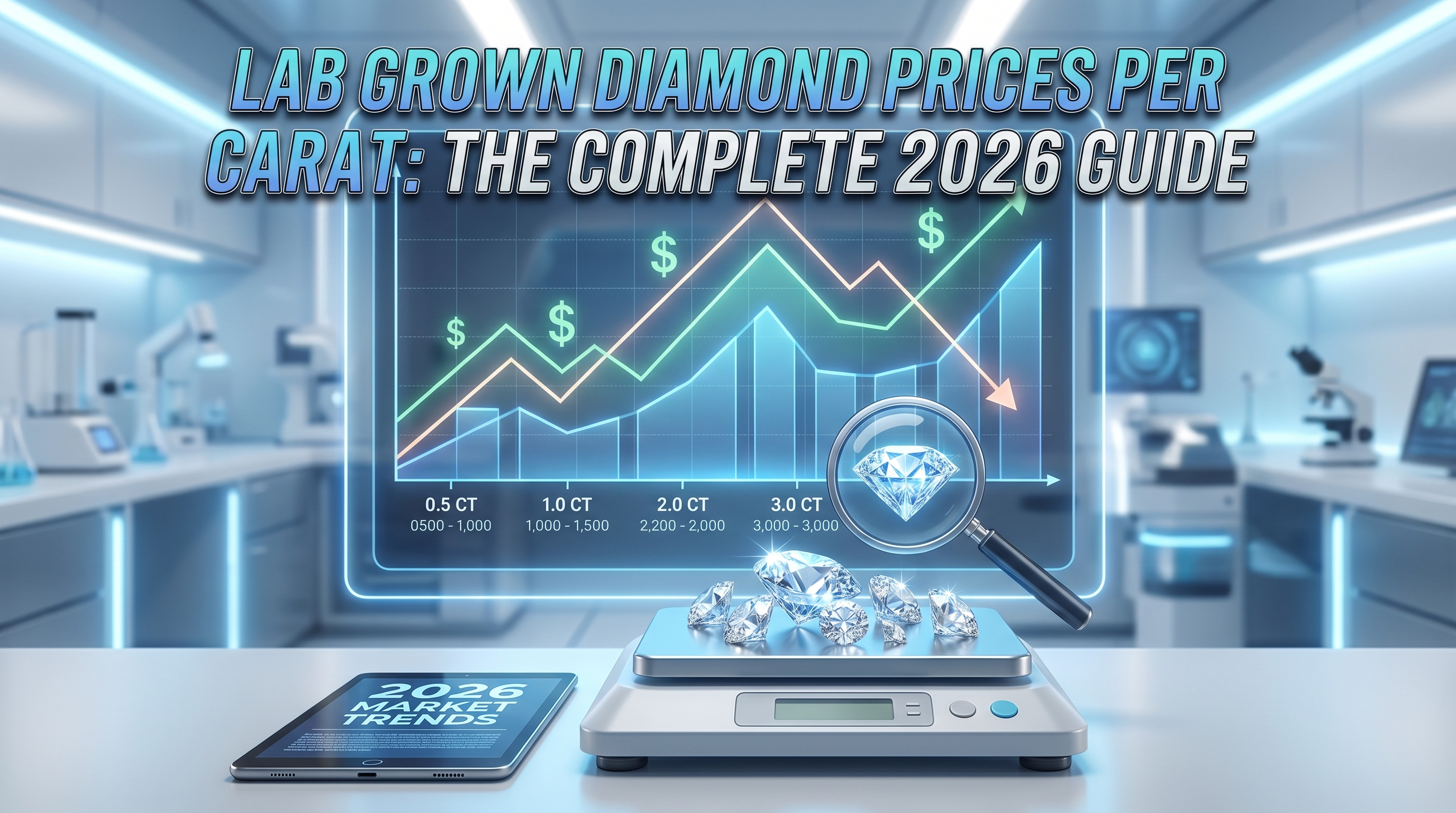
Lab grown diamond wholesale price per carat, 2020 to 2026
1 carat round brilliant, VS clarity, DEF color. Indexed to 100 at January 2020.
Source: Edahn Golan Diamond Research quarterly wholesale tracking, 2020 to 2026. Index based on January 2020 = 100. Recent stabilization reflects production cost floor.
In 2020, a 2 carat IGI certified lab grown diamond stud earring set cost between $1,400 and $1,600 at the major US online retailers. Today, that exact specification ships from direct to consumer brands for under $750. The difference is not a sale. It is what happens when wholesale prices fall 74 percent in six years and most retailers refuse to follow the data down.1
The 74 percent figure comes from industry analyst Edahn Golan, whose quarterly wholesale tracking is one of the most cited data sources in the lab grown diamond market. The 2025 BriteCo Lab Grown vs Natural Diamond Report and the 2026 Knot Worldwide Real Weddings Study have both documented the consumer side of the shift. According to BriteCo, 85.9 percent of lab grown diamonds sold in 2025 carried colorless D, E, or F color grades.2 According to The Knot, 61 percent of US engagement rings now feature lab grown center stones, a 239 percent increase since 2020.3
The category has matured. The pricing structure of the retail layer has not. For buyers in 2026, the gap between those two facts is the entire opportunity. Same diamonds. Same certifications. Half the price. The catch is that the savings sit on one specific side of the retail structure, and most buyers do not know how to find them. The structural backdrop behind this shift is analyzed in the companion piece on the diamond industry margin migration of 2026.
"Manufacturing scale created the savings. Retail structure decides who gets them. The buyer who understands both keeps the difference."
The thesis of the 2026 lab diamond market
Why have lab diamond prices fallen 74 percent?
The price collapse was not a promotion. It was infrastructure catching up to demand. Manufacturing capacity in chemical vapor deposition (CVD) and high pressure high temperature (HPHT) production expanded approximately 280 percent between 2019 and 2023,5 according to industry production data tracked across major lab grown diamond producing regions. Quality improved at the same time as supply increased, which is the inverse of how price declines normally affect product categories. In most markets, prices fall when quality falls. In lab grown diamonds, prices fell while quality rose.

The result is a strange situation for buyers. A $750 lab grown diamond purchased today carries the same VS clarity and DEF color credentials that would have cost $1,500 in 2020. A 2 carat stud that ran $1,650 in 2020 now ships from direct to consumer brands for $729. The diamonds are not different. The wholesale cost is different. The retail markup is what fills the gap, and it varies enormously depending on where you shop.
Consumer awareness has followed the production curve. A 2025 Plumb Club survey found that 84 percent of US consumers are now aware of lab grown diamonds.4 In the engagement ring category specifically, 45.3 percent of all engagement rings sold in the United States in 2024 contained lab grown center stones, up from 12 percent in 2019.6 The shift is not coming. It already happened.
How can you verify a lab grown diamond is fairly priced?
The pricing collapse has created a quality floor that is easier to verify than ever. The barrier between a buyer overpaying and a buyer getting honest 2026 pricing is three minutes of due diligence.

Every lab grown diamond worth buying carries an International Gemological Institute grading report with a unique report number that can be verified on the IGI public database. The report confirms color, clarity, cut grade, and carat weight. It ends the conversation about authenticity. A brand that cannot produce an IGI report for a stone is a brand to walk away from, regardless of price.
Brands that purchase from manufacturers directly and ship direct to consumers operate with substantially lower cost basis than multi tier retailers. The difference can be 40 to 60 percent for identical IGI certified specifications. Check whether a brand operates direct to consumer or through multi tier distribution. The pricing structure tells you whether you are paying for the diamond or for the markup chain.
Lifetime authenticity guarantee, a clear 30 day return window, IGI certification across the catalog (not just on premium pieces), and free fully insured shipping with signature on delivery. These are the minimum signals of a serious operator. Brands that ask buyers to compromise on any of these are not competing seriously in 2026.
What does a lab diamond actually cost in 2026?
A 5 carat IGI certified oval tennis bracelet at a major US online retailer prices at $5,710.7 The same specification at a direct to consumer brand prices at $1,986. The diamonds carry identical IGI grading reports. The difference, almost $4,000, is what the retail structure decides you should pay.
The savings compound at higher carat weights. Legacy retailers carry the same percentage margin structure across their entire catalog, while wholesale cost differentials between carat sizes have compressed. The bigger the stone, the wider the gap.
"In 2026, the lab diamond buyer who saves the most money is the one who reads the IGI grading report before they look at the price tag. Specifications determine value. Retail structure determines what you pay."
Garrett McMartin, Founder, Draco Diamond
The Canadian brand built around the price collapse

In White Rock, British Columbia, founder Garrett McMartin spent four years selling diamonds in person before the wholesale price reports caught up with what the retail market refused to acknowledge. The cost basis of a lab grown diamond had collapsed. The price tags at most retailers had not. In 2025, McMartin launched Draco Diamond, a direct to consumer lab grown diamond brand built around the gap. A member of the Semiahmoo First Nation and the author of The Living Laws: How the Universe Learns Through You, McMartin is also the byline on this article. The disclosure matters because the data does not change based on who reports it.
Draco Diamond ships free worldwide to 25 markets including the United States, Canada, the United Kingdom, Australia, and most of Western Europe. Every piece in the catalog is IGI certified. Returns are accepted within 30 days. The lifetime authenticity guarantee means any piece purchased from the brand can be re verified by IGI at any point in the future. Catalog pricing spans $519 USD (1 carat total weight stud earrings) to roughly $4,300 USD (the Clover bracelet at 24.54 total carat weight across 298 IGI certified stones).9 The full catalog including tennis bracelets, engagement and fashion rings, and stud earrings ships from Canada.
For US buyers, ordering from a Canadian direct to consumer brand can feel unfamiliar, but the logistics are unremarkable. Free fully insured shipping with signature on delivery means the piece arrives the same way it would from any domestic retailer. Diamond jewelry below the duty threshold typically incurs no additional fees on cross border purchase.
What buyers worry about
Every category shift creates legitimate concerns. The lab grown diamond market is no exception. Four questions surface repeatedly, and each deserves a direct answer rather than marketing reassurance.

Resale value. Lab grown diamonds typically retain 10 to 30 percent of their purchase price on resale,8 lower than natural diamonds. For buyers thinking of a piece as an investment, this matters. For buyers thinking of a piece as something to wear, it usually does not. The savings on the front end of the purchase are large enough that even with weaker resale, the total cost of ownership for a lab grown piece typically remains below the equivalent natural diamond.
Authenticity over time. An IGI certified lab grown diamond is graded under the same ISO 17025 accredited methodology as natural diamonds. The certification is permanent and re verifiable. Brands offering a lifetime authenticity guarantee will re submit a piece to IGI at any point in the future, which means provenance never expires. This is one of the structural advantages lab grown actually has over natural: every stone has documented origin.
Shipping from outside the US. Cross border purchase of diamond jewelry within standard duty thresholds incurs no additional fees in most cases. Fully insured shipping with signature on delivery means the piece is tracked and protected end to end. The logistics are functionally identical to domestic shipping. The pricing difference is what makes it worth the unfamiliarity.
Brand reliability. Lifetime guarantees and 30 day returns are only meaningful if the brand will exist in five years to honor them. The market signal is in the operational stack: IGI certification across the catalog (not just on premium pieces), transparent published pricing, a real return policy with no friction language, and named founders with public credentials. These are the trust signals that distinguish operators planning to be in business in 2030 from operators chasing 2026 sales.
How do lab grown diamonds compare to natural diamonds in 2026?
Lab grown and natural diamonds are chemically and optically identical. Both are pure carbon. Both score 10 on the Mohs hardness scale. Both refract light the same way. Independent gemological testing cannot distinguish between them by visual inspection alone, which is why IGI grading laboratories use specialized optical scanners to confirm growth method during the certification process. The result is a category where the technical equivalence is settled and the remaining differences sit in price, resale dynamics, and origin documentation.10
| Property | Lab grown diamond | Natural diamond |
|---|---|---|
| Chemical composition | Pure carbon | Pure carbon |
| Hardness (Mohs scale) | 10 | 10 |
| Optical properties | Identical to natural | Reference standard |
| 2ct IGI VS DEF price (2026) | $1,650 average | $7,500 to $15,000 |
| Resale value retention | 10 to 30% | 30 to 60% |
| Origin documentation | Yes, every certified stone | Variable |
| Dominant certification body | IGI | GIA, IGI accepted |
For buyers in 2026, the question is no longer whether lab grown diamonds are equivalent. The IGI report settles that. The question is whether the buyer values resale liquidity, which favors natural, or front end purchase economics, which favors lab grown. Most buyers under 40 land on the latter, which is why lab grown share of the US engagement ring market has grown so quickly. The 80 to 90 percent purchase price discount versus comparable natural specifications is significant enough that even with weaker resale retention, the total cost of ownership for a lab grown piece typically remains below the equivalent natural diamond.11
Three minutes is all it takes
Edahn Golan's recent data shows the rate of wholesale decline slowing into 2026. The floor is approaching. The retail gap between direct to consumer brands and traditional retailers, however, has not closed. For buyers in 2026 who do the verification work, the savings available on IGI certified pieces are larger than they have ever been.
The smartest move for a lab grown diamond buyer in 2026 is not to chase a sale. It is to spend three minutes. Pull up the IGI public database. Check the report number on the piece you are considering. Check the brand's return policy and authenticity guarantee. Compare the direct to consumer price to what legacy retailers charge for the same specifications. That is the entire process. The savings on a single piece in the 3 to 5 carat range can exceed $3,000 USD.
For the carat by carat data underpinning these comparisons, the current lab grown diamond price per carat analysis covers every specification we have priced. The information is freely available. The savings are real. The window for buyers who pay attention to the underlying data is wider than at any point in lab grown diamond history.
Lab diamond buyer FAQ
The most frequently asked questions about lab grown diamond pricing and verification in 2026, answered with current market data. Tap any question to expand.
How much have lab grown diamond prices fallen since 2020?
Lab grown diamond wholesale prices have fallen approximately 74 percent since 2020, according to industry analyst Edahn Golan. The decline continued through 2024 and into Q1 2026, though the rate has slowed as wholesale prices approach the floor of production cost. Retail prices have stabilized faster than wholesale at many legacy retailers, widening the gap between direct to consumer and traditional pricing.
What is an IGI grading report and why does it matter?
An IGI grading report is a third party certification from the International Gemological Institute that confirms a diamond's color, clarity, cut grade, and carat weight. Each report carries a unique number verifiable on the IGI public database. IGI is the dominant certification standard for lab grown diamonds and grades the majority of lab grown stones globally. A diamond without an IGI report (or equivalent certification from GIA or GCAL) is a diamond that cannot be independently verified.
What is the difference between direct to consumer and traditional lab diamond retailers?
Direct to consumer brands purchase from manufacturers directly and ship direct to buyers, eliminating multi tier distribution markup. Traditional retailers operate through distributors, wholesalers, and retail intermediaries, each of which adds margin. For identical IGI certified specifications, the price difference can be 40 to 60 percent between direct to consumer brands and traditional retailers. Both source from the same global manufacturing base.
Why are lab grown diamonds significantly cheaper than natural diamonds in 2026?
Lab grown diamonds are now priced 80 to 90 percent below comparable natural diamonds of equivalent specifications, according to multi source aggregate data published in 2026. The price differential is driven by manufacturing scale: chemical vapor deposition (CVD) and high pressure high temperature (HPHT) production capacity expanded approximately 280 percent between 2019 and 2023, while quality standardized at VS clarity and DEF color across the category.
What should I look for when buying a lab grown diamond in 2026?
Three things. First, an IGI grading report with a unique report number verifiable on the IGI public database. Second, a brand operating direct to consumer rather than through multi tier distribution, since direct to consumer pricing reflects current wholesale costs. Third, full trust signals: lifetime authenticity guarantee, 30 day returns, IGI certification across the catalog (not just on premium pieces), and free fully insured shipping with signature on delivery.
Can US buyers safely purchase lab grown diamonds from Canadian direct to consumer brands?
Yes. Canadian direct to consumer lab grown diamond brands such as Draco Diamond ship free worldwide to 25 markets including the United States, with full insurance and signature on delivery. Diamond jewelry below the duty threshold typically incurs no additional fees on cross border purchase. The IGI certification standard is identical regardless of where the brand ships from, and the lifetime authenticity guarantee remains valid for international buyers.
Are lab grown diamonds becoming the standard for engagement rings?
Yes. According to The Knot Worldwide 2026 Real Weddings Study, 61 percent of US engagement rings now feature lab grown center stones, a 239 percent increase since 2020. The 2025 Plumb Club survey found that 84 percent of US consumers are now aware of lab grown diamonds, and 45.3 percent of all engagement rings sold in the United States in 2024 contained lab grown center stones.
References
- Edahn Golan Diamond Research. Lab Grown Diamond Wholesale Prices Drop 7% in Q2. 2025. The 74 percent figure represents cumulative wholesale decline from January 2020 through end of 2024, with continued moderate softening into Q1 2026.
- BriteCo. The Lab Grown vs Natural Diamond Report. November 2025.
- The Knot Worldwide. 2026 Real Weddings Study. February 2026. Survey of 10,474 US couples married in 2025.
- The Plumb Club. 2025 Industry Awareness Survey. United States, 2,000 respondents aged 25 to 60.
- Industry production data on CVD and HPHT capacity expansion 2019 to 2023, aggregated from manufacturer reports and SkyQuest Technology lab grown diamond market analyses.
- SkyQuest Technology. United States Lab Grown Diamond Market Report. 2026. Engagement ring category share data for calendar year 2024.
- Pricing observation, James Allen and Blue Nile published catalogs, 5 carat IGI certified oval tennis bracelet specifications, accessed May 2026.
- Liori Diamonds. Lab Grown Diamond Value: The Honest Truth About Resale Worth in 2026. Resale value retention range analysis.
- Draco Diamond published catalog. dracodiamond.com. Accessed May 2026. Pricing in USD, converted from CAD at prevailing exchange rate.
- International Standards Organization. ISO/IEC 17025 General Requirements for the Competence of Testing and Calibration Laboratories. The accreditation standard under which IGI grading laboratories operate.
- Liori Diamonds. Why Are Lab Grown Diamonds Cheaper? The Truth About Pricing in 2026. Analysis of natural versus lab grown pricing differential by carat specification.
Shop the same specifications, at honest prices
IGI certified across the catalog. Free worldwide shipping to 25 markets. Lifetime authenticity guarantee. Thirty day returns.