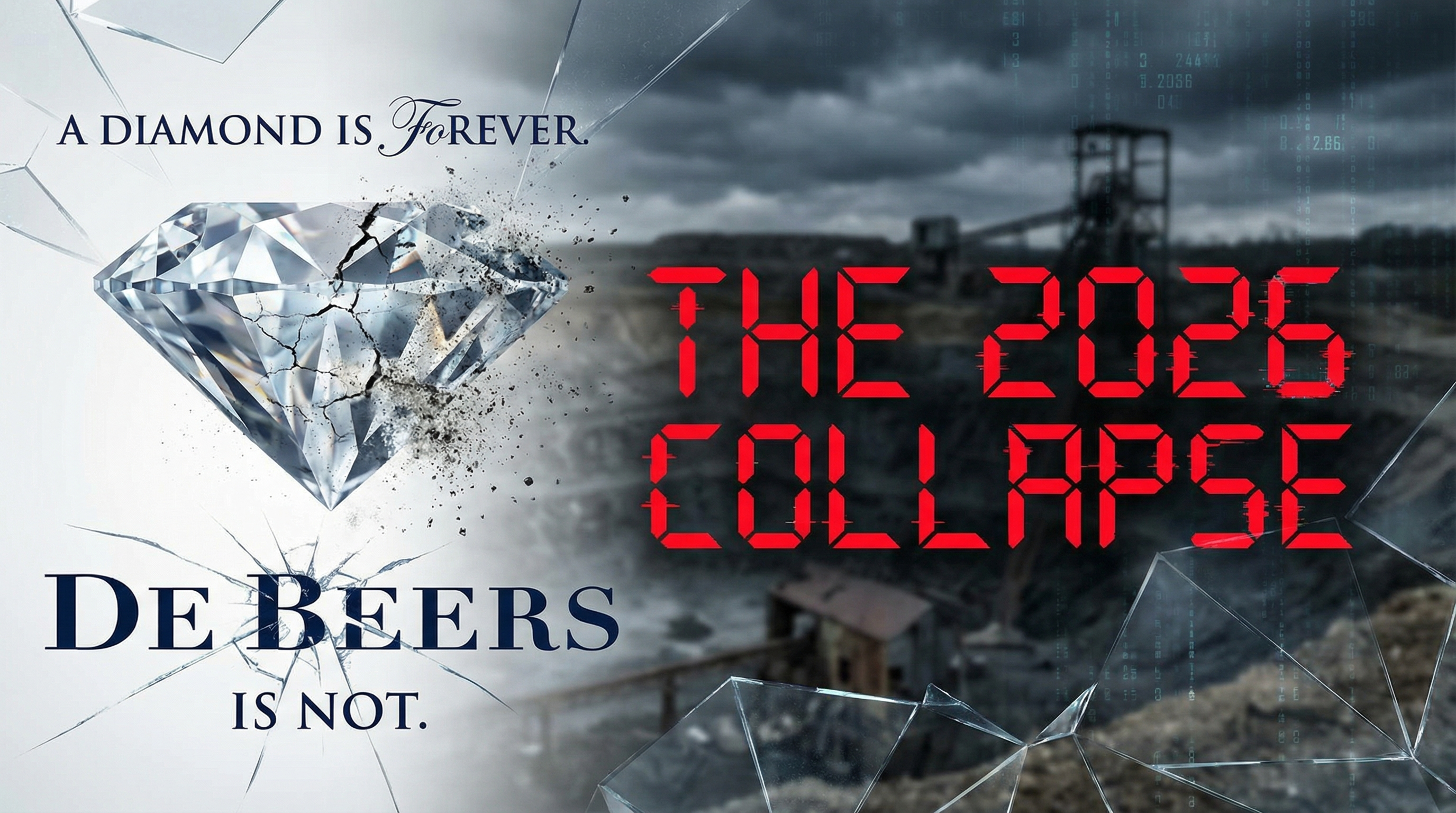
The Lightbox Autopsy: How De Beers' Lab Grown Bet Failed
De Beers built a lab grown brand to prove lab grown was cheap. Seven years later it closed the brand and proved the opposite.
The author is the founder of Draco Diamond. Lightbox facts are drawn from De Beers Group announcements and reporting by Rapaport, National Jeweler, and WWD. Lab grown share data is from The Knot 2025 Real Weddings Study. Draco prices are in CAD.

Lab grown share of US engagement rings
The category Lightbox was built to dismiss, measured by share of US engagement ring purchases.
Source: The Knot 2025 Real Weddings Study (61 percent in 2025, a 239 percent rise since 2020). Intermediate years approximate.
What De Beers was actually trying to do
Lightbox was not a lab grown business; it was a defensive weapon. When De Beers launched it in 2018, lab grown diamonds were gaining ground and threatening the scarcity story that natural diamond prices depended on. The plan was to define the category on De Beers' terms: price every Lightbox stone at a flat $800 per carat regardless of quality, sell it as a fun fashion accessory, and signal that lab grown was cheap, uniform, and unworthy of the emotional weight a natural diamond carried. Control the narrative, and you protect the core business. That was the theory.
"They priced it to say worthless. Buyers heard affordable. The same number, read two opposite ways."
Garrett McMartin, Founder, Draco Diamond
Seven years of strategic drift
The flat price did not hold. As lab grown production scaled industry wide and wholesale prices fell, the $800 per carat that once looked cheap began to look expensive, and Lightbox cut its prices to keep pace. The brand expanded into fashion lines, tested engagement rings, and shifted positioning more than once. Each move was a reaction to a market De Beers no longer set. For seven years Lightbox chased a price floor that kept dropping, while the broader lab grown category it was meant to contain grew into the mainstream.

Why it did not work
The strategy contained its own contradiction. By pricing lab grown transparently and low, De Beers taught consumers exactly how inexpensive these diamonds are to produce, which is the last thing a company defending high natural prices should advertise. Worse, the stones were real diamonds, optically identical and independently certifiable, so buyers who tried lab grown for fashion noticed there was no visible difference and chose it for engagement too. Lab grown passed 45 percent of US engagement rings while Lightbox, capped by its own positioning, never became the category leader. The brand meant to discredit lab grown instead normalised it.

What Lightbox tells buyers in 2026
Lightbox is the clearest proof available that lab grown diamonds are real value, not a gimmick, because the company most motivated to argue otherwise tried for seven years and failed. The takeaway for a buyer is simple: a lab grown diamond is the same stone as a natural one on the same 4Cs, and the price difference is the production cost, not a quality gap. Buy on the certificate and the cut. Every Draco piece is IGI certified, E to F color, VS2 clarity or better, priced to the 4Cs. See the full comparison in lab versus natural, or read the wider story in the De Beers collapse.
Lightbox FAQ
What was Lightbox by De Beers?
Lightbox was De Beers' lab grown diamond jewelry brand, launched in 2018 with flat $800 per carat pricing. It was designed to position lab grown diamonds as cheap fashion pieces and protect the price of natural diamonds, rather than to build a serious lab grown business.
Why did De Beers shut down Lightbox?
As lab grown prices fell industry wide and the category took more than 45 percent of US engagement rings, Lightbox's fixed low price strategy stopped working. De Beers announced the brand's closure in 2025 to refocus on natural diamonds.
Did Lightbox prove lab grown diamonds are worthless?
It proved the opposite. By pricing lab grown transparently and low, De Beers showed buyers how inexpensive the stones are to produce, and consumers chose them for engagement anyway. Lab grown is a real diamond on the same 4Cs, not a gimmick.
What was the $800 per carat Lightbox price?
Lightbox launched with a flat $800 per carat, the same price regardless of color, clarity, or cut, to signal that lab grown diamonds were uniform and disposable. As market prices fell, even that price came to look high, and Lightbox cut it over time.
What does the Lightbox closure mean for lab grown buyers?
It confirms lab grown diamonds have won on value. The same stone costs far less than natural for an identical IGI certificate, and the difference is production cost, not quality. Buy on cut and certificate from a transparent, independently certified seller.
References
A real diamond, at the real cost
Every Draco piece is IGI certified, E to F color, VS2 clarity or better, priced to the 4Cs in CAD. The certificate is included with every order. Free insured worldwide shipping, free resizing, 30 day returns, Lifetime Authenticity Guarantee.