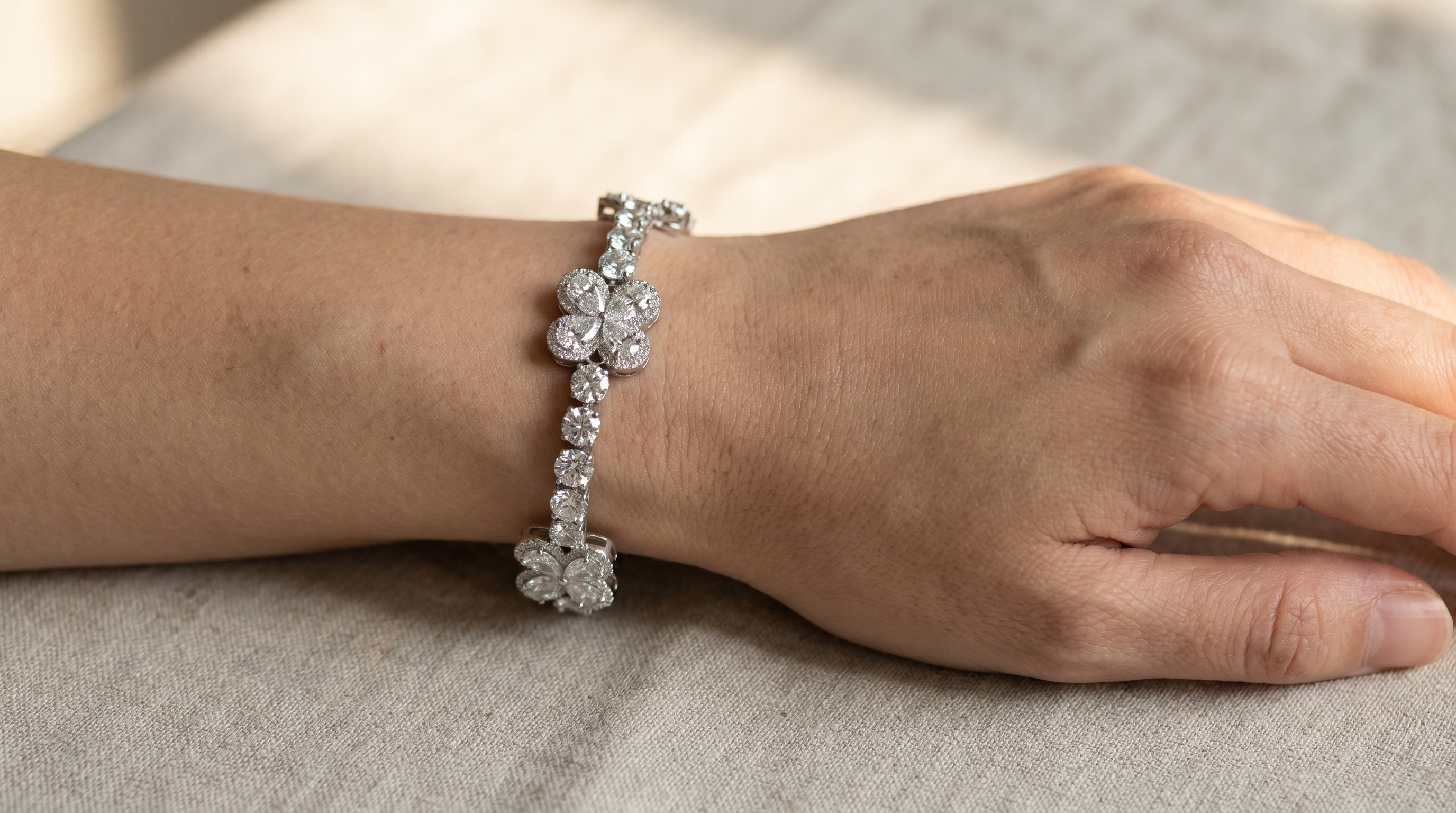
The Best Lab Diamond Tennis Bracelets of 2026
A carat by carat buying guide: what a certified tennis bracelet should cost, which cut to choose, and the IGI certified pieces worth buying this year.
The author is the founder of Draco Diamond. Every piece referenced is IGI certified and verifiable on the IGI public database. All prices in CAD; live price shows on each product page.

5 carat lab grown tennis bracelet: price and quality by retailer
The same specification compared across retailers, a 5 carat lab grown round diamond tennis bracelet in 14K white gold, as of 8 August 2026. Prices are each retailer's normal, non sale price. United States dollar prices are converted to Canadian at 1 USD to 1.39 CAD. Diamond quality is shown as each retailer states it on the listing. Prices and quality tiers change.
| Retailer | Price (CAD, 14K white gold) | Colour | Clarity | Certification |
|---|---|---|---|---|
| Draco Diamond | CAD 3,210 | E to F | VS2 and better | IGI (independent) |
| Angara | CAD 4,739 | F to G | VS | In-house (Angara report) |
| Luvansh | CAD 4,391 | H | VS to SI | In-house inspection |
| Blue Nile | CAD 7,089 | F to G | VS2 to SI1 | IGI (independent) |
| Temple and Grace | CAD 7,607 | H | VS to SI | Valuation certificate |
All bracelets compared are the standard 7 inch length.
5 carat lab tennis bracelet, normal price by retailer (CAD)
Each retailer's normal, non sale price for a 5 carat lab grown round bracelet in 14K white gold, 8 August 2026.
Source: retailer product pages, 8 August 2026. Prices in CAD; USD converted at 1 USD to 1.39 CAD.
On price, Draco is the lowest of the group at CAD 3,210, about 27 percent below the next lowest, Luvansh at CAD 4,391, about 32 percent below Angara, about 55 percent below Blue Nile, and about 58 percent below Temple and Grace.
On quality, Draco also states the highest floor of the group: E to F colour against F to G at Angara and Blue Nile and H at Luvansh and Temple and Grace, and VS2 and better clarity against the VS to SI ranges quoted elsewhere. On the stated specifications, the lower price is not a lower quality tradeoff.
On certification, Draco and Blue Nile provide independent IGI reports. Angara and Luvansh provide in-house inspection from their own gemologists rather than an independent laboratory. Temple and Grace includes a valuation certificate, which states an appraised value rather than an independent grading of colour and clarity. An independent third party report offers more assurance, because it lets a buyer verify colour and clarity through a laboratory with no stake in the sale.
Two further limitations matter. Colour and clarity are shown as each retailer presents them, and grading standards vary between labs. Several of these retailers run promotional discounts often, which can lower the price a shopper actually pays on a given day below the normal figures shown here.
Prices and quality tiers captured 8 August 2026 from Draco, Angara, Luvansh, Blue Nile, and Temple and Grace product pages. Compare the full breakdowns: Draco versus Blue Nile tennis bracelet price comparison, and Draco versus Brilliant Earth tennis bracelet comparison.
How much does a lab diamond tennis bracelet cost in 2026?
A tennis bracelet is priced by total carat weight, cut, and metal. Because lab grown wholesale prices have fallen roughly 74 percent since 2020,1 a fully IGI certified bracelet that once carried a five figure legacy price now starts under $2,000 direct. At Draco, a 3 carat begins at $1,801 and the most popular 5 carat at $2,720, all E to F color, VS2+ clarity, 7 inch, in 10K to 18K gold, platinum, or silver.
| Total carat weight | Style | From |
|---|---|---|
| 3 carat | Round brilliant, classic | $1,801 |
| 5 carat | Round, emerald, oval, marquise, pear | $2,720 |
| 6 carat | Sapphire and diamond | $2,999 |
| 7.8 carat | Princess cut | $3,560 |
| 13 carat | Pear clover | $4,201 |
| 24.54 carat | The Clover, flower cluster | $5,899 |
For the full carat by carat breakdown across every shape, the lab grown diamond price per carat analysis covers each specification in detail.
"A tennis bracelet should be judged by its certificate and its clasp, not its price tag."
Garrett McMartin, Founder, Draco Diamond
What carat tennis bracelet should you buy?
Three tiers cover almost every buyer. The right one depends on whether you want everyday elegance, a statement, or an heirloom.

The 3 carat sits comfortably under a cuff or watch and reads as elegant rather than loud. The 5 carat is the piece most buyers choose: enough presence to catch light across a room while still tailored. Seven carats and up move into defining, heirloom territory.
Wrist size to carat fit guide
A starting point for length and total carat weight by wrist size. Draco bracelets are 7 inch standard with length options at checkout, so the fit is set to your wrist from the start.
| Wrist size | Length | Balanced carat | A bracelet that fits |
|---|---|---|---|
| Petite, under 15 cm | 6.5 inch | 3 to 5 carat | 3.00ctw round brilliant |
| Average, 15 to 16.5 cm | 7 inch | 5 to 7 carat | 5 carat round brilliant |
| Larger, 16.5 to 19 cm | 7 to 7.5 inch | 7 carat and up | 7ctw princess, bezel set |
Larger wrists carry a higher carat weight well. Petite wrists suit a lower carat for proportion. A secure clasp with a figure eight safety catch matters more than length for everyday wear.
Which diamond cut is best for a tennis bracelet?
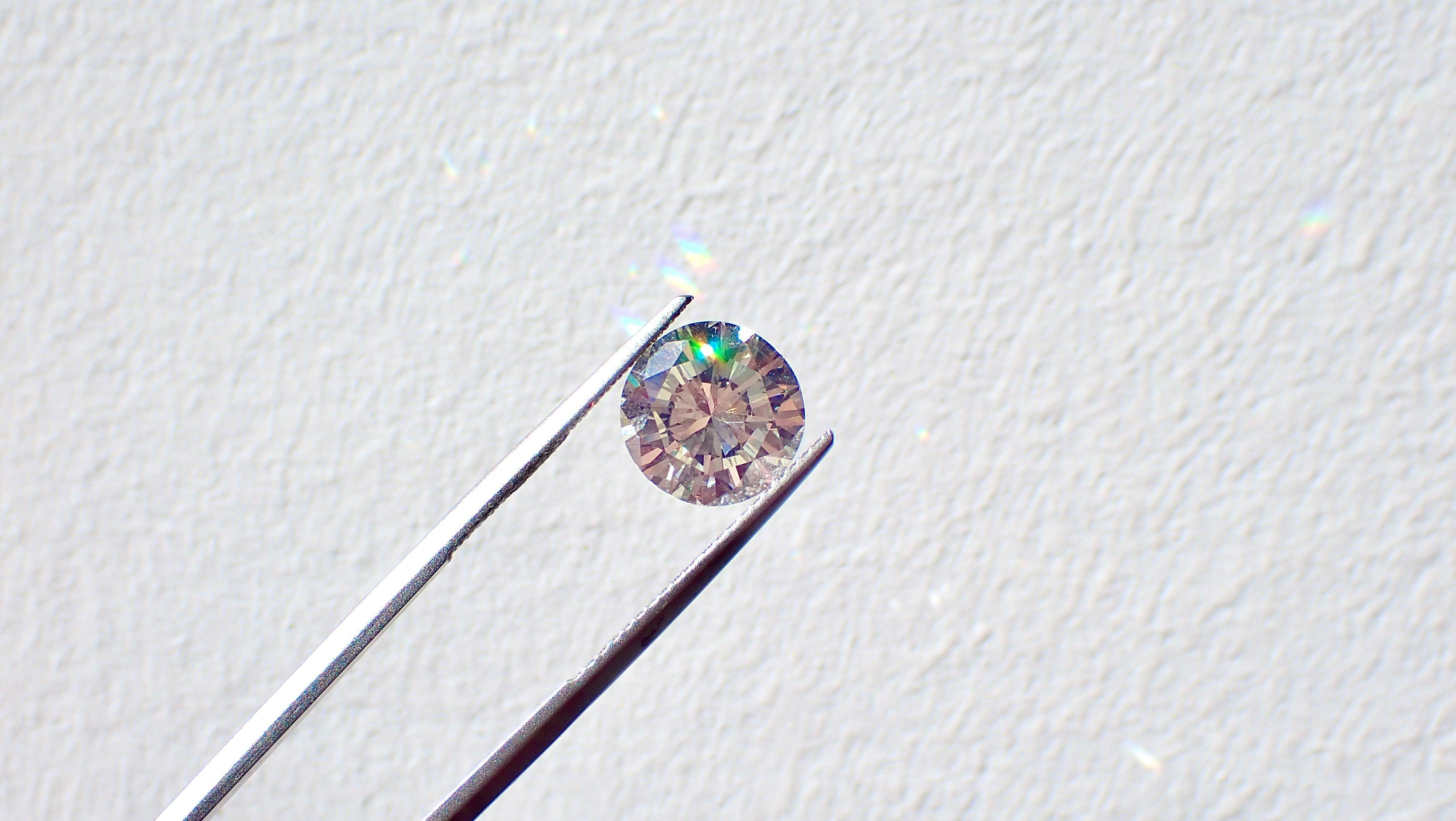
Round brilliant returns the most light and is the timeless default. Emerald and baguette give a cleaner, architectural line. Marquise and pear elongate the wrist. Heart and oval add character. Every cut at Draco carries the same E to F color, VS2+ clarity IGI certification, so the choice is purely aesthetic.

Our top lab diamond tennis bracelet picks for 2026
| Piece | Best for | Price |
|---|---|---|
| 3.00ctw VS2+, 14K White Gold | Best value, everyday | $1,801 |
| 5ct Emerald Cut | Most popular statement | $2,720 |
| 5ct Round Brilliant | Timeless classic | $2,720 |
| 7.8ct Princess Cut | Bold, architectural | $3,560 |
| 14ct Ruby and Diamond | Colored gemstone | $3,499 |
| The Clover, 24.54ct | Heirloom centerpiece | $5,899 |

What to look for before buying
Verify the report number on the IGI public database. Every Draco bracelet is E to F color, VS2+ clarity. A bracelet without certification cannot be independently verified, regardless of price.
Four prong or bezel settings hold stones over a lifetime of wear. Look for a figure eight safety catch on the clasp. Draco builds each bracelet to order with a secure closure.
The same certified specifications are routinely marked up 100 to 300 percent at legacy retail. Direct to consumer pricing reflects the stone, up to 64 percent below traditional retail for identical IGI grades.
- IGI certified report you can verify at IGI.org.
- E to F colour, VS2 clarity or better on every stone.
- A secure clasp with a figure eight safety catch.
- Matched, evenly cut stones along the full line.
- Total carat weight set against your budget.
- A clear return window, Draco gives 30 days.
Before you commit, see how direct pricing holds up. Compare Draco against Blue Nile on tennis bracelet price, Draco against Brilliant Earth, and Draco against Grown Brilliance. For clasp durability read the tennis bracelet safety guide, and for regional pricing see lab diamond tennis bracelet prices in Canada.
Tennis bracelet buyer FAQ
Are lab diamond tennis bracelets worth buying?
Yes. You get the same IGI certified, optically identical diamonds as a mined tennis bracelet at up to 64 percent less, because the price reflects the stone rather than retail markup.
How much should a lab diamond tennis bracelet cost?
A 3 carat IGI certified bracelet starts around $1,801 and a 5 carat around $2,720 direct. Heirloom 7 to 24 carat pieces run $3,560 to $5,899.
What size is a tennis bracelet?
Draco tennis bracelets are 7 inch standard, the common women's length. Email info@dracodiamond.com with sizing questions before a made to order piece is built.
What metals are available?
10K, 14K, and 18K gold in white, yellow, and rose, plus platinum and silver.
Are the diamonds real and certified?
Yes. Lab grown diamonds are chemically and optically identical to mined diamonds, and every Draco stone is IGI certified, E to F color, VS2+ clarity, verifiable at IGI.org.
What carat tennis bracelet suits my wrist size?
Petite wrists suit 3 to 5 carats on a 6.5 to 7 inch length for proportion. Average wrists carry 5 to 7 carats well at 7 inch. Larger wrists wear 7 carats and up. Draco bracelets are 7 inch standard with length options at checkout.
Can a Draco tennis bracelet be resized?
Yes. Draco bracelets are 7 inch standard and length is chosen at checkout, so the fit is set to your wrist from the start.
Is Draco actually cheaper than Blue Nile, Angara, or Temple and Grace for a 5 carat tennis bracelet?
On normal, non sale prices for a 5 carat lab grown bracelet in 14K white gold on 8 August 2026, yes. Draco is CAD 3,210, against CAD 4,739 at Angara, CAD 4,391 at Luvansh, CAD 7,089 at Blue Nile, and CAD 7,607 at Temple and Grace. Draco is about 27 percent below the next lowest and about 55 percent below Blue Nile.
References
- Edahn Golan Diamond Research. Lab grown diamond wholesale price tracking, 2020 to 2026.
- Draco Diamond published catalog, dracodiamond.com/collections/bracelets. Accessed June 2026. Prices in CAD.
IGI certified tennis bracelets, at honest prices
Every bracelet is IGI certified, E to F color, VS2+ clarity, 7 inch, in 10K to 18K gold, platinum, or silver. Made to order in Canada with free insured worldwide shipping and 30 day returns.