The Lab Grown Diamond Glossary: Every Term Explained
An A to Z reference for the words a lab diamond buyer meets, from carat and cut to CVD, HPHT, girdle, and bow tie, each defined in plain language.
The author is the founder of Draco Diamond. Definitions follow standard gemological usage and independent laboratory grading. Every IGI report referenced is verifiable free at IGI.org.

Every lab grown diamond arrives wrapped in vocabulary. Certificates, cutting terms, growth methods, and setting names all shape what you pay and what you receive. This glossary defines each term a buyer meets, in plain language, grouped from A to Z. Each entry is short enough to read in seconds and precise enough to use at the counter. For the grades that set most of the price, start with the four Cs of colour and clarity, then work outward.
A
Aggregate rating
The single averaged score drawn from many individual verified reviews, shown out of five. It reflects consistency across many buyers rather than one opinion. In structured data it is the AggregateRating that lets a search result display stars. Draco holds 4.8 out of 5 across 866 verified reviews.
B
Bezel
A setting in which a thin band of metal wraps around the edge of the stone, holding it from the sides. It guards the girdle and any points, so it suits active, everyday wear. A full bezel encircles the whole stone, while a half bezel leaves two sides open for more light.
Bow tie
A dark shape, like a bow tie, that can appear across the centre of an elongated cut such as an oval, marquise, or pear. It is caused by light leaking through the middle instead of reflecting back. Every elongated stone shows some. A well cut one shows only a faint bow tie that fills with light as the hand moves.
Brilliance
The white light a diamond reflects back to the eye from its surface and its interior. It is the brightness you notice first, before any flashes of colour. Cut quality drives brilliance more than carat, colour, or clarity.
C
Carat
The unit of weight for a diamond, equal to 0.2 grams, recorded to two decimal places on the report. It measures weight, not the size seen from above. Prices jump at the round marks, so a 1.90 carat stone can cost noticeably less than a 2.00 carat that looks almost identical. See the price per carat analysis for the economics.
Certificate (grading report)
The independent document that describes one specific diamond by carat, colour, clarity, cut, and measurements. The precise term is grading report, not certificate. Reputable lab grown diamonds carry a report from IGI, GIA, or GCAL, verifiable free on the laboratory's public database.
Clarity
The grade for a diamond's inclusions and surface blemishes, running from Flawless and IF through VVS, VS, and SI, down to I. VS2 and better is usually eye clean, meaning nothing is visible without magnification. Paying above the eye clean threshold buys a distinction you cannot see.
The clarity scale, and where eye clean sits
Clarity runs from Flawless to Included. For most lab grown diamonds, VS2 and better is eye clean, so grades above it add cost without a visible change.
Illustrative, based on standard clarity grading. Individual stones vary; confirm the grade on the report.
Colour
The grade for how colourless a diamond is, on a D to Z scale where D is completely colourless. Lab grown stones typically sit in the colourless to near colourless range, and Draco grades every stone E to F. Fancy colour diamonds are graded on a separate scale.
Crown
The upper section of a cut diamond, above the girdle. Its angle and height help split light into colour and return brightness to the eye. A crown that is too shallow or too steep lowers the overall cut grade.
Culet
The point or tiny facet at the very bottom of a diamond, where the pavilion facets meet. On modern cuts it is ideally graded None, a clean point. A large culet can appear as a small dark window when you look straight down through the table.

Cut
The grade for how well a diamond's facets are proportioned and finished, from Excellent to Poor, assigned to round brilliants. It governs how much light the stone returns, driving brilliance, fire, and scintillation, which is why cut is the grade never to compromise. Fancy shapes are judged by measurements and by eye rather than one cut grade. The four Cs together set most of the price.
CVD
Chemical Vapour Deposition, one of the two ways diamonds are grown. A carbon rich gas is energised inside a chamber so carbon settles, layer by layer, onto a thin seed. A CVD stone is a real diamond with the same properties as a mined one, graded on the same scale.
"Learn the vocabulary and the report stops being a mystery. Every word on it maps to something you can see, verify, or price."
Garrett McMartin, Founder, Draco Diamond
D
Depth
The height of a diamond from the table at the top to the culet at the bottom, given in millimetres and as a depth percentage of its width. Depth percentage affects how light travels inside the stone. Too deep and light escapes the bottom, too shallow and it leaks from the sides.
Dispersion
The splitting of white light into the colours of the spectrum as it passes through the diamond, seen as small flashes of colour. In everyday language, dispersion is fire. It depends heavily on cut quality.
E
Eternity band
A ring set with diamonds around its full circumference, so the stones meet with no gap of plain metal. A half eternity sets stones across the front face only and is easier to resize. It is the classic anniversary and stacking band.
Eye clean
A diamond with no inclusions visible to the unaided eye at a normal viewing distance. It usually corresponds to VS2 or better, though some SI1 stones qualify. It is the practical clarity target, because flaws you cannot see do not change how the stone looks. Read more on what eye clean means.
F
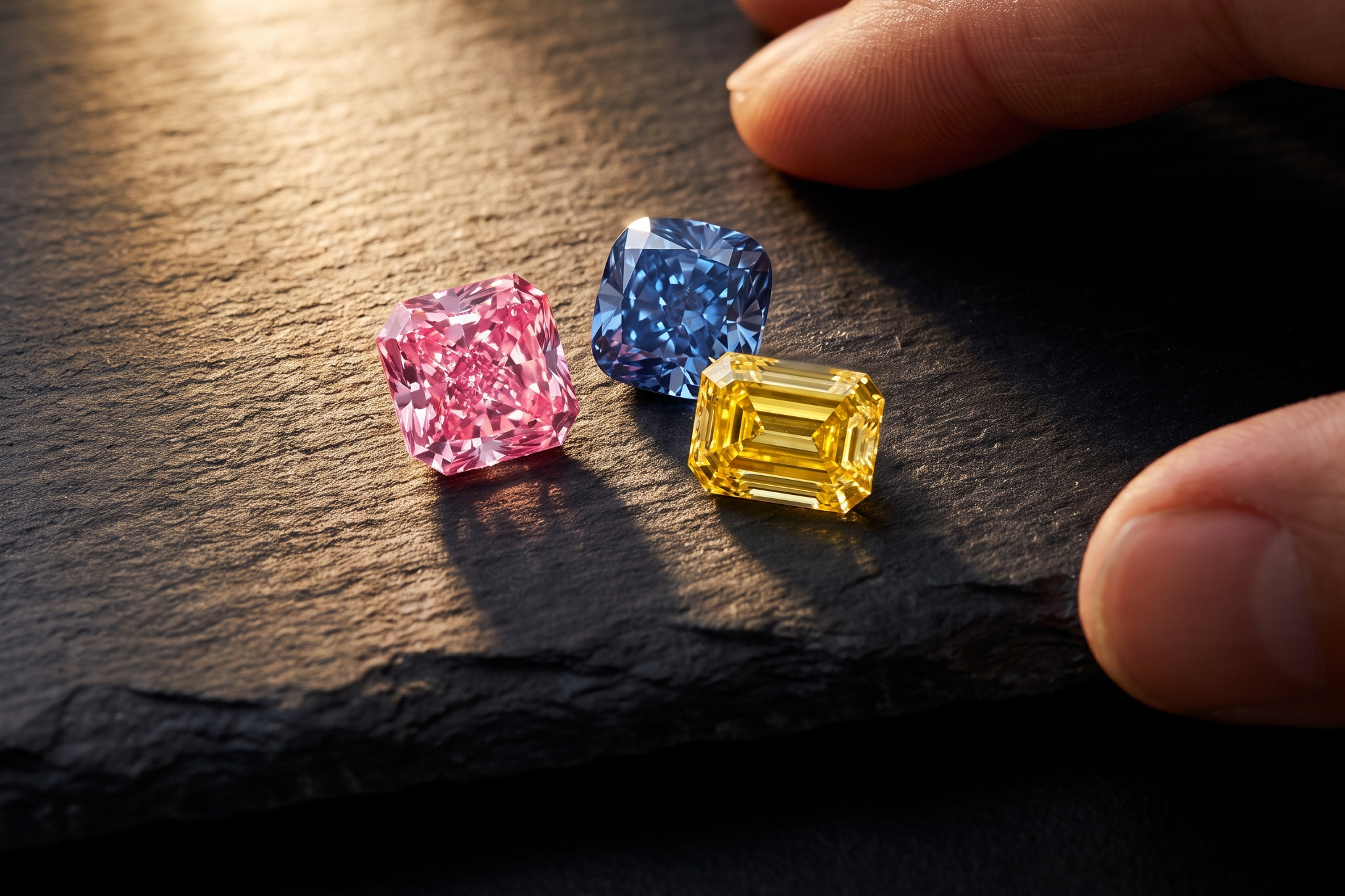
Fancy colour
A diamond with a definite body colour, such as yellow, pink, or blue, graded on its own scale by hue, tone, and saturation rather than the D to Z scale. Lab grown fancy colours are created by controlled conditions during growth. They are graded and certified like colourless stones.
Fire
The flashes of spectral colour a diamond throws, the everyday word for dispersion. Fire shows most under small, bright light sources. A well cut stone balances fire against white brilliance.
Fluorescence
A soft glow, usually blue, that some diamonds give off under ultraviolet light. It is noted on the report on a scale from None to Very Strong. Faint to medium fluorescence is generally invisible in everyday light and does not harm a colourless stone.
G
GCAL
The Gem Certification and Assurance Lab, an independent United States laboratory known for guaranteed grading and light performance analysis. It is one of the three widely recognised labs, alongside IGI and GIA. A GCAL report is verifiable on the GCAL database.
GIA
The Gemological Institute of America, the research body that created the 4Cs. On October 1 2025, GIA stopped applying the 4Cs letter grades to lab grown diamonds and moved to two descriptive tiers, premium and standard, after finding that more than 95 percent of lab grown stones fall within one narrow colour and clarity band.
Girdle
The narrow band around the widest part of a diamond, where the crown meets the pavilion. It is where prongs usually grip the stone. Its thickness is graded from Extremely Thin to Extremely Thick, with the middle of that range preferred.

H
Halo
A ring of small accent diamonds, or melee, set around a centre stone to add sparkle and apparent size. A hidden halo sits underneath the centre stone and is seen only from the side. A halo can make a centre stone look noticeably larger.
Hearts and arrows
A pattern of eight symmetrical hearts and eight arrows seen in a very precisely cut round brilliant through a special viewer. It signals top tier optical symmetry. It is a mark of cutting precision, not a separate grade on the report.
HPHT
High Pressure High Temperature, the second method of growing diamonds, which recreates the intense heat and pressure under which diamonds form in nature. The same process is also used to refine the colour of some stones. An HPHT diamond is a real diamond, identical in properties to a mined one.
| Feature | CVD | HPHT |
|---|---|---|
| Full name | Chemical Vapour Deposition | High Pressure High Temperature |
| How it grows | Carbon gas onto a seed | Heat and pressure on carbon |
| Is it a real diamond | Yes | Yes |
| Graded on the 4Cs | Yes | Yes |
I
IGI
The International Gemological Institute, the laboratory that grades the majority of the world's lab grown diamonds. An IGI report lists the full grades and measurements and is verifiable free at IGI.org. It is the most common report on lab grown stones and is accepted across the market. See how to read an IGI report.
Inclusion
A natural internal feature formed as the diamond grew, such as a crystal, feather, or cloud. Inclusions set the clarity grade and act like a fingerprint unique to that stone. In VS and higher grades most inclusions are invisible without magnification.
L
Lab grown (synthetic)
A diamond grown in a controlled setting by CVD or HPHT, with the same carbon crystal structure and the same physical and optical properties as a mined diamond. Older gemology calls it synthetic, which here means laboratory grown, not an imitation. On a report the stone is noted as laboratory grown. Read whether a lab grown diamond counts as a real diamond.
Length to width ratio
The length divided by the width of a fancy shape, taken from the millimetre measurements on the report. It describes how elongated the outline looks. An oval near 1.35 to 1.50 gives the classic balanced silhouette. Compare shapes on the diamond shapes chart.
M
Melee
Small accent diamonds, usually under 0.20 carat, used in halos, pave, and along bands. They add sparkle around a centre stone or across a setting. Their quality still matters, since dull melee lowers the look of the whole piece.
Mohs hardness
The scale of scratch resistance, from 1 to 10. Diamond, whether mined or lab grown, sits at 10, the hardest known natural material. That hardness is why a diamond resists scratching in daily wear and does not cloud or dull over time.

P
Pave
A setting of many small melee diamonds placed close together and held by tiny beads of metal, so the surface looks paved with diamonds. It adds brilliance to a band or a halo. The name comes from the French word for paved.
Pavilion
The lower section of a cut diamond, below the girdle, narrowing to the culet. Its angle is critical, acting like a cone of mirrors that sends light back up through the table. A poorly angled pavilion leaks light and dulls the stone.
Prong
A slender metal claw that holds a diamond, usually in groups of four or six. Prongs lift the stone into the light, so they maximise brilliance. They are the most common and most light friendly way to hold a centre stone.
S
Scintillation
The sparkle and the play of light and dark a diamond shows as it, the light, or the viewer moves. It is the flashing you see in motion, distinct from steady brilliance. Strong scintillation comes from precise faceting and clean symmetry.
Solitaire
A setting with a single diamond and no accent stones. It is the most classic engagement style and puts all attention on the centre stone. Because nothing distracts the eye, a solitaire rests entirely on the quality of that one diamond.
Synthetic
An older gemological term for a lab grown diamond. It means laboratory grown, with the same properties as a mined diamond, and does not mean fake or an imitation such as cubic zirconia or moissanite. See lab grown above.
T
Table
The large flat facet on the very top of a diamond, the biggest facet on the stone. Its size is given as a table percentage of the diamond's width. A balanced table helps the stone gather and return light well.
That covers the vocabulary a buyer meets most. When two stones share the same grades on their reports, the diamonds are effectively the same product, and price is the only variable left. If you have a quote in hand, bring it to us below.
Glossary FAQ
What are the 4Cs of a diamond?
The 4Cs are carat, colour, clarity, and cut. Carat is weight, colour is how colourless the stone is on a D to Z scale, clarity grades its inclusions, and cut grades how well a round brilliant is proportioned. Together they account for most of a diamond's price. On October 1 2025, GIA replaced the 4Cs letter grades for lab grown stones with premium and standard tiers, while IGI continues to report the full grades.
What is the difference between CVD and HPHT lab grown diamonds?
CVD, Chemical Vapour Deposition, grows a diamond by settling carbon from a gas onto a seed, layer by layer. HPHT, High Pressure High Temperature, recreates the heat and pressure that form diamonds in nature. Both produce a real diamond with the same physical and optical properties as a mined stone, and both are graded on the same scale.
Is a lab grown diamond the same as a synthetic diamond?
Yes. Synthetic is the older gemological term for lab grown. It means the diamond was grown in a laboratory, with the same carbon crystal structure and properties as a mined diamond. It does not mean fake or an imitation such as cubic zirconia or moissanite, which are different materials.
What does eye clean mean for a lab diamond?
Eye clean means no inclusions are visible to the unaided eye at a normal viewing distance. It usually corresponds to a clarity grade of VS2 or better, though some SI1 stones qualify. Because flaws you cannot see do not change how the stone looks, eye clean is the practical clarity target for most buyers.
What is a diamond grading report?
A grading report, often called a certificate, is an independent document that describes one specific diamond by carat, colour, clarity, cut, and measurements. Reputable lab grown diamonds carry a report from IGI, GIA, or GCAL. An IGI report number is verifiable free at IGI.org, which is how you confirm the stone matches the listing.
How hard is a diamond on the Mohs scale?
Diamond scores 10 on the Mohs scale of hardness, the highest point and the hardest known natural material. This is true of both mined and lab grown diamonds, which are the same material. That hardness is why a diamond resists scratching in daily wear and does not cloud, fade, or dull over time.
References
- International Gemological Institute. Grading standards, terminology, and Verify Your Report. IGI.org. Accessed August 2026.
- Gemological Institute of America. Update to lab grown diamond reporting, premium and standard tiers, effective October 1 2025. gia.edu.
- Gem Certification and Assurance Lab. Report verification and grading. gcalusa.com.
- Draco Diamond published catalog and grading standard. dracodiamond.com. Accessed August 1, 2026.
Now you can read the report
Every Draco diamond is IGI certified, E to F colour, VS2 and better, and ships with its certificate, verifiable free at IGI.org. Priced direct, up to 64 percent below Blue Nile for equivalent specification. Trust stack: 30 day returns, Lifetime Authenticity Guarantee, free ring resizing, free insured worldwide shipping to 25 markets, signature on delivery, IGI certified E to F colour VS2 and better. Rated 4.8 out of 5 across 866 verified reviews.