Lab Diamond Price Decline 2020 to 2026: The Full Data Report
A 1 carat lab diamond cost $3,410 per carat in 2020. By 2026 the rate is a fraction of that. Here is the year by year decline, and why it happened.
The author is the founder of Draco Diamond. Wholesale data is cited from Edahn Golan Diamond Research. Per carat figures are in USD for market comparison; Draco product prices are in CAD, converted at 1 CAD to 0.73 USD per the Bank of Canada, Q1 2026. The 2020 to 2024 series reflects average US retail for a 1 carat stone; 2025 to 2026 reflects the Draco direct to consumer 5 carat tennis bracelet per carat rate. Every Draco piece is IGI certified and verifiable at IGI.org.

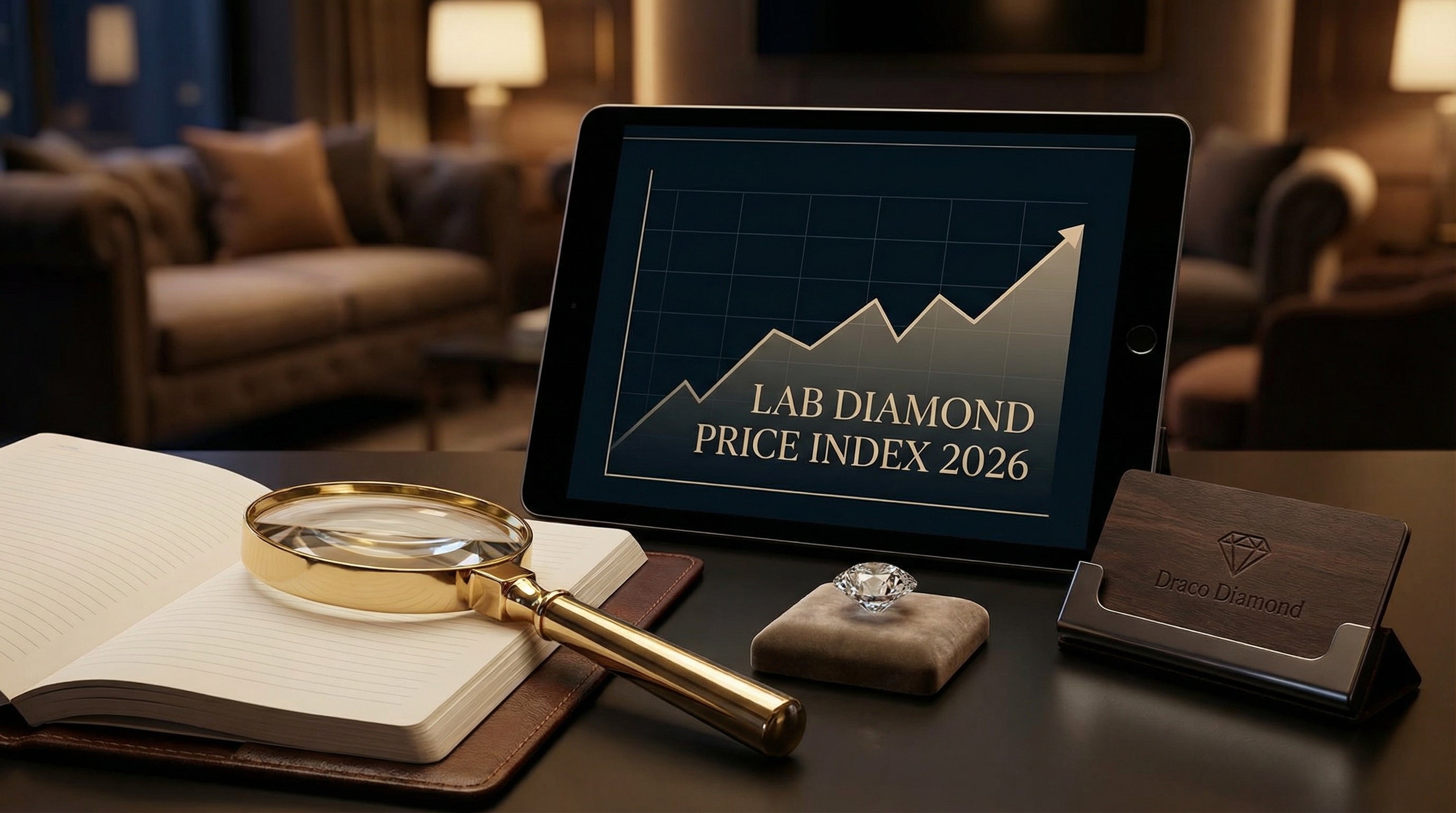
Lab diamond price per carat, 2020 to 2026
US retail for a 1 carat stone, 2020 to 2024; Draco direct to consumer 5 carat tennis bracelet rate, 2025 to 2026. USD per carat.
Source: Edahn Golan Diamond Research wholesale tracking, US retail catalogs, and Draco Diamond catalog, 2020 to 2026.
The year by year decline
In January 2020 a 1 carat IGI certified lab diamond retailed for roughly $3,410, against $5,000 to $6,000 for the natural equivalent. Six years later the per carat rate has collapsed. Below is the trajectory, with the annual rate of decline. The 2020 to 2024 figures reflect average US retail for a 1 carat stone; 2025 and 2026 reflect the Draco direct to consumer rate on a 5 carat tennis bracelet, where larger stones lower the per carat cost further.
| Year | Per carat | Annual change |
|---|---|---|
| Jan 2020 | ~$3,410 | Starting price |
| End 2021 | ~$2,800 | down 18% |
| End 2022 | ~$1,800 | down 36% |
| End 2023 | ~$1,200 | down 33% |
| End 2024 | ~$892 | down 26% |
| End 2025 | ~$415 DTC | 5ct tennis rate |
| Q1 2026 | ~$409 DTC | decline flattening |
For the current per carat rate at every size, from 0.5 carat to 10 carat, see the lab diamond price per carat report.
"The stone graded the same in 2020 as it does in 2026. The only thing that fell 88 percent was the price."
Garrett McMartin, Founder, Draco Diamond
Why prices fell
The decline was not a sale. Three structural forces drove it, and understanding them explains why the floor is now near production cost.

Lab vs natural in 2026
The decline opened the widest gap on record against natural diamonds, which are chemically and optically identical and graded on the same 4Cs. Direct to consumer, lab grown now runs roughly 90 percent below the natural equivalent. Legacy lab retail sits in between, about 80 percent below natural.
| Tier | Natural | Lab (legacy retail) | Lab (Draco DTC) |
|---|---|---|---|
| 1 ct | $4,500 to $6,500 | $800 to $1,200 | $446 to $678 |
| Mid | $12,000 to $18,000 | $2,000 to $3,500 | ~$1,234 |
| Large | $25,000+ | $4,000 to $6,000 | $1,323 to $1,628 |
For the full comparison and why the two stones are identical, read lab grown vs natural diamond price.
What it means for buyers in 2026
The decline has largely played out. With wholesale near production cost, prices are stabilizing rather than continuing the steep fall of 2020 to 2024. For a buyer, that means 2026 is a floor, not a falling knife: the value is real and durable, and waiting for a further collapse no longer makes sense. The current Draco direct to consumer rate is about $409 per carat on a 5 carat tennis bracelet, every stone IGI certified, E to F color, VS2 clarity or better.

Browse at the current rate in tennis bracelets and women's rings.
Where grades still matter
With prices low across the board, the question shifts from how much to where the money shows. Color: D commands a premium most buyers cannot see; E to F looks identical to the eye and costs less. Clarity: the gap between VVS and VS is small and invisible, while the gap between VS and SI is large and can show, so VS2 is the value sweet spot. Cut: the one grade you do not compromise on, because cut drives the light return that makes a diamond look alive.

To read those grades on a certificate yourself, see the IGI certificate guide.
Price decline FAQ
Why did lab diamond prices fall so much from 2020 to 2026?
Three structural causes: manufacturing capacity grew more than 300 percent between 2020 and 2023, production technology improved continuously, and supply outpaced demand. Wholesale fell roughly 88 percent on a per carat basis and now sits near production cost.
How much did a 1 carat lab diamond cost in 2020 versus 2026?
A 1 carat lab diamond averaged about $3,410 per carat at US retail in January 2020. By Q1 2026 the per carat rate is roughly $409 direct to consumer on a 5 carat tennis bracelet, and a finished 1 carat IGI stone runs $446 to $678 direct.
What percentage cheaper are lab diamonds than natural in 2026?
Direct to consumer, a lab diamond runs roughly 90 percent below the natural equivalent on identical IGI specifications. A 1 carat natural stone averages $4,500 to $6,500 at US retail; the equivalent lab stone is $446 to $678 direct.
Will lab diamond prices keep falling in 2026?
The steep decline has largely played out. With wholesale near production cost, prices are stabilizing rather than continuing the fall of 2020 to 2024. 2026 is a floor, not a falling knife.
Why do legacy retailers still charge more for the same lab diamond?
Legacy retailers held their markups as costs fell, pricing a finished 1 carat IGI stone at $800 to $1,200 while their own cost dropped. Direct to consumer brands passed the lower cost basis on, pricing the same specification at $440 to $680.
References
- Edahn Golan Diamond Research, wholesale lab diamond price tracking 2020 to 2026.
- Draco Diamond published catalog, dracodiamond.com. Accessed June 2026. Draco prices CAD; per carat comparison USD.
- Bank of Canada, CAD to USD reference rate, Q1 2026 (1 CAD to 0.73 USD).
The price fell. The diamond did not
Every Draco piece is IGI certified, E to F color, VS2 clarity or better, in 10K to 18K gold, platinum, or silver. The certificate is included with every order. Free insured worldwide shipping, free resizing, 30 day returns, Lifetime Authenticity Guarantee.